
By Sem Elegant Voyage | Updated: November 2026
Abu Simbel opens every day at 6 a.m., with last entry at 4 p.m. A foreign adult pays 750 EGP at the gate, or 1,200 EGP on 22 February and 22 October, when the sun reaches the sanctuary. It lies about 300 km by road from Aswan, or about 45 minutes by air.

Abu Simbel at a Glance
| At a glance | Abu Simbel |
|---|---|
| Opening hours | Every day. Opens at 6 a.m., last entry 4 p.m. (the Ministry of Tourism and Antiquities lists closing at 5 p.m.) |
| Foreign adult ticket | 750 EGP at the Ministry gate price; 822 EGP when booked online on egymonuments.com |
| Foreign student ticket | 375 EGP at the gate; 445.50 EGP online; student ID needed |
| 22 February and 22 October | Adult 1,200 EGP and student 600 EGP at the gate; 1,272 EGP and 670.50 EGP online |
| Ticket office | Cards only at the major sites since 2023, so bring a card that works abroad |
| From Aswan | About 300 km by road (about 3.5 hours each way, leaving before dawn) or about 45 minutes by air |
| Time on site | 1.5 to 2 hours for the two temples, up to 3 hours if you linger |
| Sun alignment | 22 February and 22 October, about 20 minutes. Next dates: Monday 22 February 2027 and Friday 22 October 2027 |
Abu Simbel is undoubtedly the most spectacular archaeological site in Egypt after the pyramids of Giza. Carved into the mountain 3,300 years ago by Ramesses II, these two colossal temples were intended to impress the peoples of the south and assert the power of the pharaoh. And honestly? They still succeed perfectly. When you arrive in front of the four 20 metre colossi that guard the entrance to the Great Temple, you are left breathless. This is one of those rare moments where photos don't do justice to reality.
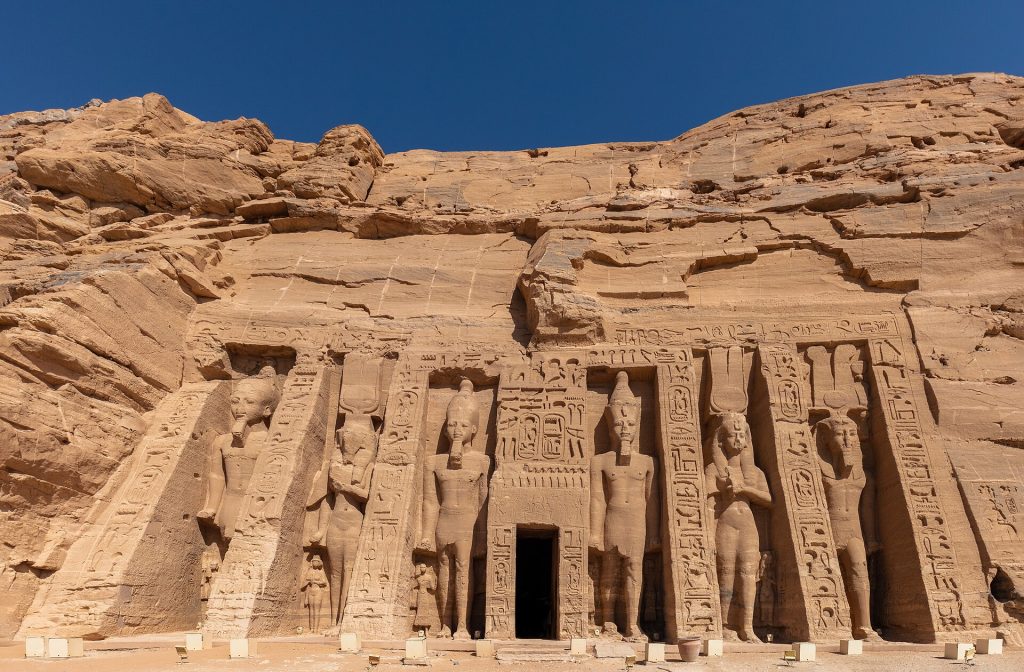
At the Great Temple's entrance stand four colossi, each 20 metres tall, while next door the temple built for Queen Nefertari matches it for beauty with six statues of its own (something never seen elsewhere in Egyptian history: a queen carved at exactly the pharaoh's scale). That UNESCO dismantled and rescued both in the 1960s, block by block, lends a modern chapter to a very ancient story.
This guide brings together all the practical information to organise your visit to Abu Simbel: opening hours, ticket prices, the road and the flight from Aswan, the sun alignment, the UK Foreign Office advice and tips from a local agency based in Egypt.
📋 All-inclusive Abu Simbel Excursion from Aswan
Private air-conditioned vehicle, English-speaking guide, entries included. Departure 3:30 a.m., return 1 p.m. From £70/person by bus, £140 by flight. We manage everything, you benefit.
Things to Do at Abu Simbel
A visit has a handful of things worth planning around:
- The Great Temple of Ramesses II: four seated colossi about 20 metres tall on the facade, the hall of Osiris pillars and the sanctuary with its four statues.
- The small Temple of Nefertari and Hathor: six statues on the facade, with the queen carved at the same scale as the king.
- The sun alignment: on 22 February and 22 October only, when the light reaches the sanctuary for about 20 minutes.
- The Sound and Light show: an evening show for visitors who stay the night, if it is running on your date.
- The view over Lake Nasser: the temples now sit on a hill built in the 1960s above the lake that would have drowned their original site.
- A Lake Nasser cruise: three to four nights between Aswan and Abu Simbel, calling at other Nubian temples along the way.
The Two Temples of Abu Simbel

The Great Temple of Ramses II
The Great Temple is dedicated to the pharaoh Ramses II and the gods Re-Horakhty, Amon-Re and Ptah. Its 33 metre high facade is guarded by four seated colossi of Ramesses II, each about 20 metres tall. One of them lost his bust in an ancient earthquake, and the pieces still lie at his feet.
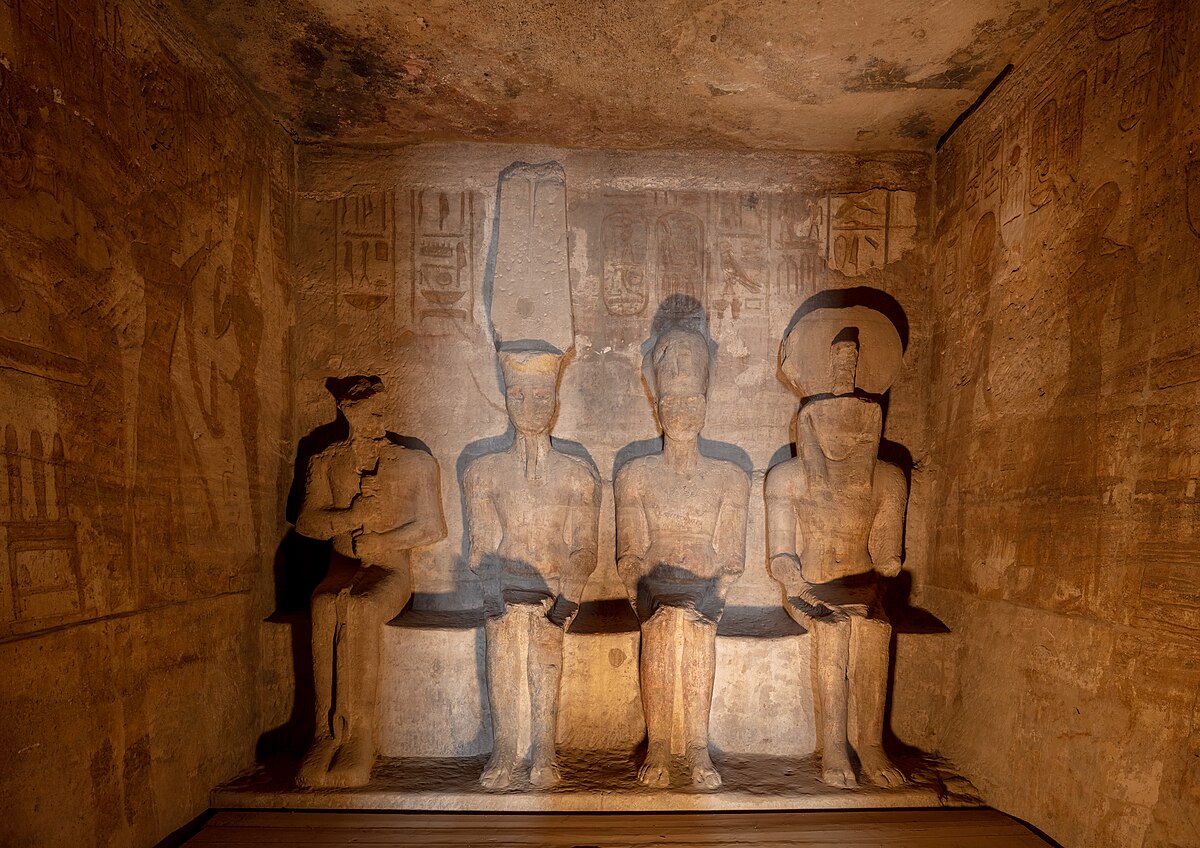
The interior extends 63 metres into the mountain through a series of increasingly smaller rooms. The large hypostyle hall, supported by eight pillars representing Ramses as Osiris, is decorated with reliefs celebrating the victory of Kadesh against the Hittites (the greatest chariot battle of Antiquity). At the back of the sanctuary, four seated statues - Ptah, Amun-Re, Ramses II and Re-Horakhty - wait for the light of the sun twice a year.
Here is something most guides skip: glance down at the colossi's feet. Clustered there are miniature figures of the royal household, Nefertari among them along with several of her children. Given that Ramses II fathered over 100 offspring, the temple doubles as a family portrait on a monumental scale.
The Temple of Nefertari (Hathor)
Consecrated to the goddess Hathor and to Queen Nefertari, the smaller temple is a remarkable declaration of devotion. Often called the small temple of Abu Simbel, it is cut into the rock just north of the Great Temple, on the same site and under the same ticket. Its six facade statues show the queen standing as tall as the pharaoh, a mark of rank without parallel in Egyptian history. Inside, the mood is more personal, with finely drawn scenes of Nefertari presenting offerings to Hathor.
Ramses II had words cut into the facade that read, roughly: "He for whom the sun rises built this temple for the great royal wife Nefertari, beloved of Mut, for all eternity." Some 3,300 years on, that message has not faded.
The Miracle of Solar Alignment
On February 22 and again on October 22, sunlight reaches 63 metres into the Great Temple and lights up the sanctuary statues for around 20 minutes. Amon-Re, Ramses II and Re-Horakhty, the three solar figures, are bathed in it, while Ptah, god of darkness, stays unlit. That an alignment worked out 3,300 years ago still holds this precisely is astonishing.
Tradition links these dates to the birthday and the coronation of Ramesses II. When the temples were moved by UNESCO in 1968, a slight delay of one day occurred. The phenomenon today takes place on the 22nd (and not the 21st as originally).
Tip: Travelling in February or October? Build your route around those two dates, because it is something you will never forget. Admission costs more on the day (the Ministry lists a raised tariff), the site is crowded, and you should reserve your Abu Simbel hotel or excursion several weeks ahead.
The next sun alignment: 22 February 2027 and 22 October 2027
Both 2026 dates have passed. The next alignments fall on Monday 22 February 2027 and Friday 22 October 2027. On 22 October 2026 Ahram Online reported that the light reached the sanctuary at 6:53 a.m. on Egypt's summer time, lit three of the four seated statues for about 20 minutes and travelled about 60 metres into the temple, with about 7,000 tourists watching. For February, Egypt Independent quoted the director general of antiquities in Aswan governorate putting the start of the 2025 alignment at 6:20 a.m. on standard time, so check the clock time for the year you travel.
The Ministry's price list charges 1,200 EGP for a foreign adult and 600 EGP for a student on both dates, against 750 and 375 EGP on an ordinary day. Ramadan is expected to begin around 8 or 9 February 2027, so 22 February 2027 may fall within it: ask your operator which opening and tour arrangements apply. The light itself lasts about 20 minutes, so if the crowds put you off, an ordinary morning at opening gives you the facade in low sun without the crush.
The Rescue by UNESCO: The Exploit of the 20th Century
When work on the Aswan High Dam began in 1960, the temples faced drowning beneath what would become Lake Nasser. UNESCO put out a worldwide appeal and dozens of countries answered it. Between 1964 and 1968 both temples were cut into 1,036 blocks (the smallest weighed about 7 tonnes, and the heaviest facade blocks were limited to 30 tonnes) and rebuilt about 65 metres higher and about 200 metres back from the river on a man-made hill. They were inaugurated at the new site on 22 September 1968, and Abu Simbel joined the UNESCO World Heritage List in 1979 as part of the Nubian Monuments from Abu Simbel to Philae.
The bill came to roughly 40 million dollars at the time, making it one of the biggest archaeological rescues ever undertaken. It succeeded, too. The temples sit whole on their new hill, and standing before them you would never guess they had been shifted at all. The achievement matches the monuments for sheer impact.
Getting from Aswan to Abu Simbel
Option 1: Coach or Private Car (Best Value)
This is the most popular option and is one of our Abu Simbel excursions from Aswan. Departure fromAswan between 3 a.m. and 4 a.m. (yes, that's early). The drive takes about three and a half hours each way, so allow up to four. Arrival around 7am. 2-3 hours visit. Return to Aswan early in the afternoon.
Price: Minibus sharing 200-500 EGP (-£10). Guided excursion with English-speaking guide and entries: 50-80 USD. Private vehicle: 130-200 USD.
Excursion prices usually leave OUT the 750 EGP entrance ticket. Confirm exactly what you are paying for.
Option 2: By Plane (Maximum Comfort)
EgyptAir and Air Cairo are the airlines usually listed for the flight from Aswan to Abu Simbel, which takes about 45 minutes. Check the day's timetable and the return time before you book, because they decide how long you have at the temples, and ask whether the transfer between the airport and the site is included. Our guide to domestic flights in Egypt explains how schedules and bookings work. The plus: no 3 a.m. start, and you are back in Aswan the same day.
Price: £100-£150 return per person. More expensive but incomparably more comfortable. Recommended if the budget allows it, especially in summer (7 hours of driving in the heat of the desert, it can be rough).
Option 3: Cruise on Lake Nasser (The Ultimate Experience)
Two 5-star vessels, the Movenpick Prince Abbas and the Steigenberger Omar El Khayam, cover Aswan to Abu Simbel over 3-4 nights, calling at temples nobody else reaches: Kalabsha, Wadi es-Seboua, Amada and Qasr Ibrim. Full board from 700 USD/person. Nothing sails between May and August because of the extreme heat. Our Lake Nasser cruise guide covers the route and the temples along it.
The three options side by side
| Option | Time | Leaves | Best for |
|---|---|---|---|
| Road (coach or private car) | About 3.5 hours each way, up to 7 hours on the road in total | Aswan, 3 to 4 a.m. | Best value, and the desert scenery |
| Flight from Aswan | About 45 minutes each way | Set by the airline timetable | Seniors, families, summer visits, anyone short of time |
| Lake Nasser cruise | 3 to 4 nights between Aswan and Abu Simbel | Fixed sailing dates | Travellers with time who want the other Nubian temples |
Getting to Aswan from the UK first
Abu Simbel is reached from Aswan, so a trip from the UK starts with getting to Aswan. When we checked flight search sites in mid 2026, none listed a nonstop flight from London to Aswan, so UK travellers connect: in Cairo, a flight to Aswan takes about 1 hour 25 minutes, or you can start a Nile cruise at Luxor and sail south to Aswan. In winter Egypt is two hours ahead of UK clocks, so a 6 a.m. opening is 4 a.m. in the UK; our guide to the time difference between Egypt and the UK shows how the gap changes through the year.
What to check when you book an Abu Simbel tour
Tours, holidays and cultural trips to Abu Simbel differ mainly in the transport and in what the price leaves out. Before you pay, ask:
- whether the entrance ticket is included, because many excursion prices leave it out;
- whether you travel by road or by air, and what time you leave Aswan or your hotel;
- whether the vehicle is private or shared, and how long you get at the temples;
- whether Abu Simbel is part of your Nile cruise programme or an optional extra added from Aswan.
If you would rather build Abu Simbel into a longer holiday, our tailor-made Egypt holiday service lets you set the route, the pace and the transport yourself.
⚡ We organise your Abu Simbel excursion
Coach, flight or a cruise on Lake Nasser? Tell us your route and budget and we will steer you to the right choice. Tickets covered, English-speaking guide, no logistics to worry about.
Is Abu Simbel Dangerous?
The UK Foreign Office (FCDO) advises against all but essential travel to the area west of the Nile Valley and Nile Delta regions, but it names Abu Simbel, with Luxor, Qina, Aswan and the Valley of the Kings, among the exceptions, so Abu Simbel is on the list of places that advice does not warn against. The same advice says terrorist attacks could be indiscriminate, including in places visited by foreign nationals, and that extra measures are in place at tourist sites. FCDO advice changes, so read the current page on GOV.UK, including its section on regional tensions, before you book.
On the ground, the FCDO says police check ID regularly and will ask to see your passport, and that you may be detained if you cannot show your ID and your visa, or a digital or paper copy. Expect checkpoints on the Aswan road and keep your passport with you rather than in a bag in the boot.
Is the police convoy still compulsory?
Guides disagree. No convoy rule appears on the Ministry of Tourism and Antiquities page for Abu Simbel or in the FCDO's Egypt advice, which states none either way. Road excursions leave Aswan before dawn and some operators describe their departures as convoys, so ask whoever is driving you how your own departure will work rather than relying on a general rule. The FCDO's separate advice is not to drive outside main cities and resorts at night, which is a good reason to leave the pre-dawn desert road to a professional driver, or to fly, rather than self-drive. Check out our Egypt security guide 2026 for the overall context.
Spending the Night in Abu Simbel: Is it Worth It?
Let's be honest: the majority of tourists make the round trip during the day from Aswan. And it works. But if you have time, spending a night in Abu Simbel changes everything.
The advantages: You are at the gate when the temples open at 6 a.m., practically alone, when the raking light of the morning gilds the colossi. You attend the Son et Lumiere show in the evening (inaccessible to day trippers). And you enjoy the calm of the Nubian village - a timeless rhythm of life.
Where to sleep: Best value goes to the Seti Abu Simbel Lake Resort (4 stars, ~£80/night, looking over Lake Nasser). Otherwise there is the Nefertari Hotel (£50-£90) or the Tuya Hotel (£20-£50, a 10 minute walk to the temples). Reserve early, as beds in the village are few.
The Sound and Light show: Operators list an evening show projected across the temple facades, with narration in several languages (English among them). We found no official 2026 schedule or ticket price, so ask your hotel or operator for the time and the ticket before you plan around it. Day trippers miss it, and it is rather magical.
Abu Simbel Opening Hours and Ticket Prices
Abu Simbel is open every day of the week, with no closing day. The site opens at 6 a.m. and the last entry is at 4 p.m., although the Ministry of Tourism and Antiquities lists the temples as closing at 5 p.m. Arrive early in any case: there is little shade, and a full visit takes up to three hours. The Ministry's Abu Simbel page gives no separate Ramadan hours, so ask your operator if you travel during the fasting month.
One ticket covers both temples. The table shows what a foreign visitor pays: the Ministry's price list is the gate price, and the official booking portal egymonuments.com shows slightly higher figures, probably a booking surcharge.
| Foreign visitor | Ministry gate price | Online on egymonuments.com |
|---|---|---|
| Adult, ordinary day | 750 EGP | 822 EGP |
| Student, ordinary day | 375 EGP | 445.50 EGP |
| Adult, 22 February and 22 October | 1,200 EGP | 1,272 EGP |
| Student, 22 February and 22 October | 600 EGP | 670.50 EGP |
Since 2023 the Ministry has made the ticket offices at the major sites, Abu Simbel included, card only, so bring a debit or credit card that works abroad rather than counting on cash at the gate. Students need a valid student ID. Prices of excursions often leave the entrance ticket out, so check exactly what you are paying for.
Best Time to Visit Abu Simbel
Time of day. Aim to be at the gate for the 6 a.m. opening, or as early as your transport allows. The Great Temple faces east, so the facade is lit by low, warm sun in the morning and falls into shade later in the day. Road excursions from Aswan usually arrive around 7 a.m., and flight passengers arrive when their timetable allows, so the quietest hour depends on how you travel.
Time of year. There is almost no shelter at the site, so the cooler months, roughly November to February, are the easiest for a day in the open. Summer is punishing: the average daily high at Abu Simbel peaks at about 40°C in June, according to the climate table on Wikipedia. If you travel in summer, choose the flight or the earliest slot and carry plenty of water.
Crowds. The two sun alignment dates, 22 February and 22 October, are the busiest days of the year. Choose an ordinary day if you prefer space.
How long to allow at the temples
Allow about two hours for the essentials, and up to three if you linger:
- About 15 minutes: the ticket check and the walk to the facade.
- 45 to 60 minutes: the Great Temple, with the facade, the hall of Osiris pillars and the sanctuary.
- 30 to 45 minutes: the Temple of Nefertari, which deserves more than a quick look.
- 15 to 30 minutes: the view over Lake Nasser and photographs outside.
If you fly, your time on site is set by the departure and return times on your tickets, so check both before you plan the visit.
Practical Information 2026
Hours: Daily, no closing day. The site opens at 6 a.m. and the last entry is at 4 p.m.; the Ministry of Tourism and Antiquities lists closing at 5 p.m.
Adult price: 750 EGP (~£10). Student rate: EGP 375. Increase on solar alignment days (Feb 22 / Oct 22).
Pictures: Phone photos are included in the ticket under Egypt's general rule. The Ministry's Abu Simbel page states no camera rule of its own, so ask at the ticket office before you bring a camera, a tripod or video equipment, which can need a permit. Our guide to photography in Egypt explains the general rules.
Duration of visit: Allow 1h30-2h to cover the two temples, or 3 hours if you linger and film.
Best photo light: Shoot the Great Temple facade from 6am to 9am while the sun is low; by afternoon it sits in shadow, lit from behind.
Water and sun: There is nowhere to shelter from the sun. Bring a hat, factor 50 sun cream and at least 1.5 litres of water each. Bottles are sold at the entrance kiosk, though at inflated tourist rates.
The excursion to Abu Simbel is an option included in our packages since Aswan. It perfectly complements theLuxor-Aswan route and the cruise on the Nile.
FAQ: Visiting Abu Simbel
Is Abu Simbel dangerous?
The UK Foreign Office does not advise against travel to Abu Simbel: it names it, with Aswan and Luxor, among the exceptions to its advice against all but essential travel in the area west of the Nile Valley. Police check ID regularly on the road, so keep your passport or a digital or paper copy with you. No convoy rule appears on the Ministry or FCDO pages, so ask your operator how your departure will run, and read the current FCDO page before you book.
What is the Abu Simbel admission price?
Adults pay 750 EGP (~£10) to see both temples, and students with an international card pay 375 EGP. Prices go up on February 22 and October 22 for the solar alignment. Coach tours rarely include the ticket, so always ask.
From Aswan, is it better to fly or take the coach?
The coach or car is the cheaper option but means a 3 to 4 a.m. start and about seven hours on the road in total. The flight (about 45 minutes each way) is more comfortable, and depending on the timetable you may arrive after the road coaches have left. If the budget allows it, we recommend flying, especially in summer.
Can we sleep in Abu Simbel?
Yes, and it is worth it to see the temples at opening (almost deserted) and, if it is running, the Sound and Light show. The Seti Abu Simbel Lake Resort is the best-value pick in the section above. Book early, as beds in the village are few.
What is the Abu Simbel solar alignment?
Each February 22 and October 22 the sun pushes 63 metres into the temple and falls on the sanctuary statues for 20 minutes. Engineered about 3,300 years ago, the effect is traditionally linked to the birthday and the coronation of Ramesses II, and it remains among the most spectacular sights ancient Egypt ever staged.
Is Abu Simbel worth the detour from Aswan?
Absolutely. Many travellers add Abu Simbel to a Nile itinerary. Our package with Abu Simbel included builds the visit into a full itinerary. Few monuments anywhere on earth, let alone in Egypt, make this kind of impression. Yes, it is a long detour (about 3.5 hours by road or about 45 minutes by air), but it earns every minute.
What time does Abu Simbel open and close?
Abu Simbel opens at 6 a.m. every day of the week, and the last entry is at 4 p.m. The Ministry of Tourism and Antiquities lists the temples as closing at 5 p.m. There is no closing day. The Ministry page gives no separate Ramadan hours, so ask your operator if you travel then, and arrive early whatever the season, because the site has little shade.
When is the best time to visit Abu Simbel?
Early in the morning, at the 6 a.m. opening, and between November and February if you can choose the season. The facade is in low sun at that hour and the heat is manageable, while summer highs average about 40°C in June. The two sun alignment dates, 22 February and 22 October, are the busiest days of the year, so pick an ordinary day if you prefer space.
Which river is Abu Simbel on, and where exactly is it?
Abu Simbel stands on the western shore of Lake Nasser, the reservoir the Aswan High Dam created on the River Nile. It is in Aswan Governorate near Egypt's border with Sudan, about 230 km south-west of Aswan in a straight line and about 300 km by road. The temples were moved above the lake in the 1960s to escape its rising water.
How old is Abu Simbel?
About 3,300 years old. The Ministry of Tourism and Antiquities dates the Great Temple to around 1264 BC, in the reign of Ramesses II. The temples were moved to their present site and inaugurated there on 22 September 1968, so the stone is ancient but the hill that carries it dates from the 1960s.
Abu Simbel or Petra: which should you choose?
They are in different countries, so the choice is really about where you are travelling. Abu Simbel is in southern Egypt, a day out from Aswan, and holds two temples cut into the rock for Ramesses II and Queen Nefertari around 1264 BC. Petra is in southern Jordan, the rock-cut capital of the Nabataeans and a UNESCO World Heritage Site since 1985. Choose Abu Simbel for pharaonic Egypt and Petra for a Jordan itinerary; they are not substitutes.
Ramses II is waiting for you.
Coach, air or a Lake Nasser cruise: we arrange your Abu Simbel trip. Just send your dates and budget.
Before you go, see our checklist for travelling to Egypt, our guide to visas, our guide to budgeting and our 2026 guide to safety in Egypt.
Several of our packages take in Abu Simbel: