
By Sem Elegant Voyage | Updated: March 2026
QUICK RESPONSE
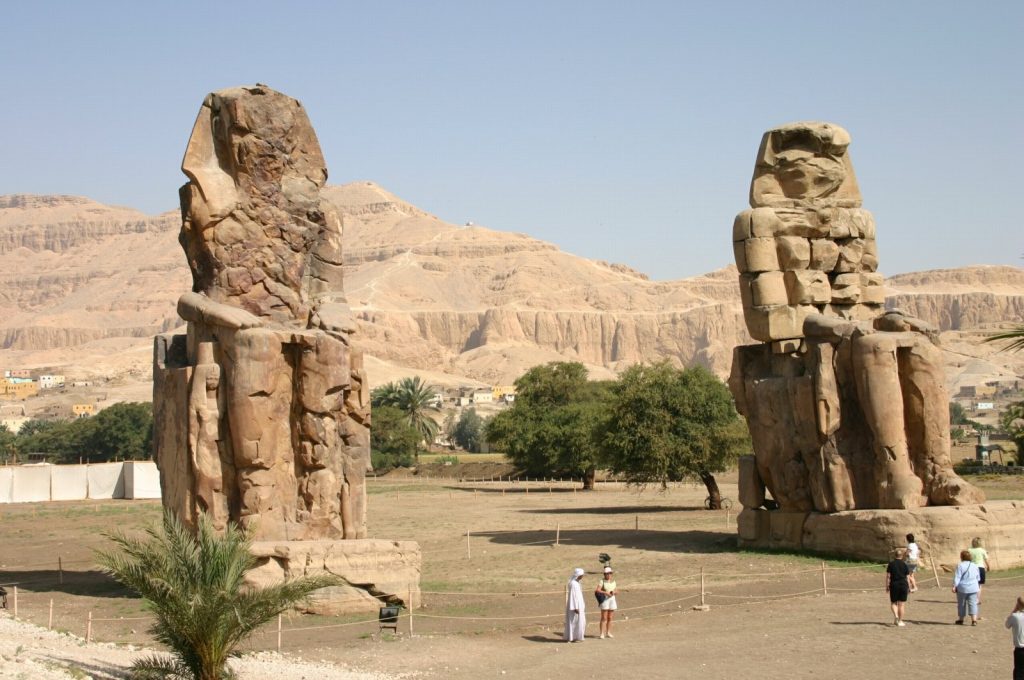
Colossi of Memnon. West bank, Luxor. 100% free entry. Two 18 meter statues, 3300 years old. They used to sing (crack sound at sunrise). Today silent. You spend 30-45 min there. Ideal before the Valley of the Kings. That said, it's nothing without historical context.
The Colossi of Memnon? This is the most oversold Egyptian oddity. The tourists disembark, take three photos, leave. "What were those again? Giant statues. OK, next site." No one stays for the story. And that's the problem. In short, we explain it correctly here.
We, a local agency with 10 years in Luxor, see them every week. The groups arrive tired from the Valley of the Kings, the photos of the colossi take 8 minutes, and then it's over. By the way, it's losing 90% of the interest. These statues carried the story of a pharaoh, of a lost capital, of acoustic mysteries. It was serious.

Who Was Memnon (Legend vs. Reality)
First trap: the name “Colossi of Memnon”. It's misleading. Memnon is a Greek character from mythology (Ethiopian king, son of Aurora). No Egypt in it.
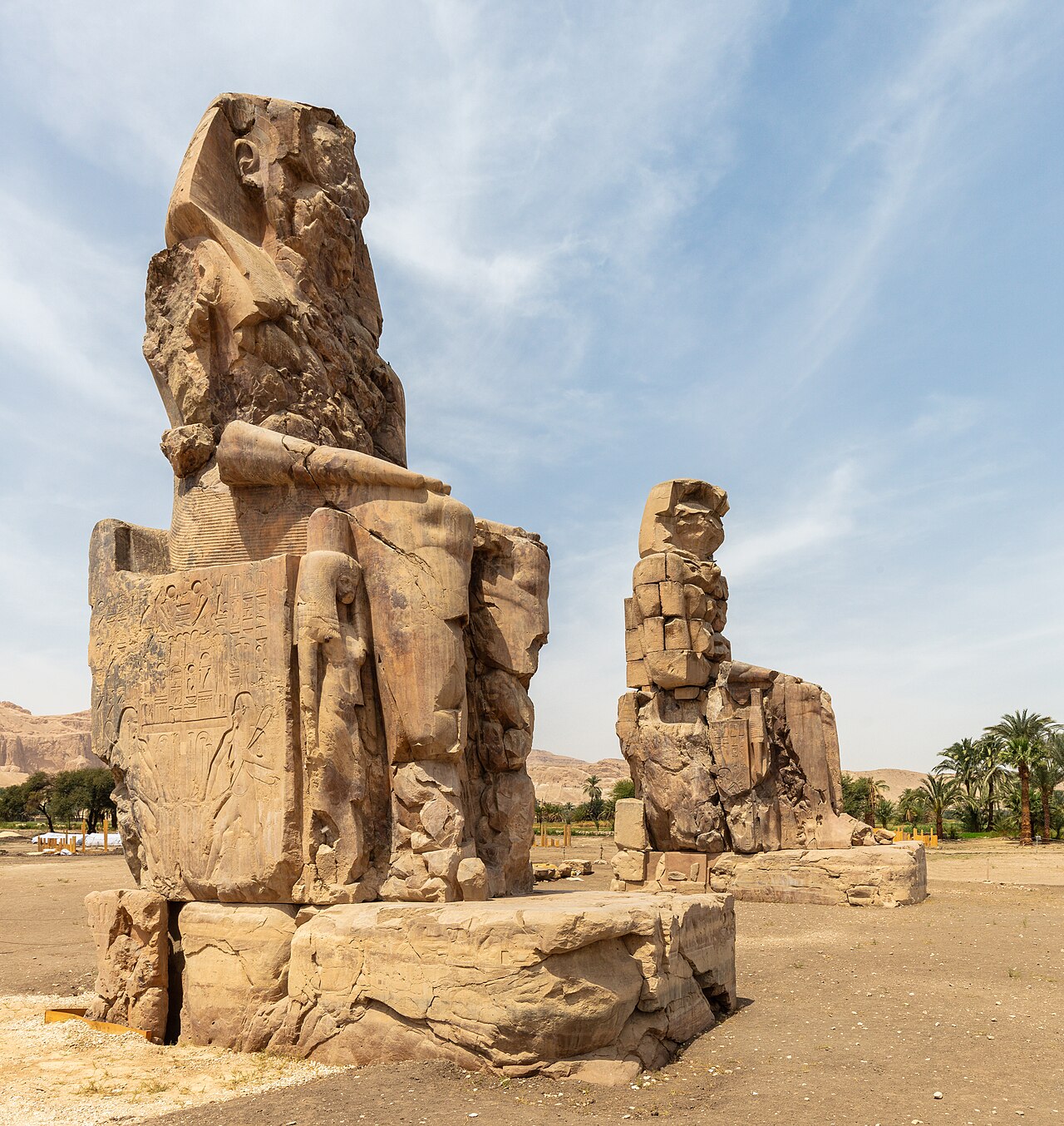
These two statues? They represent Amenhotep III, pharaoh of the 18th dynasty (1390-1352 BC). Him. Not Memnon. But the ancient Greeks who visited Egypt saw these giant silent statues and thought "that must be Memnon" (the Greeks connected everything to their mythology). Suddenly, the name stuck. And it stayed. Monumental historical inconsistency.
Egyptological correction: These statues would be called "Colossi of Amenhotep III" in correct Egyptology. But “Colossi of Memnon” prevailed. Historical errors persist. It is the same mechanism that put Cheops in power when there were other pharaohs before him.
Singing Statues: A Bizarre Reality
The phenomenon of singing statues. It's not a Hollywood invention. It was real. Between the 1st and 3rd centuries AD, the Colossi of Memnon emitted mysterious sounds at sunrise. High-pitched sounds, like the sound of a broken string. Documented by Greek and Roman travelers.
What was causing this?
Scientific explanation (the real one): the statues were damaged by an earthquake in 27 BC. Internal cracks. As the sun rose, the heat of the day widened these cracks in the sandstone. Air was escaping = high pitched sounds. It's not supernatural, it's physical.
Magical explanation (what the ancients thought): it was Memnon who cried for his mother Aurora (goddess of the sunrise). Poetic. Fake. But poetic. As a result, ancient tourists came on purpose to listen to the statues “cry”. It was a tourist route as early as 100 A.D. Greek travelers paid for it. Nothing new under the Egyptian sun.
Why did it stop?
Around 200 AD, the emperor Septimius Severus had the statues repaired (restoration, cement). Cementing = crack closure. No cracks = no sound. End of the phenomenon. The emperor killed magic unintentionally. In trying to preserve, he suffocated.
Physical and Architecture Description
Two statues. Side by side. Red limestone sandstone. Each: 18 meters high. 700 tonnes each. Built around 1350 BC. BC under Amenhotep III (a prosperous pharaoh, little known, but built massive things).
Current status
Damaged. The original statues had crowning, minor details. Today, just the torsos and heads (no legs, the legs are buried under the sand). Hieroglyphics partially visible on the sides. Broken nose (ancient vandalism).
Greek restoration visible. Brown Roman cement in certain areas. It's cosmetic, it ruins beauty. That said, it's the reality: ancient monuments survive via patchwork of repairs.
Details to observe
Huge feet (2 meters long, you stand on one toe). Greek inscriptions engraved by ancient tourists (yes, even 1800 years ago monuments were scratched). Classic Egyptian representation: seated pharaoh, ceremonial, double crown (Upper Egypt + Lower Egypt).
Observation Tip: Go there late afternoon (4-5 p.m.). Shadows create interesting outlines. The hieroglyphs stand out. Sunrise? Touristy, over-crowded, and the statues no longer sing (so no special interest).
This Entire Site (Beyond the Statues)
The Colossi are not isolated. They once guarded the entrance to the Mortar Temple of Amenhotep III. Gigantic funerary temple (comparable in size to Karnak). Shaved. Disappeared. The colossi are the only vestiges that stand.
Around ? Agricultural fields. Nile silt. Archaeologists have excavated sections (1990s). They found mud brick walls, dumps, traces of ceremonies. But the site is poorly equipped for tourists.
Practical Visit: Duration and Times
Duration of visit
30-45 minutes solo. If you have a guide and you really listen, 1h30. Tourists in a hurry? 8 minutes (camera, selfie, party).
Entrance and prices
100% free. Free. No barrier, no official, nothing. You arrive, you look. Optional donation to local caretaker (5-10 EGP, honest if you like). This is the beauty of the Colossi: total accessibility.
Access hours
24 hours a day. Not closed. You can come at midnight if you like (strange but possible). Sunset: best time for light. Sunrise: touristy but banal (the statues don't sing, eh).
How to Get There and Combine with Other Sites
The Colossi are on the West Bank of Luxor. Next to the Valley of the Kings. It’s a logical detour that’s obligatory if you’re visiting the valley.
Transport from East Bank (hotels)
Crossing the Nile by felucca (traditional boat): 80-120 EGP per person (authentic, 30 min, tourist). White taxi: 60-80 EGP one way (you negotiate). Uber? Partially works. Organized tourist circuit: included by default (most Valley of the Kings tours pass through the Colossi).
Valley of the Kings + Colossi (ideal combination)
Valley of the Kings: 7 a.m.-12:30 p.m. (morning, before heat). Colossi: 1 p.m.-2 p.m. (quick lunch afterwards). Easy. You combine over half a day. Consult our complete guide to Luxor.
Colossi + Temple of Medinet Habou (1h30 total)
Médinet Habou is further away (mortuary temple of Ramses III). 4 km. You are already on the west bank, add 20 minutes by car. Interesting if you like temples and you have time.
You have 2 days in Luxor and you want to see as much as possible? Day 1: Valley of the Kings + Colossi of Memnon (half day). Day 2: Complete Karnak + Luxor Temple sunset. English-speaking guide provided. £110 per person (min 2).
Request a quoteResponse in less than 2 hours · 7 days a week · No obligation
A visit to the Colossi of Memnon is ideally part of your complete guide to Luxor. These giant statues mark the historic entrance to the royal necropolis, and many visitors continue towards Nile cruises to explore other ancient treasures. To optimize your budget, consult our 2026 budget guide. A well organized cruise naturally integrates the Colossi into the itinerary. Also discover the Temple of Edfu and Kom Ombo Temple to complete your circuit.
Best Time to Visit
Season. October-March: ideal temperature (22-28°C), no oppressive heat. April-May and September: 38-42°C. Avoid unless you like burning.
Time of day. Sunset (4 p.m.-5:30 p.m.): better light, statues take on a golden hue. Early morning (7 a.m.-8 a.m.): pale but quiet light. Midday (12 p.m.-2 p.m.): too hot, too bright, little contrast.
Crowd. December-January: peak. February-March: average. September: almost no one (but untenable in the climate). Tuesday-Thursday: less touristy than Saturday-Sunday.
Sunrise time? Tour to listen to the statues sing? This is 100% tourist scam. The statues do not sing (repaired for 200 years). Agencies sell it as a "mystical experience". This is false. Avoid this trap.
Photography Tips
Classic angles. Front view: 4 p.m.-5 p.m. (low sun, shadows sculpting the features). Lateral side: reveals the hieroglyphs. Feet (yes, feet): extraordinary in macro (tiny details, human scale).
Drone allowed? Informally no. Local authorities turn a blind eye depending on the day. Don't test luck. Phone ? Okay. Camera ? Better. ISO 800, f/5.6, speed 1/200. No flash (useless and indelicate).
Advanced composition
Symmetrical statues = symmetrical composition. Rule of thirds: place a statue on one third, sky on the other. Contrast: silhouette the statues against the sunset sky (it's dramatic). Context: include fields or roads for human scale.
Accessibility and Practical Information
Terrain and walking
Flat land. Sand + gravel. No stairs. Accessible for most mobility. If motor disability, you can stay nearby, no need to walk far.
Water and shade
No water on site. Bring 1-2 liters. No shade (a few small precarious shelters from sellers). Hat required. SPF50 sunscreen. (arrive before 3 p.m., late afternoon sunburn is quick).
Souvenir sellers
A few sellers of postcards, statuettes, scarves. Average harassment (not aggressive). “No, no, no” is enough. Initial price 50% usual surcharge (negotiate firmly).
Larger Historical Context: Amenhotep III
Who really was Amenhotep III? Pharaoh of the 18th Dynasty (1390-1352 BC). Prosperous reign. No major wars, he was diplomatic (married to foreign princesses for alliances). Religion, art, monumentality: his thing.
Constructions: Gigantic mortuary temple (razed, the Colossi remain). Expansion of Luxor. Statue in Sudan. The guy was obsessed with monumentality. In short, the Colossi of Memnon was his stone business card.
Want to understand the full story (not just the statues)? Our Egyptologist guides offer complete context on Amenhotep III, 18th Dynasty, ancient construction. Colossi + historical context = 1h30 for £60 (2 people minimum).
Book a guided tourResponse in less than 2 hours · 7 days a week · No obligation
Frequently Asked Questions
Can we climb them?
No. No access. The statues have a symbolic barrier (pretty weak, honestly). But it's forbidden. If you try, a guard will stop you. It's an archaeological site, not a playground.
Why didn't they completely restore them?
Partial restoration in 2002 (consolidation). Complete restoration? Impossible. The legs are buried, removing the sand would destabilize everything. The lack of legs is the trade-off: preserve vs. totally restore.
How long if I just do Colossi without Valley of the Kings?
45 min realistic. 30 mins fast. The photos are 10 min. Read the story, observe details = additional 35-40 min. If you're alone without a guide, it's hard to spend more than an hour there without becoming repetitive.
Is it really free?
Yes. 100% free. There is no official access control. You arrive and it's good. Donation for local caretaker (5-10 EGP) is appreciated but not obligatory. It's rare in Egypt, it's free.
Are there really engraved Greek inscriptions?
Yes. Ancient Greek travelers (including a guy named Heron in 100 AD) carved their names. It's visible on the feet. The old ones also did tourism + vandalism (the more things change, the more they stay the same).
What you really need to know
The Colossi of Memnon are not “just statues”. It is the story of a pharaoh obsessed with monumentality. It's an ancient acoustic oddity. It was Greek tourists who got the name wrong. It was the Roman Empire that unknowingly broke the cracks.
Free. Accessible. Fast. But tasteless if you come there without understanding why. So, provide that context. Read this article. Hire a guide for 1h30. Transform “old statues” into an understanding of a civilization.
Ready to combine the Colossi with a real Egyptian day? “Complete Valley of the Kings” package: 5 hours, two major tombs (Tutankamon + Thutmose III) + Colossi of Memnon sunset + English-speaking guide. £70 per person (min 2).
Order the packageResponse in less than 2 hours · 7 days a week · No obligation