
By Sem Elegant Voyage | Updated: November 2026
Kom Ombo is a Ptolemaic double temple on the Nile's east bank, shared by Sobek the crocodile god and Haroeris the falcon god. It opens at 7 a.m. (last entry 8 p.m.). The adult ticket is 450 EGP, card only, and includes the Crocodile Museum. Arrive by Nile cruise or by road, 28 miles north of Aswan.
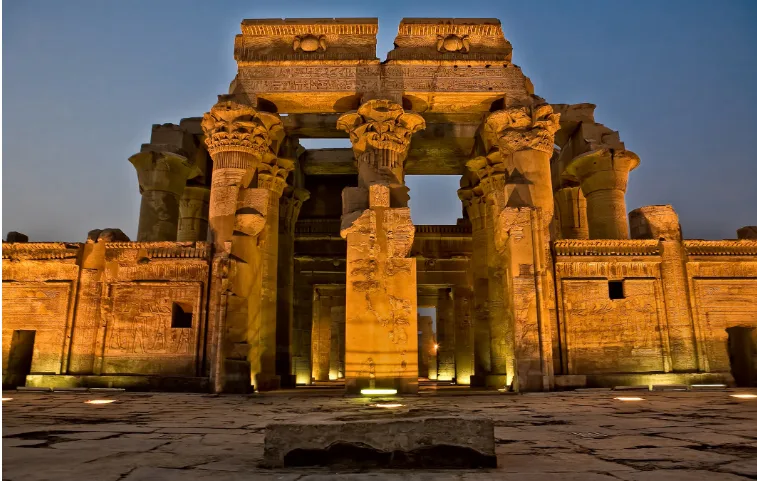
Kom Ombo Temple - perched on the east bank of the Nile 28 miles north of Aswan, this sanctuary is the only known double temple in ancient Egypt - half dedicated to Sobek, the crocodile god, half dedicated to Haroeris (Horus the Elder), the falcon god. Built during the Ptolemaic dynasty (180-47 BC), it is a mandatory stop between Edfu and Aswan on Nile cruises. Often rushed through in 45 minutes, it is nevertheless one of the most fascinating temples in Egypt - thanks in particular to its adjoining Crocodile Museum and a famous relief of what scholars read as surgical instruments.
From Aswan or Luxor, SEV arranges private excursions to Kom Ombo with an English-speaking guide, or builds the stop into our customized Nile cruise packages. Request your quote.
Request a Kom Ombo quote on WhatsApp →


Kom Ombo Temple: the double sanctuary of Sobek and Haroeris
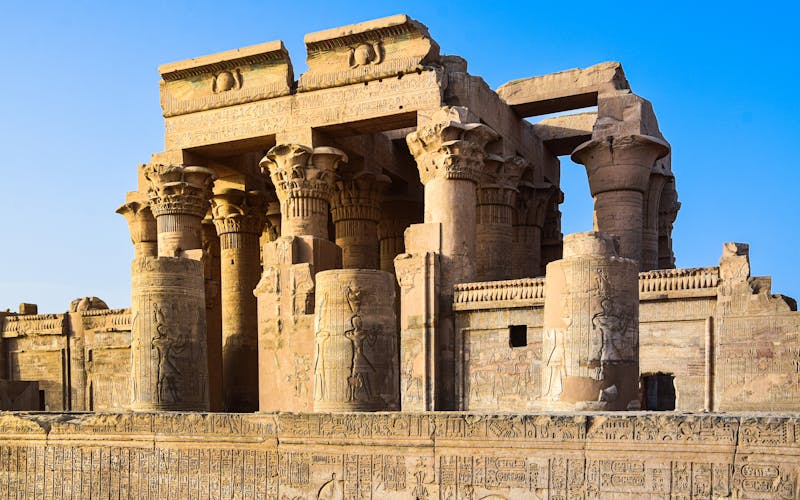
What makes Kom Ombo special is obvious the moment you approach the temple - the entrance pylon is doubled, the inner court is doubled, the sanctuary is doubled. Everything is replicated twice, in perfect mirror image about 40 feet apart. The south side (right as you enter) is consecrated to Sobek the crocodile, the north side (left) to Haroeris the falcon. No other temple in Egypt has this layout.
Why this duality? The usual explanation is that Kom Ombo sits on the historical boundary between the territory of the crocodile god Sobek (downstream, toward Edfu) and the territory of the falcon god Haroeris (upstream, toward Aswan). The Ptolemies, who funded the construction, wanted to unite the two cults within a single sanctuary to bind the region together and shore up their Hellenistic legitimacy over Upper Egypt.
The temple of Sobek: the crocodile god's half of Kom Ombo
Travelers who search for the temple of Sobek in Egypt usually end up at Kom Ombo, because it is the Sobek temple on the standard Nile route. His half is the south side, where he is worshipped with Hathor and Khonsu. The north half belongs to Haroeris with Tasenetnofret and Panebtawy. Both halves follow the same plan, so once you have walked one you can read the other.
The crocodile story continues next door. The Crocodile Museum, open since 2012, keeps mummified Nile crocodiles, statues of Sobek in several sizes and a model of a tomb from the Shutb cemetery. Around three hundred crocodile mummies are reported from the area around the temple, and the museum shows only a selection. If Sobek is the reason for your visit, see the museum first, then the south half of the temple, and cross to the Haroeris side last. Our complete list of the temples of Egypt shows how Kom Ombo compares with the other great sanctuaries.
History - the Ptolemies and the cult of the crocodile god
The temple you see today was begun under Ptolemy VI Philometor (180 to 145 BC) and completed by later Ptolemaic rulers whose names appear on its reliefs, among them Ptolemy XII Neos Dionysos, the father of Cleopatra VII. Roman rulers then added to it and restored parts of it. Earlier shrines may have stood on the spot, but the temple you walk through is Ptolemaic and Roman.
Sobek was the crocodile god of the Nile, and his cult was strong around Kom Ombo, where the river was both a lifeline and a danger. Crocodiles sacred to Sobek were mummified in this region, and around three hundred crocodile mummies are reported from the area around the temple. The adjoining museum displays a selection of them.
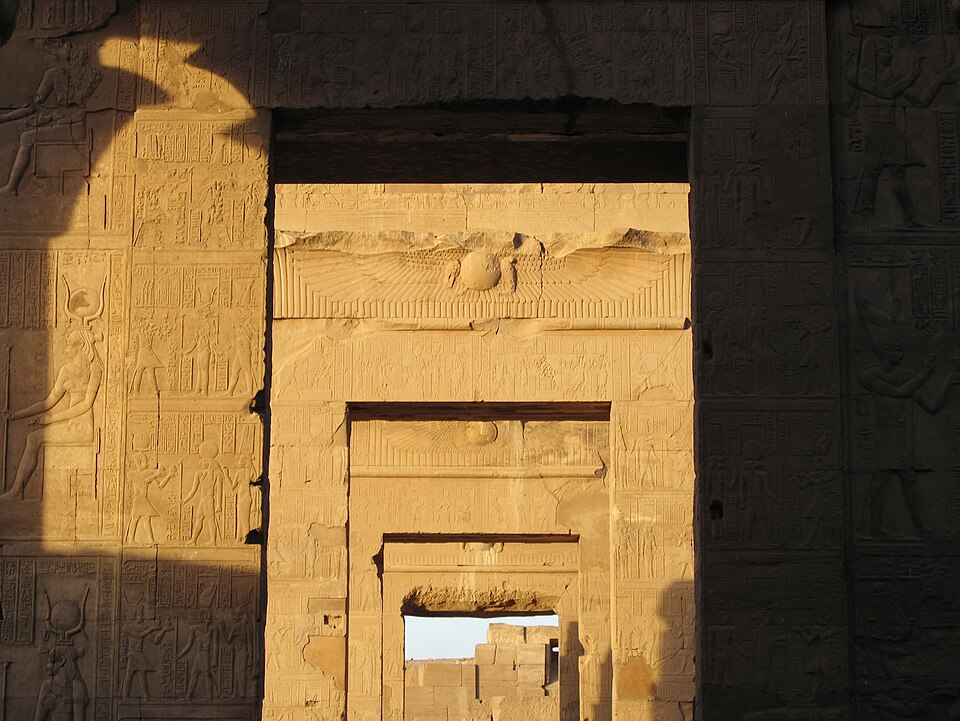
The temple suffered over the centuries: Nile floods, earthquakes and builders who reused its stones all took their toll, and some reliefs were defaced by early Christians who used the temple as a church. Jacques de Morgan cleared and restored the buildings in 1893. Fortunately, many Ptolemaic reliefs were carved deep enough to survive.
How to get to Kom Ombo in 2026
Kom Ombo lies 28 miles north of Aswan and 37 miles south of Edfu. There are several ways to get there, depending on your itinerary.
- On a Nile cruise (the easiest) - Nile cruises between Luxor and Aswan normally stop at Kom Ombo for a visit of 1.5 to 2 hours. Included in the cruise package.
- On an excursion from Aswan - private air-conditioned SEV vehicle, departure at 6 a.m., arriving at Kom Ombo at 7:30 a.m. Two hours of touring with an English-speaking guide. Return to Aswan by 11 a.m. or continue on to Edfu.
- Train + taxi (budget): take the Aswan to Daraw train, then a local taxi to the temple. Fares and timetables change and the connection is slow, so this suits only flexible travelers, and a private car is far more predictable.
By road from Luxor
Luxor is roughly 105 to 110 miles (170 to 180 km) from Kom Ombo by road, with Edfu on the way, so this is a full-day trip rather than a quick detour. Most travelers do it as part of a Luxor to Aswan transfer: a private car leaves Luxor in the morning, stops at the Temple of Edfu, continues to Kom Ombo and ends in Aswan. Plan on three hours or more of driving in total before you add the visits, and SEV can arrange it as a private excursion with an English-speaking guide. If you would rather not spend the day in a car, a Nile cruise or a dahabiya covers the same temples while you sail, and our Luxor to Aswan day-by-day itinerary shows how the days fit together.
On a cruise: the direction decides the order
Edfu lies north of Kom Ombo, so the order of the two temples depends on the way you sail. On a typical Luxor to Aswan sailing, the ship calls at Edfu first and reaches Kom Ombo later, in the late afternoon on many programs. Going from Aswan to Luxor, Kom Ombo usually comes first, often at dawn, and Edfu follows. The two temples keep different hours: Kom Ombo takes its last visitors at 8 p.m., Edfu at 4 p.m., so a late Kom Ombo stop still works. Edfu stands on the west bank and Kom Ombo on the east bank. Our guide to which direction to choose for a Nile cruise compares the two routes, and the Luxor to Aswan stops guide lists every call along the way. Dahabiyas follow the same logic, and the Luxor to Aswan dahabiya program includes both Edfu and Kom Ombo. Planning to base yourself in Aswan instead? Start with our complete guide to visiting Aswan.
What you absolutely must see at Kom Ombo temple
The site is compact (820 feet by 330 feet) but dense. Here are the elements not to miss during your 1.5-hour visit.
- The double pronaos (entrance) - ten papyriform columns with bell-shaped capitals. Beautiful scenes of ritual purification where Ptolemy VIII receives the lustral water from Thoth and Horus.
- The liturgical calendar (inner wall) - on the east side, a detailed calendar of the annual religious festivals with their offerings. It is one of the main sources on the cult of Sobek.
- The relief of surgical instruments (rear wall): see the dedicated section below.
- The deep nilometer (at the heart of the site) - a masonry well in which the annual Nile flood was measured. Depth of about 20 feet.
- The two inner sanctuaries - the walls are in ruins, but you can clearly make out the double plan. On the Sobek side (right), reliefs of the crocodile god with a human head. On the Haroeris side (left), Horus standing as a uraeus.
- The crypt of Sobek (to the right of the sanctuary) - a small underground space where the sacred mummies were kept.
The relief of surgical instruments - our favorite
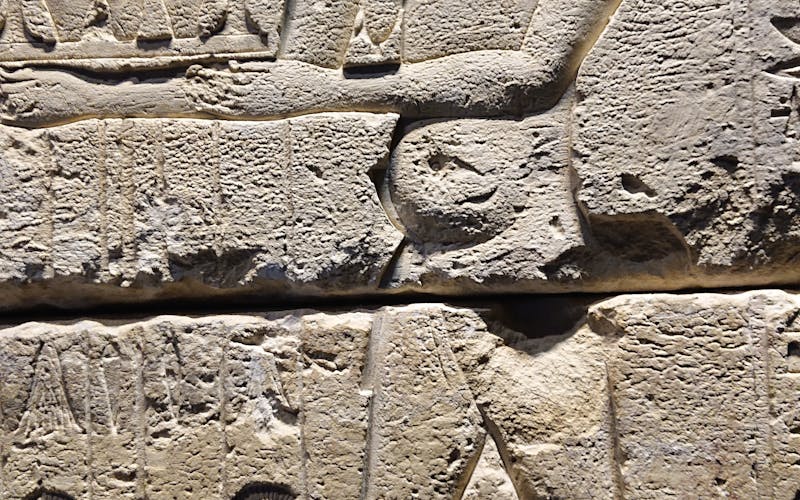
On the inside face of the rear wall, in the passage that runs around the main building, a carved relief shows what scholars read as a set of medical and surgical instruments: scalpels, forceps, scissors, specula, cupping vessels and medicine bottles, among others. It is one of the best-known images of ancient Egyptian medicine, but the details are still debated, including how old the scene is and how much of it shows real surgery rather than ritual, so treat any claim that it is the oldest medical record in the world with caution.
For lovers of the history of science, this is the highlight of Kom Ombo. It is easy to miss because you have to walk around the back of the temple to find it. With SEV, your English-speaking guide takes you straight to it for about 10 minutes of explanation on ancient Egyptian medicine and how healers worked in Ptolemaic and Roman Egypt.
The Crocodile Museum - the site's hidden gem
Open since 2012, this small modern museum stands next to the temple. Its main hall shows mummified Nile crocodiles, the longest about 14 feet (4.3 m) and the smallest about 6.5 feet (2 m). Other cases hold crocodile fetuses, crocodile eyes, golden and ivory teeth taken from the mummies, and statues of Sobek in different sizes.
A tomb model based on finds from the Shutb cemetery shows how people were buried and what pottery coffins looked like. The visit is included in the temple ticket, with no surcharge. Allow 25 to 30 minutes.
Our tip - visit the museum BEFORE the temple to fully grasp the importance of the cult of Sobek. It completely changes how you read the reliefs of the main sanctuary.
Kom Ombo temple tickets and opening hours
Tickets are sold at the entrance. The ticket office takes cards only, so carry a card that works abroad and keep your cash for tips, drinks and the bazaar. One ticket covers the temple and the Crocodile Museum.
Opening hours: the temple opens at 7 a.m. every day and the last entry is at 8 p.m., the same in winter and summer according to the official monuments portal (egymonuments.com). Ramadan timetables can differ, so check the official listing before a visit in that month. The site gets very hot in summer because the riverbank offers no shade, so bring a hat, water and sunglasses. There is no restaurant inside the grounds, but a small souvenir bazaar and cold drinks at the exit.
Kom Ombo on a Nile cruise - the perfect stop
Kom Ombo was designed by nature to be visited by cruise - the temple sits directly on the bank of the Nile, about 65 feet from the water. The 5-star ships moor at the quay right in front of the pylon, and you walk to the site in 3 minutes. No road transfer is needed.
Here is one example of a morning stop at Kom Ombo on a 5-star ship heading to Aswan (times shift with the ship, the season and the direction of the sailing):
- 6:00 a.m. - The ship arrives at Kom Ombo. The quay is 65 feet from the temple.
- 6:30 a.m. - Breakfast on board with a view of the pylon bathed in the rising sun.
- 7:30 a.m. - Disembark and tour (1.5 hours with the onboard English-speaking Egyptologist).
- 9:00 a.m. - Reboarding and departure toward Aswan (3 hours of sailing).
- 12:30 p.m. - Arrival in Aswan and lunch on board with a view of the pink granite obelisks.
For the international traveler, this is the best option. The 4-night Luxor-Aswan cruise always includes Kom Ombo + Edfu + Valley of the Kings + Karnak + Philae. SEV offers 5-star cruise packages with a private English-speaking guide on board - including domestic flights between Egypt's destinations, transfers, cruise, tours, and tips. Request your personalized quote on WhatsApp.
Get a custom Nile cruise quote →
FAQ - Frequently asked questions about Kom Ombo temple
What are the Kom Ombo temple opening hours?
Kom Ombo temple opens at 7 a.m. and the last entry is at 8 p.m., every day, according to the official monuments portal (egymonuments.com). The same ticket covers the Crocodile Museum next door. Hours can change during Ramadan, so check the official listing if you travel in that month. For cooler air and softer light, arrive at 7 a.m. or in the late afternoon.
How much does it cost to visit Kom Ombo temple in 2026?
The foreign adult ticket costs 450 EGP and covers both the temple and the adjoining Crocodile Museum. Students aged 24 or under with a valid ID pay 225 EGP. The ticket office accepts cards only, so bring a card that works abroad. For the dollar amount, check the exchange rate in your card app on the day of your visit, since it moves.
Can you take photos at Kom Ombo temple?
Yes. Phones and cameras without flash are allowed with the normal ticket, and photography with a mobile phone is free of charge. A tripod or camera stand and commercial filming need a ticket or permit. The reliefs and the Nile frontage look best early in the morning and in the last hours of the afternoon.
Where is Kom Ombo and how far is it from Aswan and Luxor?
Kom Ombo stands on the east bank of the Nile, about 28 miles (45 km) north of Aswan and 37 miles south of Edfu. From Luxor it is roughly 105 to 110 miles (170 to 180 km) by road. Cruise ships stop there between Luxor and Aswan, and day trips run from both cities.
Why is Kom Ombo a double temple?
Kom Ombo is unique in Egypt because two cults coexist within a single building along parallel axes - the south side (right) dedicated to Sobek the crocodile, the north side (left) dedicated to Haroeris (Horus the Elder) the falcon. The region historically marks the boundary between the two local cults, and the Ptolemies who built the temple wanted to unite the communities under a single sanctuary.
How long do you need to visit Kom Ombo?
Allow 1.5 hours minimum on site - 1 hour for the temple, 30 minutes for the Crocodile Museum. With an English-speaking guide who explains the reliefs, plan on 2 hours. If you arrive by cruise, the program is generally set at 1.5 hours with a quick return to the ship.
Is the Crocodile Museum worth it?
Yes. Open since 2012, the Crocodile Museum shows mummified Nile crocodiles up to about 14 feet (4.3 m) long, crocodile fetuses, golden and ivory teeth, and statues of Sobek. The visit is included in the temple ticket, and 25 to 30 minutes is enough. Our tip: see the museum before the temple, because it explains why Sobek mattered here and makes the reliefs easier to read.
Can you visit Kom Ombo without a cruise?
Yes. From Aswan, allow 45 minutes by private car (28 miles north). SEV arranges morning excursions from your Aswan hotel with an air-conditioned vehicle, an English-speaking guide and 2 hours on site - typically combined with Edfu (37 miles farther north) for a full day. Starting from $80 per person for a group of four.
When is the best time to visit Kom Ombo?
Early in the morning, right at the 7 a.m. opening. The site sits on a riverbank with no shade, and the heat builds quickly as the morning goes on. The last hours of the afternoon are also lovely, with warm light on the ochre reliefs and the Nile, and the gate takes visitors until 8 p.m. (last entry).
Is there an audio guide at Kom Ombo?
No, there is no official audio guide. There are a few explanatory panels in English and Arabic. To really understand the double sanctuary and the medical relief, an English-speaking guide is highly recommended. SEV includes a private English-speaking Egyptologist in its Kom Ombo excursion packages.
Can you combine Kom Ombo and Edfu in one day?
Yes, and it is the classic combo for day trips from Aswan. Depart Aswan at 6 a.m., tour Kom Ombo 7:30-9:30 a.m., drive to Edfu 9:30-10:45 a.m., tour the Temple of Horus at Edfu 10:45 a.m.-12:45 p.m., lunch in Edfu, return to Aswan 3-4:30 p.m. SEV's rate for two people on a private tour - starting from $190 per person (transfers + entries + lunch + English-speaking guide).
Is the temple wheelchair accessible?
Partially. The quay-to-temple path is flat, and the entrance through the pylon is accessible. The inner court and the pronaos are passable with assistance. The inner sanctuaries have a few steps. The Crocodile Museum is accessible (with an access ramp). SEV can arrange a visit with dedicated assistance - let us know when you make your request.
What flights are there from Cairo to Aswan in 2026?
EgyptAir and Air Cairo operate flights between Cairo (CAI) and Aswan (ASW). Flight time is about 1 hour 25 minutes. Fares change with the season and with how early you book, so compare the airline sites before you buy. To combine Kom Ombo + Aswan + Philae over 3 days, a 4-night Luxor-Aswan Nile cruise is generally the simplest and most economical solution.