
More than two thirds of Egypt is covered by the Western Desert. Beginning on the west bank of the Nile, the desert extends west to Libya and south to Sudan, part of the immense expanse of the Sahara Desert that stretches across North Africa to the Atlantic Ocean.
Visit the Egyptian desert in 2026, it means discovering five sub-regions which cover two thirds of the territory: the White Desert of Farafra, the Siwa oasis and Bahariya, the Sinai desert with Mount Sinai and Sainte-Catherine, the Great Western Desert (Kharga, Dakhla, Farafra) and the valley of whales Wadi al-Hitan near Fayoum. This comprehensive guide details each region, 4x4 safaris, Bedouin bivouacs, the best time, the 2026 budget and practical logistics for a successful Egyptian desert trip.
Our English-speaking agency has been a specialist in the Egyptian desert for more than ten years. We know the Bedouin 4x4 drivers, the quality camps in the heart of the White Desert, the hidden hot springs of Siwa and the military authorizations required for certain areas. This guide shares this expertise to prepare your stay in the Egyptian desert.
The Egyptian desert covers more than 960,000 km² or 94% of the national territory, more than mainland France. It is divided into five distinct sub-regions that every English-speaking traveler should know before choosing their itinerary:
Each of these regions offers completely different landscapes and experiences. The White Desert attracts for its chalky formations sculpted by the wind which give the impression of walking on another planet. Siwa seduces with her cultural isolation (Berber language Siwi) and its ancient baths. Sinai is the pilgrim desert for Mount Sinai at sunrise. Fayoum is the desert express accessible without leaving Cairo for more than two days. Our agency assembles these regions into coherent itineraries according to your interests.
The White Desert Egypt (Sahara el-Beyda in Arabic) is the visual jewel of the Egyptian desert and the main reason why English-speaking travelers cross 370 kilometers of track from Cairo. Situated between the Farafra Oasis and the Bahariya Oasis in the Western Desert, this wind-eroded chalk plateau features surreal white formations in the shapes of mushrooms, chickens, sphinxes and tents, rising from orange sandy soil.
The White Desert National Park (Bahariya-Farafra) was created in 2002 over 3,010 km². The most photographed training courses are located in the sector White Desert New (north of the park) with the famous limestone “mushrooms” and “chickens”. The sector White Desert Old (south) offers taller and wilder monoliths. The best experience remains night in bivouac Bedouin: traditional camp, meal around the fire, starry sky without light pollution (up to 3,000 stars visible) and pink sunrise over the white formations.
Access: 4x4 compulsory from Bahariya (2h30 track), convoy of two vehicles recommended. Entrance to the park: 100 EGP in 2026. Organized bivouac 1 night: 80 to 150 EUR per person including 4x4, meals, tents, sleeping bags. Our agency works with three English-speaking Bedouin operators based in Bahariya, all holders of official tourist authorization.
On the road between Bahariya and the White Desert, three geological sites deserve a systematic stop. The Black Desert (Sahara el-Aswad), located 20 km south of Bahariya, is a volcanic field of approximately 20 km² where black basalt cones emerge from orange sand soil. The main peaks (Gebel el-Marsous and Gebel el-Ingliz) offer a 360° panorama of the Western Desert. Short 20 minute climb recommended at sunset.
The Crystal Mountain (Gebel el-Izaz), located 50 km south of the Black Desert, is a small mountain of transparent and crystallized quartz formed millions of years ago by hydrothermal activity. A natural arch allows you to cross the formation. Protected site, collection prohibited. 15 minutes on site is enough but the site is an emblematic photo point.
The Agabat Valley (Wadi Agabat), just before the entrance to the White Desert, is a depression of golden sand with huge chalky rocks resembling frozen waves. It is the setting for several documentary films and iconic photographs of the Egyptian desert. Our agency systematically includes these three stops in a 2 day/1 night Bahariya-White Desert safari.
Want a 2-day White Desert safari from Cairo? Our English-speaking agency organizes the round-trip 4x4 transfer, the overnight bivouac with English-speaking Bedouin guide, all meals and entry to the park. 2-day package from 280 EUR per person. WhatsApp quote 24h.
TheBahariya oasis (Al-Wahat al-Bahariya) is the obligatory gateway to the White Desert from Cairo. Located 370 km southwest of the capital (4.5 hours of asphalt road, most in good condition), this 2,000 km² oasis depression is home to 30,000 inhabitants in the central village of Bawiti. Bahariya is the refueling, resting and departure point for 4x4 safaris to the White Desert, Black Desert and Crystal Mountain.
In Bahariya itself, three historical sites to visit: the Valley of the Golden Mummies (Valley of the Golden Mummies, discovered in 1996, more than 250 golden Greco-Roman mummies, local museum), the Greco-Roman tombs (Dynasty 26), and the temple of Alexander the Great of Aïn el-Muftella. The hot springs of Bir el-Ghaba (Bir Matar, Bir Ramla) allow swimming at 38°C among the palm trees. Combined museum + tombs + temple entrances: 240 EGP in 2026.
Where to sleep in Bahariya: Desert Safari Home (Bedouin camp, 40-60 EUR), Bahariya Palace Hotel (ok, 50-70 EUR), Oasis Panorama (oasis view, 80-110 EUR). Our agency systematically recommends a 3-day Bahariya + White Desert + Crystal Mountain combo to cover the entire area without rushing.
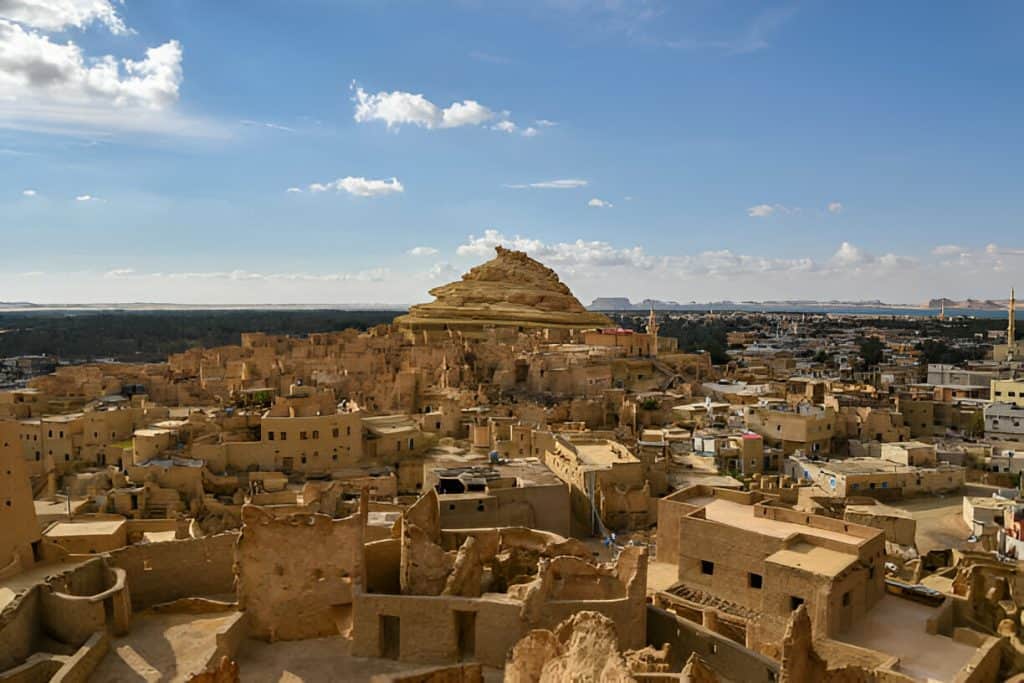
TheSiwa oasis (Siwa Oasis) is the most isolated and cultural of the Egyptian oases. Located 820 km northwest of Cairo, just 50 km from the Libyan border, Siwa is populated by the Siwi Berber minority who still speak Siwi (Berber language) rather than Arabic. The 80 km² oasis has 33,000 inhabitants, 300,000 date palms and 70,000 olive trees. It was here that Alexander the Great consulted in 331 BC. the Oracle of Amon in temple of the Oracle (Aghurmi) to be confirmed that he was indeed the son of Zeus-Amon.
In Siwa Egypt, the major sites not to be missed: the Shali citadel (kershef fortress, mixture of salt and clay, 13th century, partially collapsed in 1926 after 3 days of rare rain), the thermal springs (Cleopatra Spring with its ancient swimming pool, Fatnas Island for sunset), the Siwa salt lake with its highly saturated turquoise waters (Dead Sea type buoyancy), the temple of the Oracle of Amon, the Umm Ubayda temple and the Gebel el-Mawta (Mountain of the Dead) with its painted tombs. Recommended duration: 3 to 4 days on site.
Access to Siwa: asphalt road from Marsa Matrouh (300 km, 3h30) or from Cairo via Marsa Matrouh (820 km, 10-11h with breaks). No air connection. Upper Egypt bus from Cairo or Alexandria (150 EGP, 10 hours, uncomfortable). Recommended option: EgyptAir Cairo-Marsa Matrouh flight (45 min) + private Siwa transfer (3h30, 90-120 EUR). Where to sleep in Siwa: Adrere Amellal (luxury eco-lodge without electricity, 450-650 EUR per night), Taziry Ecolodge (180-250 EUR), Siwa Shali Resort (80-120 EUR), Albabenshal Lodge (in the historic citadel, 120-180 EUR).
Beyond Bahariya and Siwa, three other less visited oases make up the Great Western Desert Egyptian. Farafra is the smallest (5,000 inhabitants), located 170 km south of Bahariya, known for its traditional mud-brick village and Badr's Museum (works by local artist Badr Abdel Moghny). It is also the departure base for the southern sector of the White Desert and the entry into the Great Sea of Sand (Great Sand Sea), immense expanse of dunes which runs 650 km to the Libyan border.
Theoasis of Dakhla (Al-Wahat al-Dakhla) is 350 km south of Farafra. Its landscapes alternate between pink dunes, red cliffs and cultivated fields. Sites to visit: Al-Qasr (medieval Islamic village), Bashendi (Roman tombs), Deir el-Hagar (Roman temple), Bir el-Gebel (natural source). Dakhla is the most rural and preserved center of the Western Desert, recommended for travelers looking for village life and slow travel.
TheKharga oasis (Al-Wahat al-Kharga) is the southernmost, 200 km southeast of Dakhla, capital of the governorate. It is less picturesque than Dakhla but contains exceptional Roman and Coptic sites: the Hibis temple (Persian dynasty 27, the best preserved of its time), the Bagawat necropolis (4th-6th century, more than 200 painted Christian chapels), and the Dush Fortress. Access: EgyptAir Cairo-Kharga flight (2 to 3 flights per week) or 8-9 hours drive via Assiout. A complete Bahariya-Farafra-Dakhla-Kharga tour takes 7 to 8 days in 4x4 with Bedouin driver, a format reserved for adventurous travelers.
The Sinai desert is a triangular peninsula of 61,000 km² between the Red Sea and the Mediterranean, geographically in Asia but politically Egyptian. It forms a desert distinct from the Western Desert, more mountainous, more vegetated in its valleys, and culturally different (majority Bedouin population Jebeliya and Tarabin). Two major areas for tourism: the South Sinai (Mount Sinai, Saint Catherine, Dahab, Nuweiba, Sharm) and the North Sinai (access restricted for security reasons since 2013).
The Mount Sinai (Jebel Musa, 2,285 m) is the place where Moses received the Ten Commandments according to Judeo-Christian tradition. The night ascent (departure at 2 a.m., 3 hours of walking or camel riding to the summit, 750 final steps called "Steps of Repentance") allows you to watch the sunrise from the summit. Iconic experience, around 300 pilgrims and tourists per night. The Saint-Catherine monastery at its foot (6th century, Greek Orthodox, UNESCO) is home to the oldest active library in the world and the Burning Bush. Monastery entry: free but reduced hours (9 a.m.-12 p.m. except Friday, Sunday and Orthodox holidays).
In Sinai, Bedouin safaris in the wadis (dry valleys) are offered from Dahab or Nuweiba: Colored Canyon (canyon with striated walls), Blue Hole (diving lagoon + desert), White Canyon, Ain Khudra oasis. 1-3 day format with bivouac and Bedouin meals. Budget 60-150 EUR per day. Our agency recommends the combined 2 days Mount Sinai + monastery + 1 night bivouac in a wadi for a complete approach to the Sinai desert.
The Fayoum is the desert depression closest to Cairo (100 km, 2 hours drive), often described as an oasis although technically a basin fed by the Nile via the Bahr Youssef. It measures 12,000 km² and is home to the Lake Qaroun (salt, 240 km², one of the oldest natural lakes in the world). Fayoum is ideal for a desert day trip from Cairo if you are short on time for Bahariya or Siwa.
Wadi al-Hitan (Valley of the Whales), in the Fayoum desert 150 km from Cairo, has been classified as UNESCO since 2005. This unique paleontological site preserves more than 400 fossil skeletons of prehistoric whales (Basilosaurus, Dorudon) dating back 40 to 50 million years, when the region was a shallow tropical sea. The open-air museum with wooden walkways allows a 2-hour visit. Entry 200 EGP in 2026. Combinable with Wadi al-Rayan (lake and waterfalls), the Magic Lake Desert and the Sandboarding dunes. Ideal format: 1 day excursion from Cairo, 7 a.m.-8 p.m., 90-130 EUR per person privately.
Fayoum is also home to the village of Tunis (colony of artists and potters), the Kom Aushim Museum (Greco-Roman Karanis) and the pyramid of Meidum at the edge. Our agency recommends Fayoum as introduction to the Egyptian desert for travelers with only 1 free day from Cairo.
Fayoum + Wadi al-Hitan desert excursion from Cairo: full day 7 a.m.-8 p.m. with English-speaking driver, Bedouin lunch, UNESCO site entry. From 110 EUR per person. WhatsApp quote 24h.
A 4x4 safari Egypt in the desert requires an equipped vehicle (Toyota Land Cruiser or Hilux double cabin), an experienced Bedouin driver-guide, and in the majority of parks a military authorization issued on ID with 48 to 72 hours notice. In sensitive areas (Great Sand Sea towards Libya, South Sinai, Kharga-Dakh oasis on the Sudanese border) a convoy of at least two vehicles is required by the police. No “free” 4x4 rental for foreigners in these areas. All tours must pass through a local agency or registered Bedouin operator.
Recommended equipment for a desert safari: warm sleeping bag (night temperatures 0 to 10°C in winter, sudden drop after sunset), headlamp, cotton clothing (even at 40°C during the day, Bedouins are covered against the sun), closed walking shoes (scorpions), sunglasses + wide-brimmed cap, factor 50 sunscreen, 3 to 4 liters of water per day and per person, personal medication. Our agency provides tents, sleeping bags, mattresses, Bedouin blankets, meals 3 times a day and a wood fire in the evening.
A desert bivouac Typical includes: camp setup at the end of the afternoon, mint tea, sunset over the formations, dinner over a wood fire (chicken, rice, baladi bread, soup, tagine), night under the stars or tent, breakfast at sunrise before leaving. The best camps have dry sanitary facilities without a shower (the shower returns to the hotel the next day). Some luxury lodges (Adrère Amellal in Siwa, Desert Lodge in Dakhla) offer high-end comfort but at a price 3 to 5 times higher.
The ideal duration of your Egyptian desert stay depends entirely on the targeted regions. Here are the typical formats recommended depending on your available time:
The question "how many days in the desert" does not have a single answer: a busy traveler will prefer 2 days White Desert, a passionate traveler will take 10 days to see everything. We calibrate according to your availability and interests (archaeology, photography, spirituality, pure adventure).
The best desert period Egyptian extends from mid-October to mid-April with a peak of excellence between November and February. Daytime temperatures then drop between 18 and 28°C (total comfort for walking, driving, exploring) and nights fluctuate between 2 and 12°C (warm sleeping bag obligatory at the bivouac). Visibility is maximum, the dry and clear air allows you to see the stars perfectly. This is also the period when sandstorms (khamsin) are rare.
Period to absolutely avoid : from May to September. Daytime temperatures regularly reach 45-48°C in the Western Desert (record 52°C south of Dakhla in 2010) and make any activity dangerous from 10 a.m. Tent bivouacs are impractical (40°C at night). The period of khamsin (March-May) brings sandstorms that reduce visibility to 100 meters and close desert roads for 1 to 3 days. Only Sinai at altitude (Mount Sinai 2,285 m) remains tolerable in summer with nights at 15-18°C.
Our 2026 recommendation : leave between November 15 and February 28 for optimal conditions. December and January offer the best photographic quality (level light). Avoid Christmas week and New Year if you want a quiet White Desert bivouac (all Bedouin operators are fully booked, prices marked 25-40%). The February-early March period still offers excellent weather conditions with low season prices.
Egyptian desert accommodation is divided into four distinct categories depending on the level of comfort and desired isolation:
Our agency typically combines 2 nights bivouac (White Desert + Bahariya) + 2 nights eco-lodge (Siwa) + 1 night return to Cairo in the 5-night format. This alternation avoids the fatigue of continuous camping while maintaining desert authenticity.
The budget desert Egypt depends on the comfort chosen, the number of days and the number of travelers (the private 4x4 is the most expensive element, shared with 4 people it becomes economical). Here are the actual ranges for 2026, all inclusive (4x4 + driver + meals + bivouac + park entries):
Our standard package 4 days White Desert + Siwa in medium comfort starts at 650 EUR per person (based on 2 people) with Cairo-Marsa Matrouh domestic flight included. The same package in superior comfort starts at EUR 1,100 per person. These 2026 prices include ALL fees, with no hidden extras (park entrances, team tips, water, meals).
The Egyptian desert is generally safe in 2026 for open tourist areas, but several strict rules apply. First, no desert travel is possible without a registered Bedouin agency or operator : free rental of 4x4s is prohibited to foreigners in all protected areas. Then, some routes require a military convoy (armed police escort): the Great Sea of Sand towards Libya, the border areas of South Sinai and South Kharga towards Sudan. Deadline for obtaining the permit: 2 to 3 working days before departure.
Areas totally banned to foreigners in 2026 : North Sinai (Arish region, Rafah, Bir al-Abd) since 2013, northern Libyan border beyond Siwa, southern parts of the New Valley governorate. These restrictions are updated quarterly by the Ministry of Tourism. Our agency systematically checks authorizations before any quote and refuses requests that violate prohibited areas.
In terms of practical risks: no criminal insecurity in the oases and tourist parks (Bahariya, Farafra, White Desert, Siwa, Dakhla, Fayoum). The local Bedouins are hospitable and there have been no reported incidents against English-speaking tourists for 10+ years. Natural precautions: scorpions (closed shoes, shake the shoes in the morning), heat stroke (quantity of water), dehydration (impossible to walk more than 2 hours at midday). Single women: tolerated but not recommended outside organized agencies due to isolation and lack of telephone coverage in 80% of the Western Desert.
Our agency Sem Elegant Travel has been a specialist in the Egyptian desert for more than ten years. We work directly with the best Bedouin operators in Bahariya, Farafra, Siwa and Dakhla, without intermediaries. All of our driver guides are local Bedouins who grew up in the desert and speak fluent French or English. Our Egypt desert itineraries are 100% tailor-made, no industrial package: each quote is calibrated to your dates, your level of comfort, your budget, your composition (couple, family, group of friends) and your level of adventure.
Here are five typical formats that our English-speaking customers request the most (2026 price, average comfort, based on 2 people):
Each request is processed personally by a English-speaking advisor within 24 hours maximum. We check the required military authorizations, reserve 4x4s and camps, and organize airport transfers. Our Egypt packages hub details tours including a desert extension and our hub day trips presents Fayoum + Wadi al-Hitan options from Cairo.
In summary, this complete guide explains what to do in the egyptian desert over 1 to 10 days (White Desert, Siwa, Sinai, Fayoum, Wadi al-Hitan), how to organize a 4x4 safari and a Bedouin bivouac in complete safety, and how to combine the white desert egypt with the oases of the Great Western Desert. To prepare a Egypt desert trip coherent, our English-speaking agency assembles these tailor-made elements according to your schedule, your budget and your preferred level of comfort.
To start a Egyptian desert quote 2026 : send your travel period, your number of travelers, the regions that attract you (White Desert, Siwa, Sinai, Fayoum) and your preferred level of comfort. WhatsApp at +20 10 96569859. We always respond within 24 hours with three calibrated proposals.
Three final steps before your Egyptian desert trip: (1) choose your dates and your regions (White Desert alone, or combined Siwa / Sinai / Fayoum), (2) decide your level of comfort (bivouac vs eco-lodge), (3) write to us. Free WhatsApp quote within 24 hours. Direct English-speaking response, no call center, no intermediary.
Turnkey tours prepared by the SEV team, reservation on quote by WhatsApp - English-speaking advisor within 1 hour.
Bahariya, white desert, black desert, oasis: our package dedicated to the Egyptian Sahara.
Complete circuit with eastern desert stage on the Red Sea side.
The Giza plateau: first discovery in the desert before the open sea.
Short 4-day format, perfect as an extension before a desert outing.
Long weekend in Cairo before or after a desert expedition.
Minimum 2 days for White Desert + Bahariya from Cairo (most popular format). 4 to 5 days ideal to add Siwa or Mount Sinai. 7 to 10 days for a complete Western Desert Grand Tour including Farafra, Dakhla and Kharga. For a unique day trip, Fayoum + Wadi al-Hitan is the only realistic option from Cairo.
Between mid-October and mid-April for optimal comfort. The ideal period is November to February with daytime temperatures 18-28°C and nights 2-12°C. Absolutely avoid May to September (45-48°C daytime, bivouac impractical). The khamsin season (March-May) brings sandstorms to be avoided for long trips.
The White Desert is located in the Western Desert, between the Farafra oasis to the south and the Bahariya oasis to the north, approximately 370 km southwest of Cairo. The national park covers 3,010 km² and includes two main sectors: White Desert New (north, mushroom formations) and White Desert Old (south, taller monoliths). Access by 4x4 from Bahariya in 2h30 of track.
Two options: direct route Cairo-Marsa Matrouh-Siwa (820 km, 10-11 hours with breaks) by private car or Upper Egypt bus. Recommended option: EgyptAir Cairo-Marsa Matrouh flight (45 min, 90-140 EUR) then private 4x4 transfer to Siwa (3h30, 90-120 EUR). No direct Cairo-Siwa flight exists. Our agency organizes the flight + return transfer combo from 280 EUR per person.
Yes, and it is the iconic Egyptian desert experience. The bivouac takes place in the national park, installation at sunset, padded tents on the ground, wood-fired meal, starry sky without light pollution. Budget: 80-150 EUR per person for 1 night all inclusive (4x4 from Bahariya + Bedouin guide + equipment + meals). Our agency works with three English-speaking Bedouin operators from Bahariya, all holders of official tourist authorization.
The White Desert is a plateau of wind-eroded chalk with white formations of mushrooms, chickens and sphinxes. The Black Desert is a 20 km² volcanic field with black basalt cones on an orange sand floor. They are only 50 km apart (Black Desert between Bahariya and Crystal Mountain, White Desert 20 km further south). Both are visited on the same day in a 4x4 safari from Bahariya.
It depends on the areas. The White Desert, Bahariya, Siwa, Fayoum and Wadi al-Hitan are accessible without a military permit but only via agency or registered Bedouin operator. The Great Sand Sea (Libya), South Sinai beyond St. Catherine and the southern Kharga-Sudan border require a military permit issued within 2-3 business days. North Sinai has been completely closed to foreigners since 2013. Our agency checks and obtains all the necessary permits.
Yes, from Sharm el-Sheikh, Dahab or Nuweiba on a 2 day/1 night tour. Departure in the afternoon, dinner at the monastery, night ascent of Mount Sinai (departure 2 a.m., 3 hours of walking or camel riding), sunrise at the summit, descent to the Sainte-Catherine monastery (6th century UNESCO), return at the end of the day. Budget 120-180 EUR per person all inclusive. Covering clothing required to enter the monastery (shoulders, knees, no shorts).
Wadi al-Hitan (Valley of the Whales) is a UNESCO paleontological site in the Fayoum Desert which preserves more than 400 fossil skeletons of prehistoric whales (Basilosaurus, Dorudon) dating back 40 to 50 million years. The region was then a shallow tropical sea. The open-air museum with walkways allows you to see the fossils in situ. It is the only site in the world where we can observe the evolution of whales from land mammals to marine cetaceans. 2 hours of visit, 200 EGP in 2026.
In average comfort (private 4x4, fixed camps, English-speaking guide), count on 600 to 1,000 EUR per person for 5 days all inclusive (except your flight to Egypt). In superior comfort (eco-lodges like Taziry or Desert Lodge), 1,250 to 2,000 EUR per person. These 2026 prices include 4x4, driver-guide, all meals, bivouacs, park entrances, domestic flight Cairo-Marsa Matrouh for Siwa. The main station is the private 4x4 (350-450 EUR per day), shared by 4 people.
Yes via an organized agency. Local Bedouin operators are hospitable and there have been no reported incidents against English-speaking tourists for 10+ years in open areas (Bahariya, White Desert, Siwa, Fayoum, Sainte-Catherine). For a single woman, we strongly recommend going through an agency and not independent due to isolation (80% of the Western Desert has no telephone coverage). Family with children: perfect from 8 years old, not recommended under 5 years old (bivouac, long 4x4 journeys, heat).
Covering cotton clothing (light pants, long-sleeved shirt) even at 40°C, wide-brimmed hat, sunglasses, closed walking shoes (scorpions), factor 50 sunscreen, cheche-type scarf for wind and sand. For winter bivouac: warm sleeping bag (0-5°C), thick fleece, hat. In traditional Nubian or Bedouin villages: covered shoulders and knees appreciated. For the Sainte-Catherine monastery: strict dress code (no shorts, no tank top).
Yes, mainly in Fayoum (Magic Lake and Wadi al-Rayan) and in the Great Sand Sea from Siwa. Boards provided by local operators. Activity accessible even to beginners, duration 1-2 hours, price 15-25 EUR per person. Sandboarding can be added as an option to any Fayoum or Siwa 3+ day package. It’s a family activity popular with children aged 10-18.
Through our agency directly. All our desert guides are local Bedouin graduates from the Egyptian Ministry of Tourism, licensed, fluent French or English speakers, specialists in their region (Bahariya, Siwa, Sinai, Fayoum). We strictly avoid unofficial drivers who offer "informal" safaris without military authorization. A English-speaking desert driver-guide costs 120 to 180 EUR per day per 4x4 group, included in our 2 to 10 day packages. This transparency is one of our differentiating commitments compared to anonymous online platforms.