
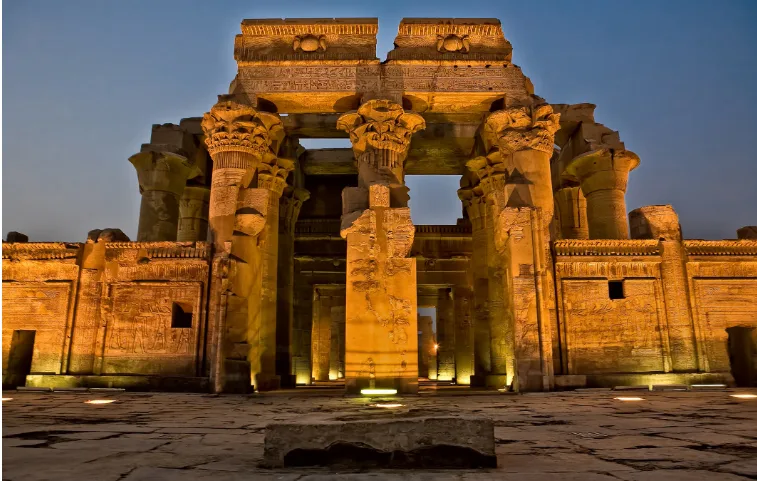
Kom Ombo Temple - perched on the east bank of the Nile 28 miles north of Aswan, this sanctuary is the only known double temple in ancient Egypt - half dedicated to Sobek, the crocodile god, half dedicated to Haroeris (Horus the Elder), the falcon god. Built during the Ptolemaic dynasty (180-47 BC), it is a mandatory stop between Edfu and Aswan on Nile cruises. Often rushed through in 45 minutes, it is nevertheless one of the most fascinating temples in Egypt - thanks in particular to its adjoining Crocodile Museum and the oldest pharmacopeia relief in the world.
From Aswan or Luxor, SEV arranges private excursions to Kom Ombo with an English-speaking guide, or builds the stop into our customized Nile cruise packages. Request your quote.
Request a Kom Ombo quote on WhatsApp →
Kom Ombo - Egypt's only double sanctuary
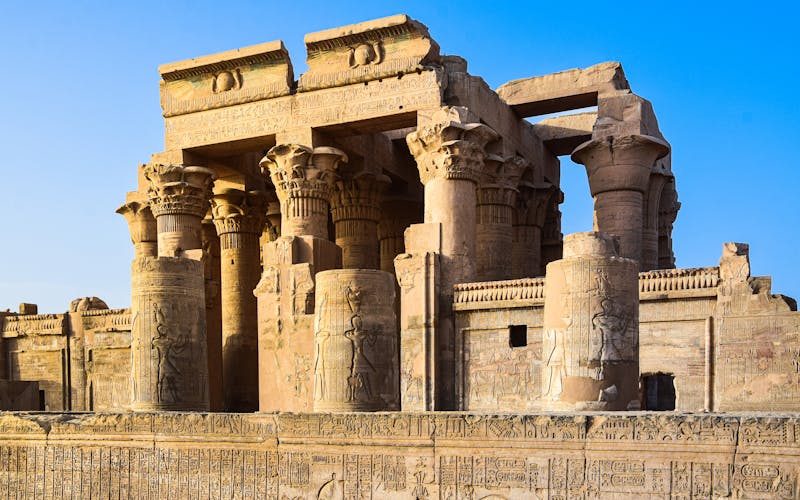
What makes Kom Ombo special is obvious the moment you approach the temple - the entrance pylon is doubled, the inner court is doubled, the sanctuary is doubled. Everything is replicated twice, in perfect mirror image about 40 feet apart. The south side (right as you enter) is consecrated to Sobek the crocodile, the north side (left) to Haroeris the falcon. No other temple in Egypt has this layout.
Why this duality? Three theories. The most likely - Kom Ombo sits on the historical boundary between the territory of the crocodile god Sobek (downstream, toward Edfu) and the territory of the falcon god Haroeris (upstream, toward Aswan). The Ptolemies, who funded the construction, wanted to unite the two cults within a single sanctuary to bind the region together and shore up their Hellenistic legitimacy over Upper Egypt.
History - the Ptolemies and the cult of the crocodile god
A sanctuary already existed on the site as far back as the Middle Kingdom (12th dynasty, 2000-1800 BC), but what is visible today dates essentially from the reigns of Ptolemy VI Philometor (180-145 BC) and Ptolemy XII Neos Dionysos (80-51 BC, father of Cleopatra VII). The Romans, under Augustus and Tiberius, completed the pronaos and certain exterior reliefs.
The cult of Sobek was especially well developed in the Kom Ombo region because the Nile makes a dangerous bend there - crocodiles were plentiful. Taming a sacred crocodile on behalf of the temple was seen as protection against attacks from the river. The priests kept a dozen living crocodiles in sacred pools (the lakes of Sobek), fed daily and mummified at death. It was at Kom Ombo that the largest collection of crocodile mummies in Egypt was found - now displayed in the adjoining museum.
The temple suffered over the centuries - an earthquake (1199), the annual Nile floods, and above all dismantling by the Coptic Christians (5th century) who turned it into a church. Fortunately, many Ptolemaic reliefs were carved deep enough to survive.
How to get to Kom Ombo in 2026
Kom Ombo lies 28 miles north of Aswan and 37 miles south of Edfu. There are three ways to get there, depending on your itinerary.
- On a Nile cruise (the easiest) - every 5-star ship stops at Kom Ombo between Luxor and Aswan, usually in the morning with a visit of 1.5 to 2 hours. Included in the cruise package.
- On an excursion from Aswan - private air-conditioned SEV vehicle, departure at 6 a.m., arriving at Kom Ombo at 7:30 a.m. Two hours of touring with an English-speaking guide. Return to Aswan by 11 a.m. or continue on to Edfu.
- Train + taxi (budget, not recommended) - Aswan-Daraw train (15 EGP, 30 minutes), then a Daraw-Kom Ombo taxi (50 EGP, 10 minutes). A slow, unreliable option for international travelers.
What you absolutely must see at Kom Ombo temple
The site is compact (820 feet by 330 feet) but dense. Here are the elements not to miss during your 1.5-hour visit.
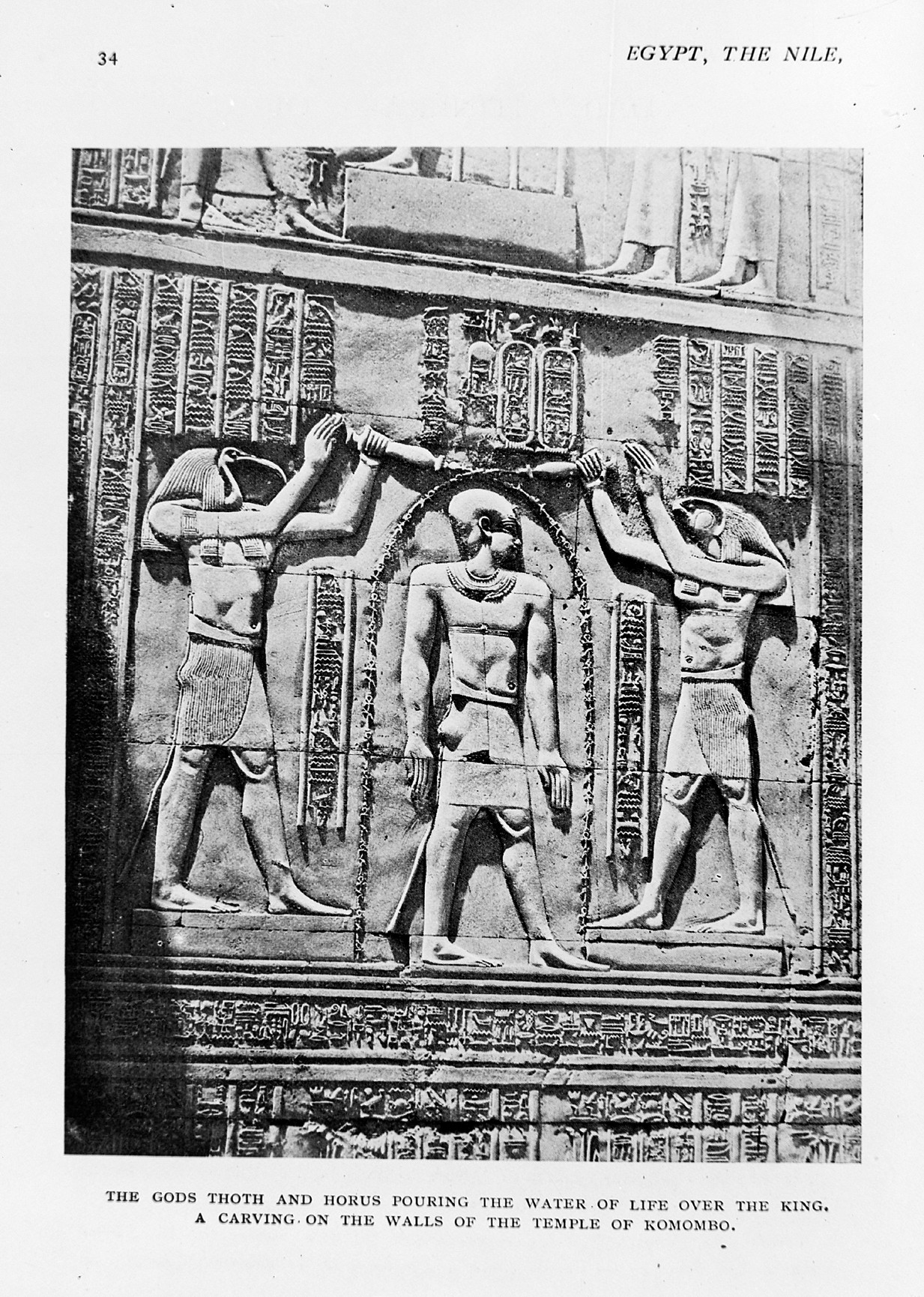
- The double pronaos (entrance) - ten papyriform columns with bell-shaped capitals. Beautiful scenes of ritual purification where Ptolemy VIII receives the lustral water from Thoth and Horus.
- The liturgical calendar (inner wall) - on the east side, a detailed calendar of the annual religious festivals with their offerings. It is one of the main sources on the cult of Sobek.
- The relief of surgical instruments (rear exterior wall) - see the dedicated section below.
- The deep nilometer (at the heart of the site) - a masonry well in which the annual Nile flood was measured. Depth of about 20 feet.
- The two inner sanctuaries - the walls are in ruins, but you can clearly make out the double plan. On the Sobek side (right), reliefs of the crocodile god with a human head. On the Haroeris side (left), Horus standing as a uraeus.
- The crypt of Sobek (to the right of the sanctuary) - a small underground space where the sacred mummies were kept.
The relief of surgical instruments - our favorite
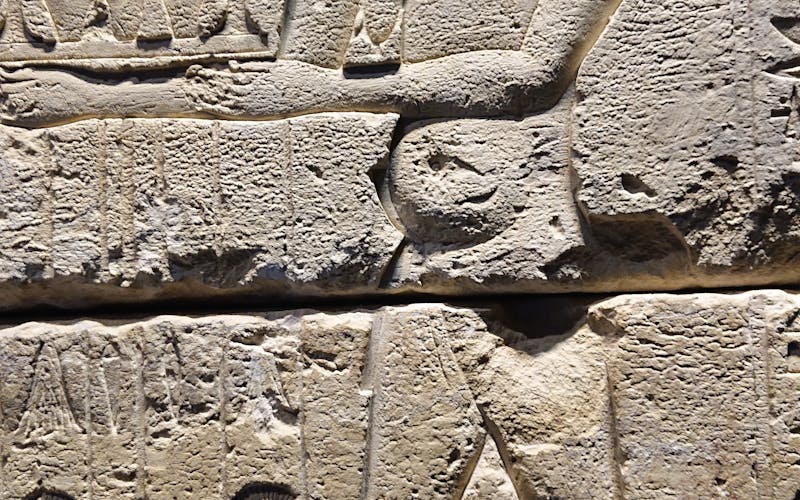
On the rear exterior wall of the temple (northeast side), a carved relief depicts some thirty medical and surgical instruments - scalpels, forceps, scissors, bone saws, cupping vessels, scales for weighing ingredients, mortars, and dishes. It is one of the oldest surviving records in the world of organized surgical practice and pharmacopeia, dated to the 2nd century BC.
For lovers of the history of science, this is the highlight of Kom Ombo. Most tour guides overlook it because you have to walk all the way around the temple to find it. With SEV, your English-speaking guide takes you straight to it - 10 minutes of historical explanation on ancient Egyptian medicine, the school of Alexandria, and the transmission of knowledge to Hippocrates.
The Crocodile Museum - the site's hidden gem
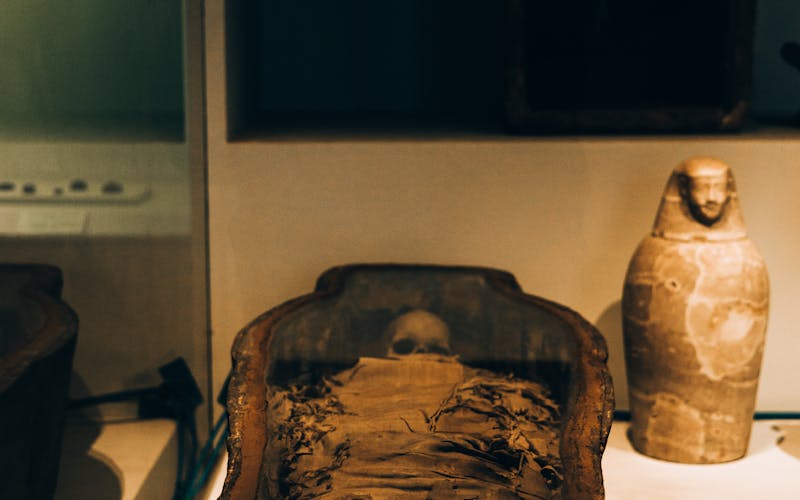
Opened in 2012, this small modern museum (3 air-conditioned rooms) adjoins the temple and displays around fifty crocodile mummies recovered from the sacred pools and the site's animal necropolis. Various sizes - from a 12-inch hatchling to a 16-foot adult. Well-lit cases, with trilingual panels (Arabic, English, French).
Also on display - votive jewelry in gold and bronze, statues of Sobek, liturgical papyri, and the extraordinary gilded mask of a crocodile mummy found intact with its linen shroud. The visit is included in the temple ticket (no surcharge). Allow 25-30 minutes.
Our tip - visit the museum BEFORE the temple to fully grasp the importance of the cult of Sobek. It completely changes how you read the reliefs of the main sanctuary.
Kom Ombo prices 2026 and ticketing
Opening hours 2026 - 7 a.m. to 5 p.m. (winter), 6 a.m. to 6 p.m. (summer). The site gets very hot in summer because the bank offers no shade - bring a hat, water and sunglasses. There is no restaurant inside the grounds, but a small souvenir bazaar and cold drinks at the exit.
Kom Ombo on a Nile cruise - the perfect stop
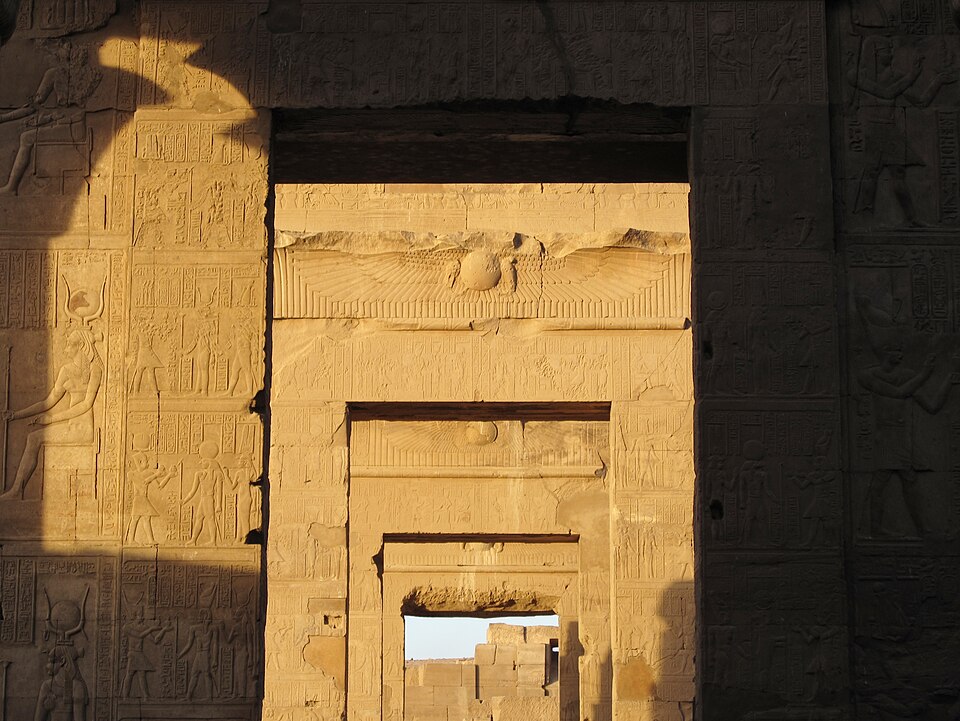
Kom Ombo was designed by nature to be visited by cruise - the temple sits directly on the bank of the Nile, about 65 feet from the water. The 5-star ships moor at the quay right in front of the pylon, and you walk to the site in 3 minutes. No road transfer is needed.
Here is the typical sequence of a Kom Ombo stop on a 5-star Luxor-Aswan cruise, on a morning schedule:
- 6:00 a.m. - The ship arrives at Kom Ombo. The quay is 65 feet from the temple.
- 6:30 a.m. - Breakfast on board with a view of the pylon bathed in the rising sun.
- 7:30 a.m. - Disembark and tour (1.5 hours with the onboard English-speaking Egyptologist).
- 9:00 a.m. - Reboarding and departure toward Aswan (3 hours of sailing).
- 12:30 p.m. - Arrival in Aswan and lunch on board with a view of the pink granite obelisks.
For the international traveler, this is the best option. The 4-night Luxor-Aswan cruise always includes Kom Ombo + Edfu + Valley of the Kings + Karnak + Philae. SEV offers 5-star cruise packages with a private English-speaking guide on board - including domestic flights between Egypt's destinations, transfers, cruise, tours, and tips. Request your personalized quote on WhatsApp.
Get a custom Nile cruise quote →
FAQ - Frequently asked questions about Kom Ombo temple
How much does it cost to visit Kom Ombo temple in 2026?
The foreign adult ticket costs 360 EGP (about $8) in 2026 and includes access to BOTH the temple AND the adjoining Crocodile Museum. ISIC students and children aged 6-12 pay half price (180 EGP). The ticket is payable only in cash EGP at the entrance booth.
Why is Kom Ombo a double temple?
Kom Ombo is unique in Egypt because two cults coexist within a single building along parallel axes - the south side (right) dedicated to Sobek the crocodile, the north side (left) dedicated to Haroeris (Horus the Elder) the falcon. The region historically marks the boundary between the two local cults, and the Ptolemies who built the temple wanted to unite the communities under a single sanctuary.
How long do you need to visit Kom Ombo?
Allow 1.5 hours minimum on site - 1 hour for the temple, 30 minutes for the Crocodile Museum. With an English-speaking guide who explains the reliefs, plan on 2 hours. If you arrive by cruise, the program is generally set at 1.5 hours with a quick return to the ship.
Is the Crocodile Museum worth it?
Yes, absolutely. Opened in 2012, the Crocodile Museum displays around fifty crocodile mummies recovered on the site, along with votive jewelry, statues of Sobek and liturgical papyri. The visit is included in the temple ticket; allow 25-30 minutes. Our tip - visit the museum BEFORE the temple to better understand the reliefs.
Can you visit Kom Ombo without a cruise?
Yes. From Aswan, allow 45 minutes by private car (28 miles north). SEV arranges morning excursions from your Aswan hotel with an air-conditioned vehicle, an English-speaking guide and 2 hours on site - typically combined with Edfu (37 miles farther north) for a full day. Starting from $80 per person for a group of four.
When is the best time to visit Kom Ombo?
Early in the morning at opening (6-8 a.m. in summer, 7-9 a.m. in winter). The site sits on a bank with no shade, and the heat rises quickly after 10 a.m. The sunset over the temple (5-6 p.m. depending on the season) is also magnificent - ochre reliefs, a shimmering Nile, and total calm once the cruise ships have left.
Is there an audio guide at Kom Ombo?
No, there is no official audio guide. There are a few explanatory panels in English and Arabic. To really understand the double sanctuary and the medical relief, an English-speaking guide is highly recommended. SEV includes a private English-speaking Egyptologist in its Kom Ombo excursion packages.
Can you combine Kom Ombo and Edfu in one day?
Yes, and it is the classic combo for day trips from Aswan. Depart Aswan at 6 a.m., tour Kom Ombo 7:30-9:30 a.m., drive to Edfu 9:30-10:45 a.m., tour the Temple of Horus at Edfu 10:45 a.m.-12:45 p.m., lunch in Edfu, return to Aswan 3-4:30 p.m. SEV's rate for two people on a private tour - starting from $190 per person (transfers + entries + lunch + English-speaking guide).
Is the temple wheelchair accessible?
Partially. The quay-to-temple path is flat, and the entrance through the pylon is accessible. The inner court and the pronaos are passable with assistance. The inner sanctuaries have a few steps. The Crocodile Museum is accessible (with an access ramp). SEV can arrange a visit with dedicated assistance - let us know when you make your request.
What flights are there from Cairo to Aswan in 2026?
EgyptAir and Air Cairo operate 4-6 daily flights between Cairo (CAI) and Aswan (ASW). Flight time is 1 hour 25 minutes. The 2026 fare is $95-160 one way depending on the season. To combine Kom Ombo + Aswan + Philae over 3 days, a 4-night Luxor-Aswan Nile cruise is generally the simplest and most economical solution.