
More than two thirds of Egypt is covered by the Western Desert. Beginning on the west bank of the Nile, the desert extends west to Libya and south to Sudan, part of the immense expanse of the Sahara Desert that stretches across North Africa to the Atlantic Ocean.
A trip to the Egyptian desert in 2026 opens up five sub-regions that between them cover two thirds of the country: Farafra's White Desert, the Siwa oasis together with Bahariya, the Sinai desert around Mount Sinai and Sainte-Catherine, the Great Western Desert with Kharga, Dakhla and Farafra, and the valley of whales, Wadi al-Hitan, close to Fayoum. In this guide you will find every region described, along with 4x4 safaris, Bedouin camps, when to go, a 2026 budget and the practical logistics that make a desert holiday work.
For well over a decade our English-speaking team has specialised in Egypt's deserts. We know which Bedouin 4x4 drivers to trust, which camps deep in the White Desert are worth the night, where Siwa hides its hot springs, and which zones need a military permit. Everything we have learned is set out here so you can plan your desert stay with confidence.
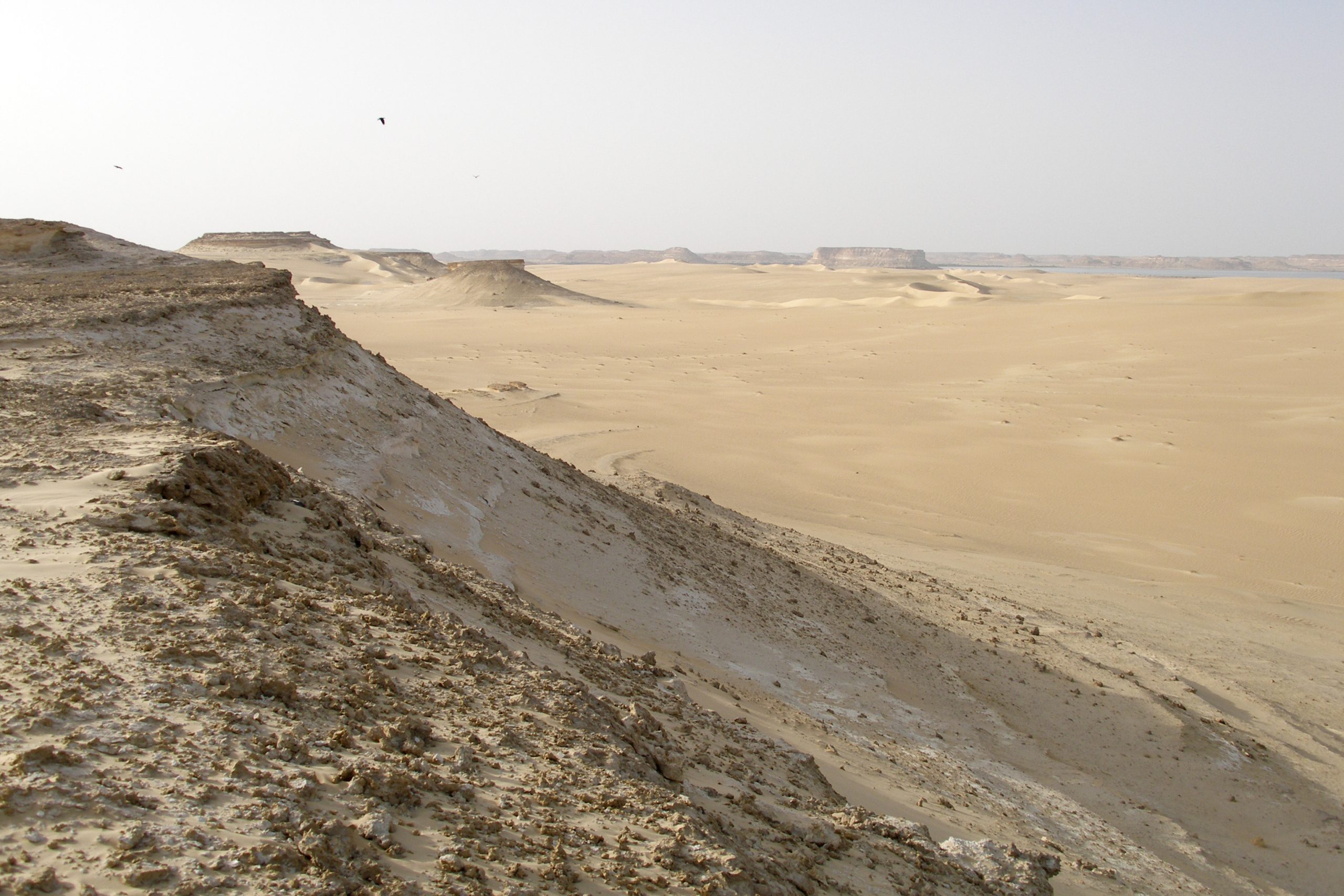
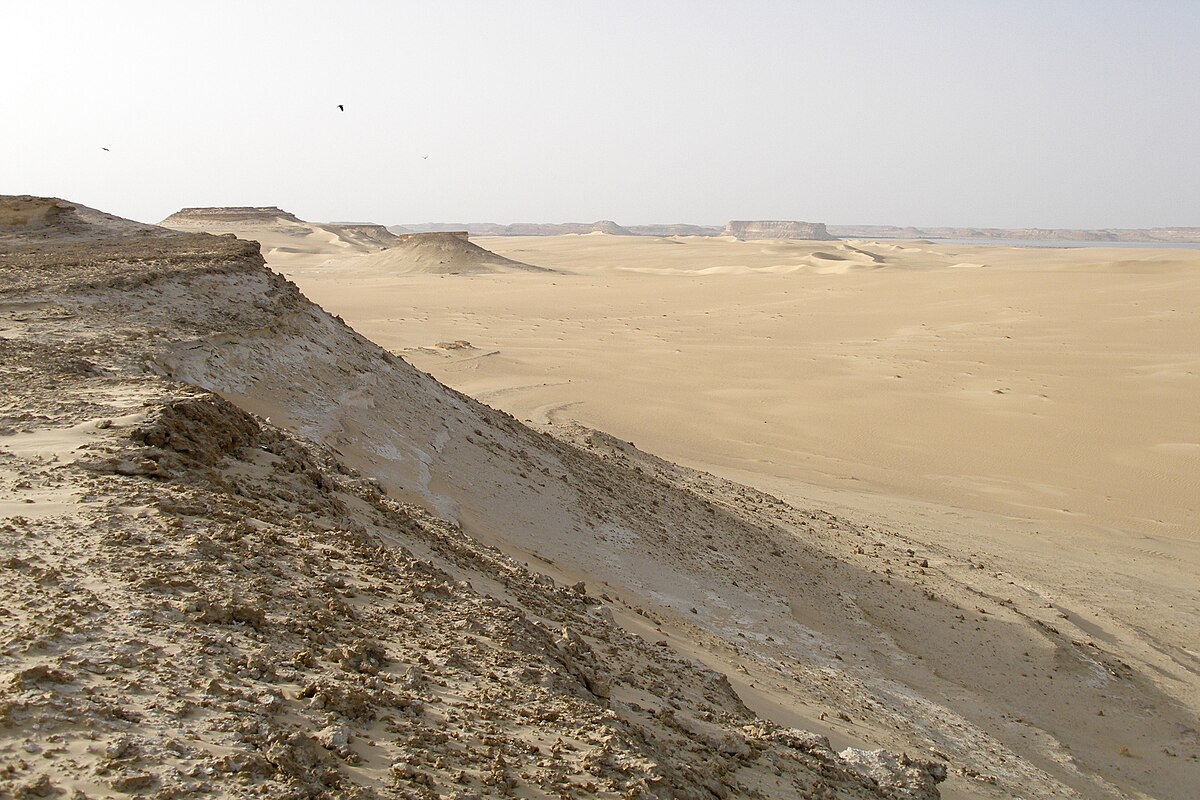
At more than 960,000 km², the Egyptian desert makes up 94% of the country's land, an area larger than mainland France. Before settling on a route, a British traveller should know its five separate sub-regions:
No two of these regions look or feel alike. In the White Desert the draw is the wind-carved chalk formations, which make you feel you have landed somewhere off the map. Siwa wins visitors over with its cultural isolation (the locals speak Siwi, a Berber tongue) and its age-old bathing springs. Sinai is the pilgrim's desert, climbed for dawn on Mount Sinai. Fayoum is the quick desert fix, reachable from Cairo without being away for more than two days. We stitch these regions into itineraries that match what interests you.
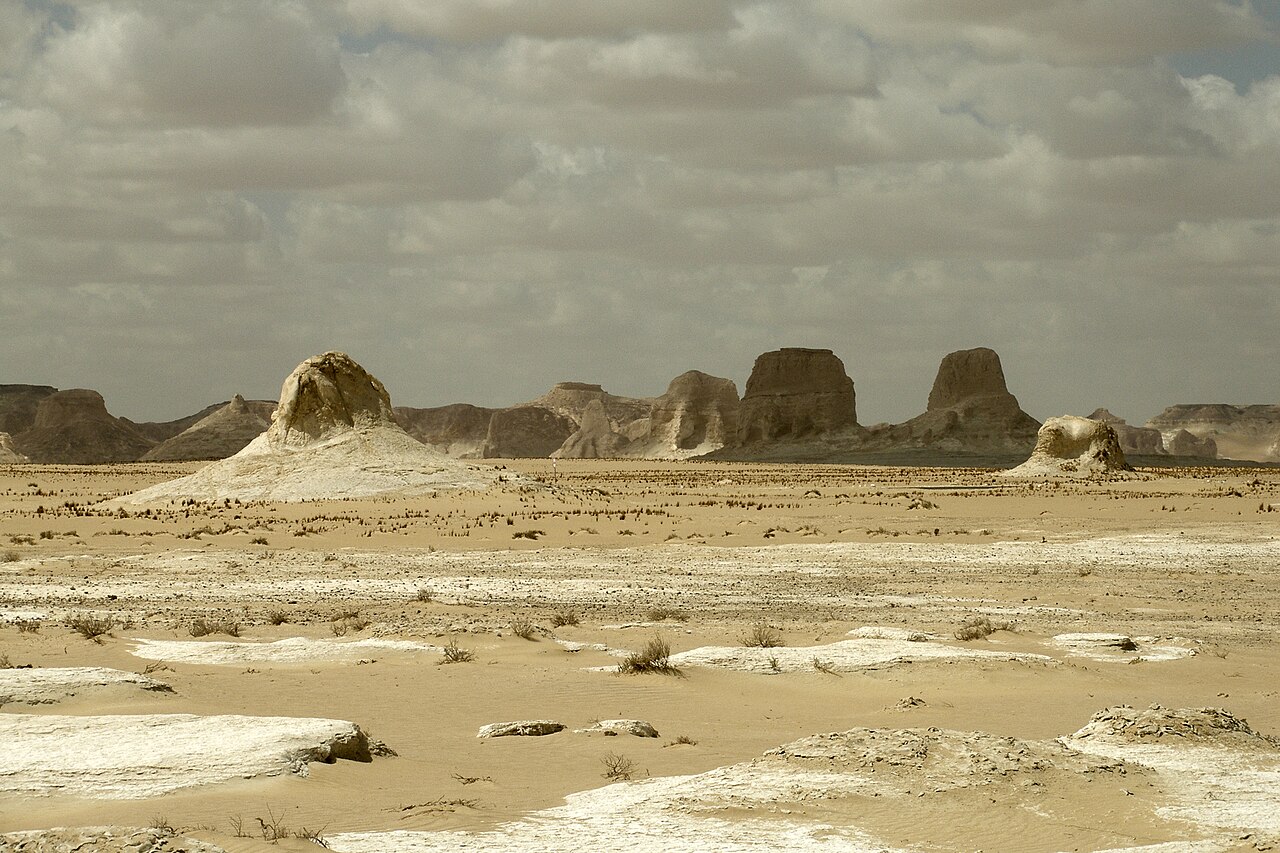
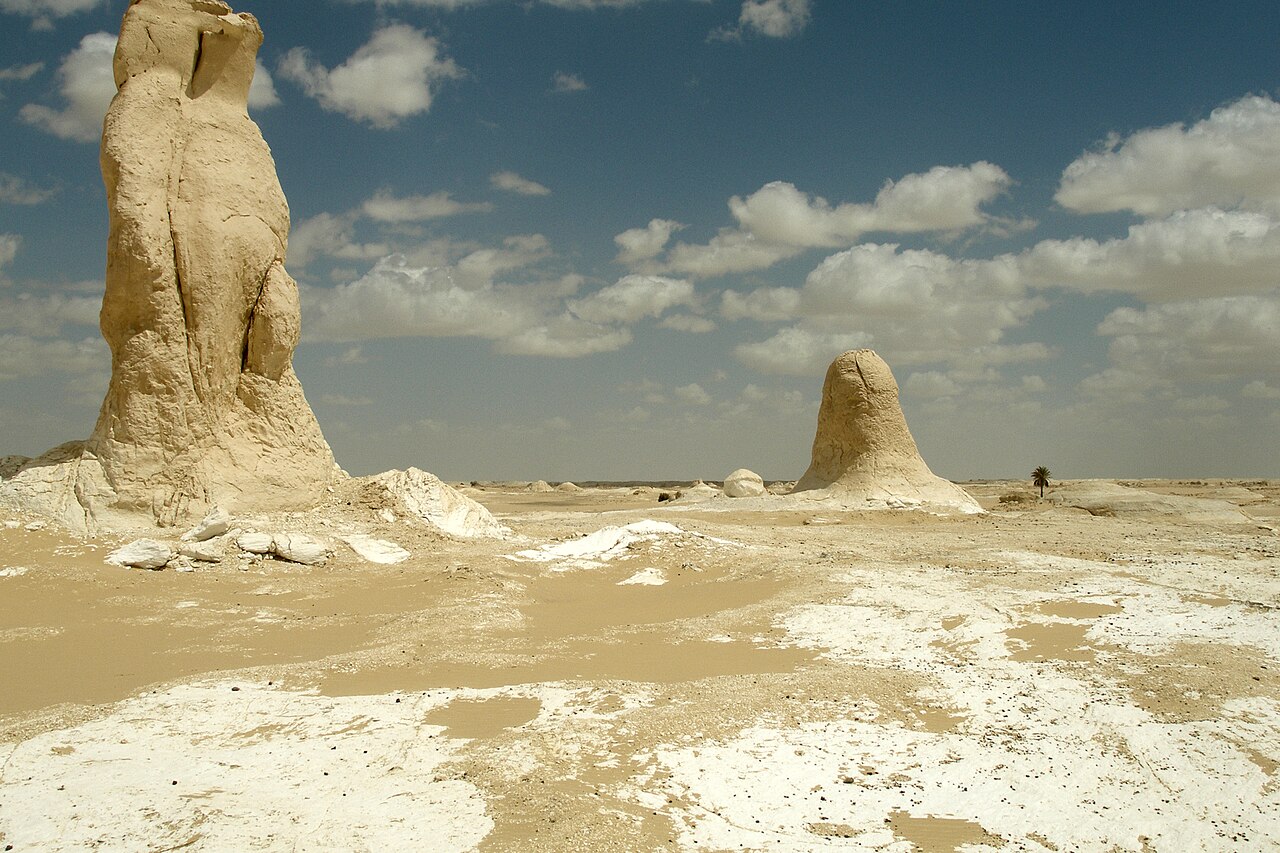
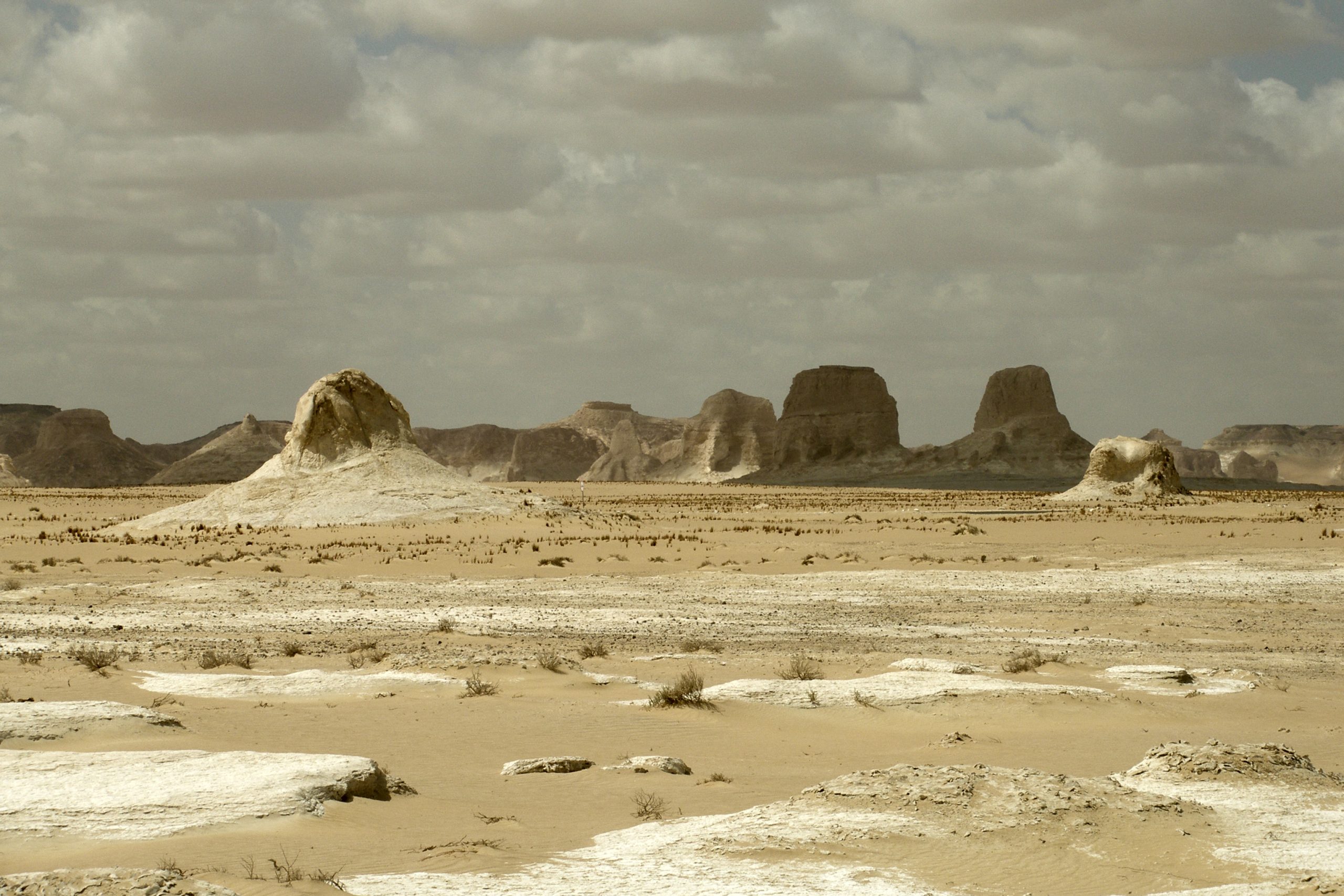
Known in Arabic as Sahara el-Beyda, the White Desert Egypt is the showpiece of the country's deserts and the reason so many British visitors put up with 370 kilometres of track out of Cairo. It sits in the Western Desert between the oases of Farafra and Bahariya, a chalk plateau scoured by wind into strange white shapes, mushrooms, chickens, sphinxes and tents, standing on orange sand.
Created in 2002, the White Desert National Park (Bahariya-Farafra) spans 3,010 km². The formations that fill most camera rolls sit in the White Desert New sector to the north, where the celebrated limestone “mushrooms” and “chickens” stand. Further south, the White Desert Old sector has monoliths that are both taller and wilder. Nothing beats a night in bivouac Bedouin-style: a traditional camp, supper by the fire, a sky free of light pollution (as many as 3,000 stars can be seen) and a pink dawn breaking over the white rocks.
Getting there: a 4x4 is compulsory from Bahariya (2h30 on track) and a two-vehicle convoy is advised. Park entry costs 100 EGP in 2026. A one-night organised bivouac runs £60 to £120 per person, covering 4x4, meals, tents and sleeping bags. We work with three English-speaking Bedouin operators in Bahariya, each holding an official tourism authorisation.
Between Bahariya and the White Desert, three geological sites justify a stop every time. Some 20 km south of Bahariya lies the Black Desert (Sahara el-Aswad), a volcanic field of roughly 20 km² in which cones of black basalt rise out of orange sand. Its main summits (Gebel el-Marsous and Gebel el-Ingliz) give a 360° view over the Western Desert. Allow a short 20 minute climb, ideally at sunset.
Another 50 km south of the Black Desert stands Crystal Mountain (Gebel el-Izaz), a low hill of clear crystallised quartz created millions of years ago by hydrothermal activity. You can walk through the formation via a natural arch. The site is protected and taking samples is forbidden. A quarter of an hour (15 minutes) is plenty, though it remains one of the desert's signature photo stops.
Right before the White Desert entrance comes the Agabat Valley (Wadi Agabat), a golden sand hollow studded with enormous chalk outcrops that look like waves stopped mid-break. Several documentaries and many of the best-known photographs of Egypt's desert were shot here. All three stops are built into our 2 day/1 night Bahariya-White Desert safari as standard.
Fancy a 2-day White Desert safari starting in Cairo? We arrange the 4x4 there and back, a night in camp with an English-speaking Bedouin guide, every meal and the park fee. The 2-day package starts at £220 per person. Quote by WhatsApp in 24h.

Every White Desert trip from Cairo passes through the Bahariya oasis (Al-Wahat al-Bahariya). It lies 370 km southwest of the capital, 4.5 hours on a tarmac road that is largely in good repair, and the 2,000 km² depression supports 30,000 people around the main village of Bawiti. This is where safaris refuel, rest and set off by 4x4 for the White Desert, the Black Desert and Crystal Mountain.
Bahariya has three historic sights of its own: the Valley of the Golden Mummies (found in 1996, over 250 gilded Greco-Roman mummies, with a small local museum), the Greco-Roman tombs (26th Dynasty), and the temple of Alexander the Great at Aïn el-Muftella. At the hot springs of Bir el-Ghaba (Bir Matar, Bir Ramla) you can bathe at 38°C under the palms. A combined ticket for museum, tombs and temple costs 240 EGP in 2026.
Places to stay in Bahariya: Desert Safari Home (a Bedouin camp, £30-£50), Bahariya Palace Hotel (decent, £40-£50) and Oasis Panorama (views over the oasis, £60-£80). We usually suggest a 3-day Bahariya + White Desert + Crystal Mountain combination so you see the whole area at a sensible pace.
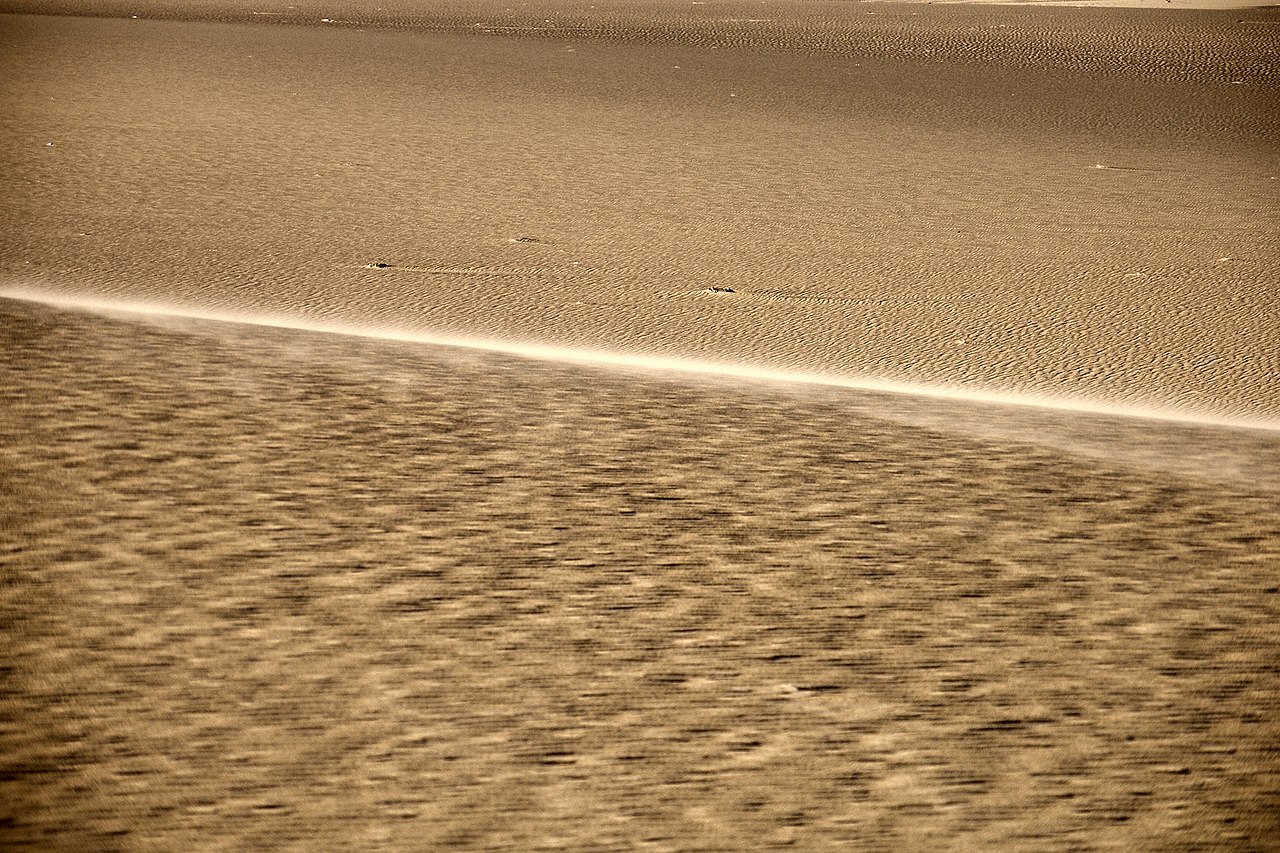
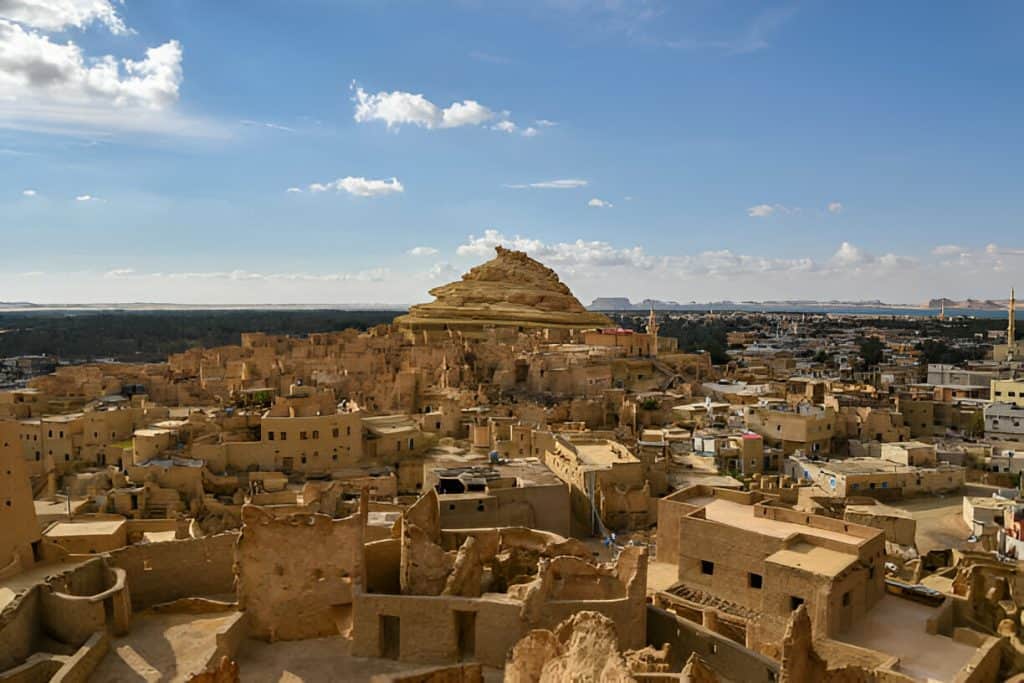
Of all Egypt's oases, the Siwa oasis (Siwa Oasis) is the most remote and the richest in culture. It sits 820 km northwest of Cairo and a mere 50 km from Libya, and its people, the Siwi Berber minority, still use Siwi (a Berber language) rather than Arabic. Across 80 km² live 33,000 residents, 300,000 date palms and 70,000 olive trees. In 331 BC Alexander the Great came here to question the Oracle of Amon at the temple of the Oracle (Aghurmi) and hear it confirmed that he was the son of Zeus-Amon.
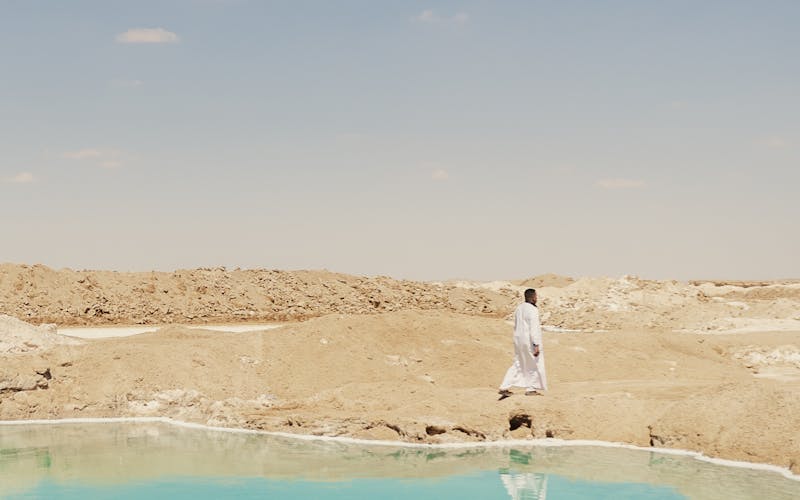
The essential sights of Siwa Egypt: the Shali citadel (a kershef fortress of salt and clay from the 13th century, part of which collapsed in 1926 after 3 days of unusual rain), the thermal springs (Cleopatra Spring and its ancient pool, Fatnas Island at sundown), the Siwa salt lake, whose turquoise water is so saturated you float as in the Dead Sea, the temple of the Oracle of Amon, the Umm Ubayda temple and the painted tombs of Gebel el-Mawta (Mountain of the Dead). Plan on 3 to 4 days here.
Reaching Siwa: by tarmac road from Marsa Matrouh (300 km, 3h30) or all the way from Cairo through Marsa Matrouh (820 km, 10-11h including stops). There is no flight into Siwa. The Upper Egypt bus from Cairo or Alexandria costs 150 EGP, takes 10 hours and is far from comfortable. Our preferred route: the 45 min EgyptAir hop Cairo-Marsa Matrouh followed by a private transfer to Siwa (3h30, £70-£90). Stay at Adrere Amellal (a luxury eco-lodge with no electricity, £350-£500 a night), Taziry Ecolodge (£140-£190), Siwa Shali Resort (£60-£90) or Albabenshal Lodge (inside the old citadel, £90-£140).
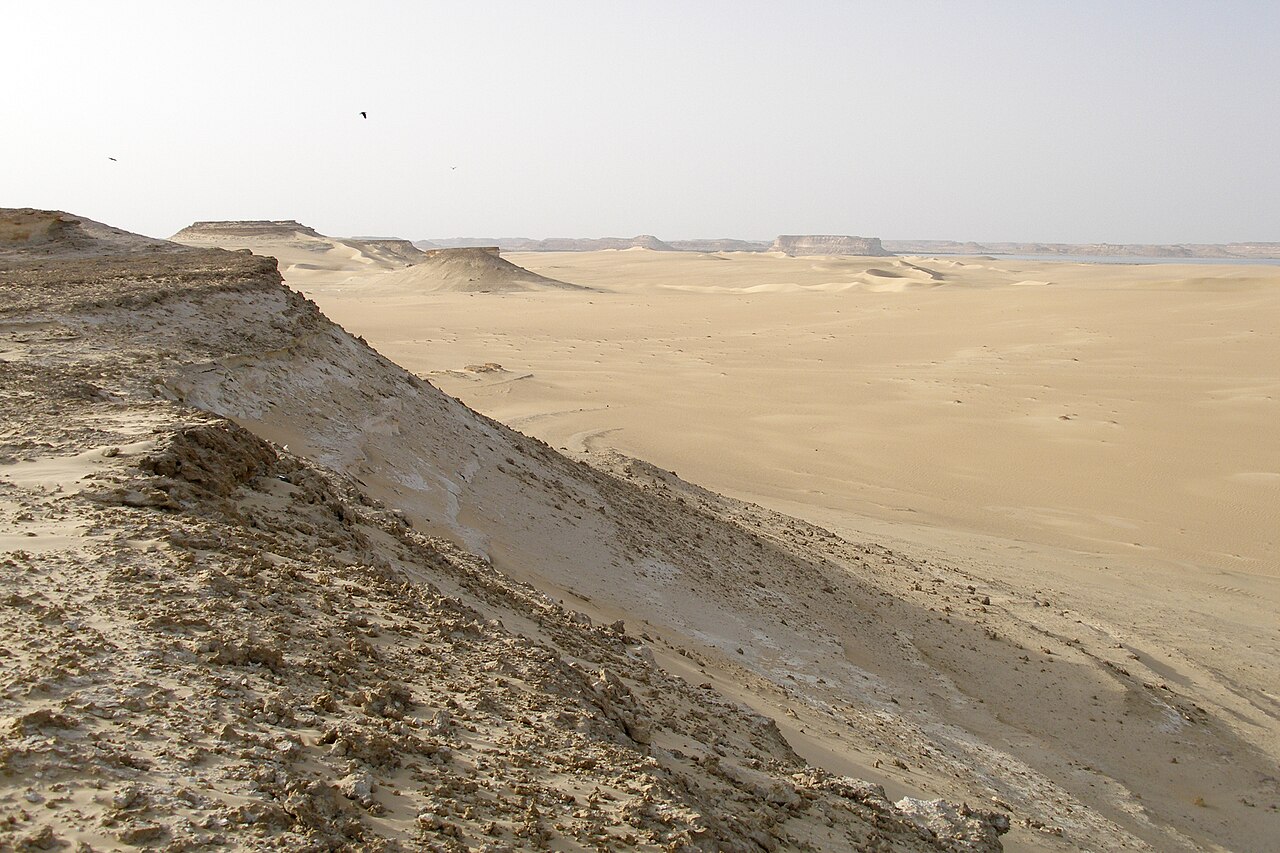
Past Bahariya and Siwa, the Egyptian Great Western Desert holds three further oases that few visitors reach. Farafra, the smallest with 5,000 residents, lies 170 km south of Bahariya and is known for its old mud-brick village and for Badr's Museum, filled with the work of local artist Badr Abdel Moghny. It also serves as the jumping-off point for the southern White Desert and for the Great Sea of Sand (Great Sand Sea), a colossal dune field stretching 650 km to the Libyan border.
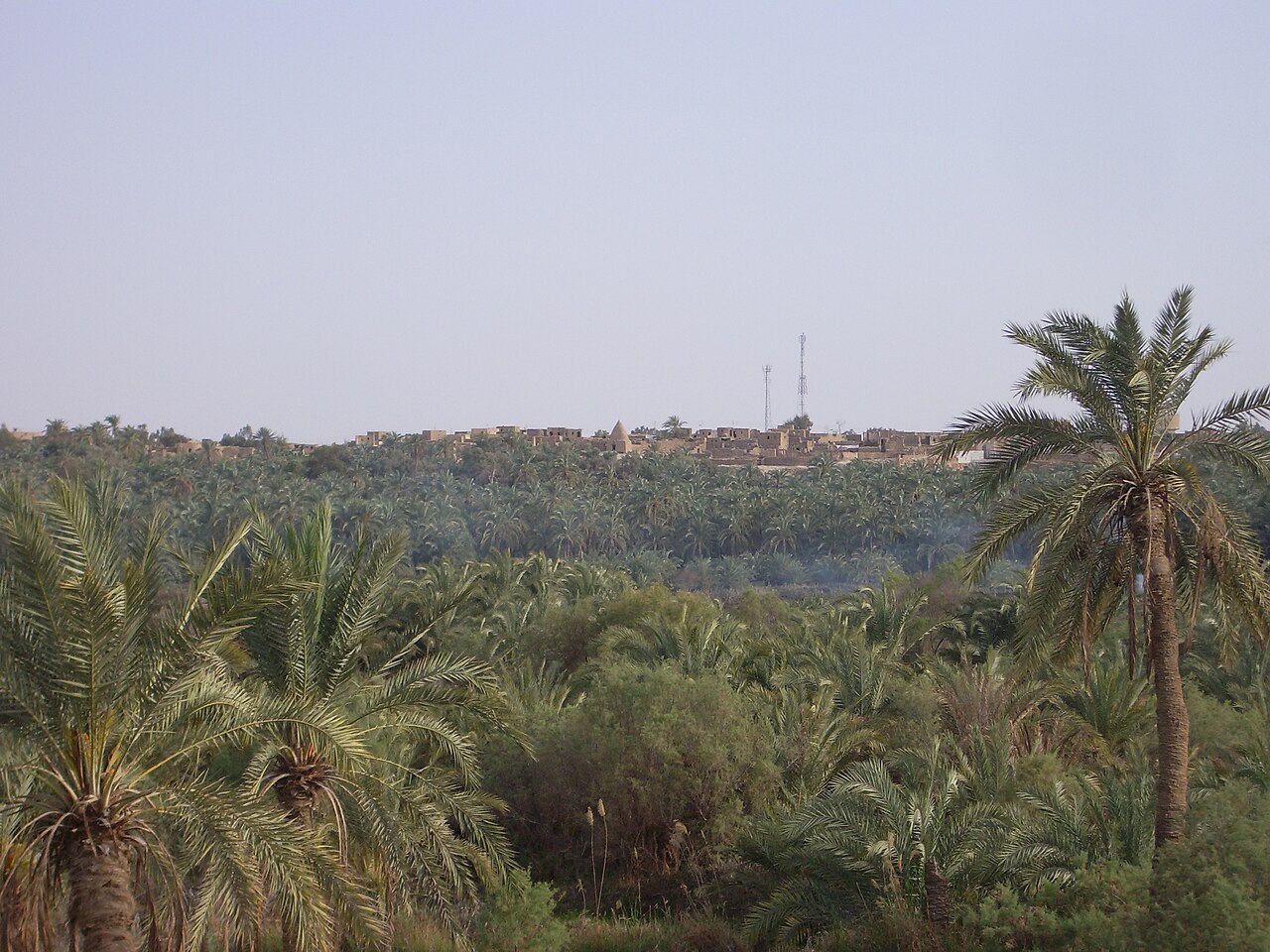
Some 350 km south of Farafra you reach the oasis of Dakhla (Al-Wahat al-Dakhla), where pink dunes, red escarpments and farmed plots follow one another. Worth seeing: Al-Qasr (a medieval Islamic village), Bashendi (Roman tombs), Deir el-Hagar (a Roman temple) and Bir el-Gebel (a natural spring). Dakhla is the most rural, least altered centre in the Western Desert, ideal for anyone after village life and slow travel.
Furthest south lies the Kharga oasis (Al-Wahat al-Kharga), 200 km southeast of Dakhla and the seat of the governorate. It is plainer than Dakhla to look at, yet its Roman and Coptic heritage is outstanding: the Hibis temple (Persian 27th Dynasty, the finest survivor of its era), the Bagawat necropolis (4th-6th century, over 200 painted Christian chapels) and the Dush Fortress. You can fly EgyptAir Cairo-Kharga (2 to 3 services a week) or drive 8-9 hours via Assiout. Doing the whole Bahariya-Farafra-Dakhla-Kharga loop takes 7 to 8 days by 4x4 with a Bedouin driver, a trip for the genuinely adventurous.
Covering 61,000 km² between the Red Sea and the Mediterranean, the Sinai desert is a triangular peninsula that belongs to Asia on the map but to Egypt politically. It differs from the Western Desert: more mountainous, greener in its valleys and culturally its own, with a population that is largely Jebeliya and Tarabin Bedouin. Tourism concentrates on two zones, the South Sinai (Mount Sinai, Saint Catherine, Dahab, Nuweiba, Sharm) and the North Sinai, off limits on security grounds since 2013.
Judeo-Christian tradition holds that Moses was given the Ten Commandments on Mount Sinai (Jebel Musa, 2,285 m). Climbing by night (setting off at 2am, 3 hours on foot or by camel, then the final 750 "Steps of Repentance") puts you on the top for sunrise. It is an unforgettable moment shared with roughly 300 pilgrims and visitors each night. Below sits the Saint-Catherine monastery (6th century, Greek Orthodox, UNESCO), which houses the world's oldest working library and the Burning Bush. Entry to the monastery is free, but opening is limited (9am-12pm, closed Friday, Sunday and Orthodox feast days).
Sinai's Bedouin safaris run through the wadis (dry valleys) out of Dahab or Nuweiba: the Coloured Canyon with its striped rock walls, the Blue Hole (a dive lagoon paired with desert), the White Canyon and the Ain Khudra oasis. Trips last 1-3 days with camping and Bedouin cooking, at £50-£120 a day. For the fullest picture of the Sinai desert we suggest the 2 day combination of Mount Sinai, the monastery and 1 night camped in a wadi.

Nowhere in the desert is closer to Cairo than the Fayoum, 100 km and a 2 hour drive away. People call it an oasis, though strictly it is a basin that the Nile feeds through the Bahr Youssef. Spanning 12,000 km², it contains Lake Qaroun (saline, 240 km², among the oldest natural lakes on earth). If you cannot spare the days for Bahariya or Siwa, Fayoum makes the perfect desert day out from Cairo.
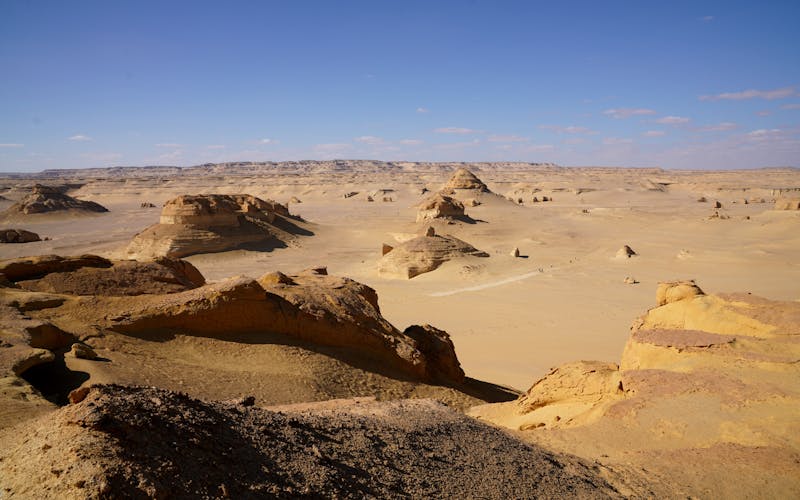
Listed by UNESCO since 2005, Wadi al-Hitan (Valley of the Whales) lies in the Fayoum desert 150 km out of Cairo. This one-of-a-kind palaeontological site holds over 400 fossilised skeletons of prehistoric whales (Basilosaurus, Dorudon) from 40 to 50 million years ago, when a shallow tropical sea covered the area. Wooden walkways lead round the open-air museum in about 2 hours. Entry is 200 EGP in 2026. It pairs well with Wadi al-Rayan (lake and waterfalls), the Magic Lake Desert and the Sandboarding dunes. Best done as a 1 day excursion from Cairo, 7am-8pm, 90-11 per person on a private basis.
Fayoum also has the village of Tunis, where artists and potters have settled, the Kom Aushim Museum (Greco-Roman Karanis) and, on its fringe, the pyramid of Meidum. For anyone with just 1 free day in Cairo, we suggest Fayoum as an introduction to the Egyptian desert.
Fayoum + Wadi al-Hitan desert day out from Cairo: 7am to 8pm, English-speaking driver, Bedouin lunch, UNESCO site entry. Starting at £80 per person. Quote by WhatsApp in 24h.
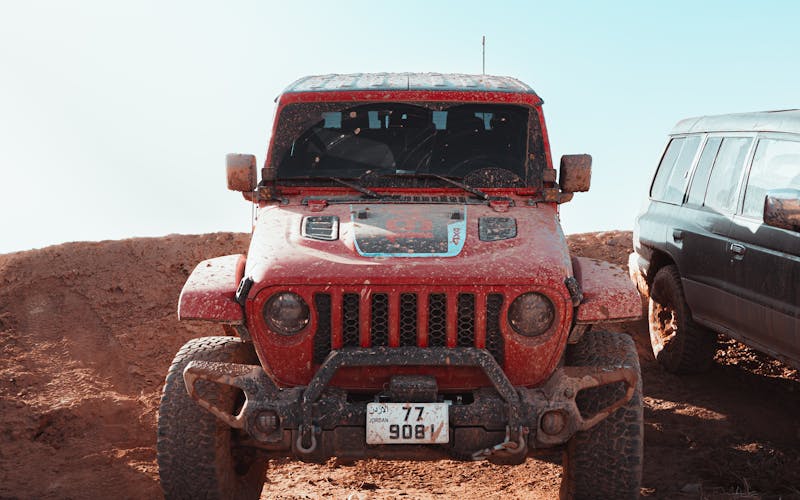
Any 4x4 safari Egypt desert trip calls for a properly kitted vehicle (Toyota Land Cruiser or double-cab Hilux), a seasoned Bedouin driver-guide and, in most parks, a military authorisation issued against your ID with 48 to 72 hours' notice. Where the ground is sensitive (the Great Sand Sea toward Libya, South Sinai, the Kharga-Dakh oases near the Sudanese border) the police insist on a convoy of two vehicles or more. Foreigners cannot simply hire a 4x4 and drive off unaccompanied in these zones; every trip goes through a local agency or a registered Bedouin operator.
What to bring on a desert safari: a warm sleeping bag (winter nights fall to 0 to 10°C, and the temperature plunges once the sun goes), a head torch, cotton clothes (even at 40°C by day the Bedouin stay covered against the sun), closed walking shoes because of scorpions, sunglasses plus a wide-brimmed hat, factor 50 sun cream, 3 to 4 litres of water per person per day and any personal medicines. We supply tents, sleeping bags, mattresses, Bedouin blankets, 3 meals a day and a wood fire each evening.
A typical desert bivouac runs like this: the camp goes up late in the afternoon, mint tea, sunset over the rock formations, supper cooked on a wood fire (chicken, rice, baladi bread, soup, tagine), a night beneath the stars or in a tent, then breakfast at first light before moving on. Even the better camps have dry toilets and no shower; that waits for the hotel the following day. A handful of luxury lodges (Adrère Amellal in Siwa, Desert Lodge in Dakhla) offer real comfort, at 3 to 5 times the cost.
How long your Egyptian desert stay should last comes down to which regions you want to cover. These are the usual formats we suggest for the time you have:
There is no single answer to "how many days in the desert": someone pressed for time will settle on 2 days in the White Desert, while a real enthusiast will give it 10 days and see the lot. We size the trip to your dates and to what draws you (archaeology, photography, spirituality, pure adventure).
The best desert period in Egypt runs from mid-October to mid-April, and it is at its very best between November and February. By day the temperature settles between 18 and 28°C, ideal for walking, driving and exploring, while nights sit between 2 and 12°C (a warm sleeping bag is essential at the camp). The air is dry and clear, so visibility is at its peak and the stars are superb. Sandstorms (khamsin) are also rare in these months.
The months to absolutely avoid : May through September. In the Western Desert the daytime reading regularly hits 45-48°C (the record is 52°C, set south of Dakhla in 2010), making anything strenuous dangerous after 10am. Camping in tents becomes unworkable, with 40°C at night. The khamsin season (March-May) whips up sandstorms that cut visibility to 100 metres and can shut desert roads for 1 to 3 days. Only high-altitude Sinai (Mount Sinai, 2,285 m) stays bearable in summer, with nights at 15-18°C.
What we suggest for 2026 : travel between November 15 and February 28 for the finest conditions. The soft, level light of December and January is the best for photography. Steer clear of Christmas week and New Year if you want the White Desert camp to yourself (every Bedouin operator is full and prices rise 25-40%). Late February into early March still brings excellent weather at low-season rates.
Desert lodging in Egypt falls into four clear categories, depending on how much comfort and how much solitude you want:
In our 5-night format we usually pair 2 nights camping (White Desert + Bahariya) with 2 nights in an eco-lodge (Siwa) and 1 final night back in Cairo. Alternating this way keeps the desert feel without the wear of camping every night.
Your budget desert Egypt figure will hinge on comfort level, length of trip and group size (the private 4x4 is the biggest single cost, and splitting it between 4 people makes it affordable). These are the real 2026 ranges, fully inclusive (4x4, driver, meals, camp and park fees):
In average comfort, our standard package 4 days White Desert + Siwa begins at £500 per person (based on 2 sharing), Cairo-Marsa Matrouh domestic flight included. In superior comfort the same trip begins at £850 per person. Every 2026 price covers ALL costs, with nothing hidden: park entries, tips for the crew, water and meals.
In 2026 the open tourist zones of Egypt's desert are broadly safe, provided you respect some firm rules. To begin with, no desert travel is possible without a registered Bedouin agency or operator : foreigners may not hire a 4x4 independently anywhere in the protected areas. Next, certain routes need a military convoy (an armed police escort): the Great Sea of Sand toward Libya, the frontier zones of South Sinai and the south of Kharga toward Sudan. Allow 2 to 3 working days before departure for the permit.
Zones that remain banned to foreigners in 2026 : North Sinai (the Arish area, Rafah, Bir al-Abd) since 2013, the northern Libyan frontier past Siwa, and the southern reaches of the New Valley governorate. The Ministry of Tourism revises these restrictions every quarter. We verify permits before issuing any quote and turn down requests that would enter a closed zone.
On everyday risks: the oases and tourist parks (Bahariya, Farafra, White Desert, Siwa, Dakhla, Fayoum) have no problem with crime. The Bedouin are welcoming hosts, and for 10+ years there has been no reported incident involving English-speaking visitors. The real hazards are natural: scorpions (wear closed shoes and shake them out each morning), heat stroke (drink plenty) and dehydration (walking more than 2 hours at midday is not possible). Women travelling alone: accepted, but better with an organised agency, since the region is isolated and 80% of the Western Desert has no phone signal.
For more than ten years Sem Elegant Travel has specialised in the deserts of Egypt. We deal directly with the leading Bedouin operators in Bahariya, Farafra, Siwa and Dakhla, with no middlemen. Every one of our driver-guides is a local Bedouin who grew up in the desert and speaks fluent French or English. Our desert itineraries are 100% bespoke rather than off-the-shelf: each quote is built around your dates, the comfort you want, your budget, who is travelling (couple, family, group of friends) and how adventurous you feel.
These are the five formats our British clients ask for most often (2026 prices, average comfort, based on 2 sharing):
An English-speaking adviser handles every enquiry personally, within 24 hours at most. We secure the military permits where needed, book the 4x4s and camps and arrange your airport transfers. See our Egypt packages hub for tours with a desert extension, while our day trips hub covers Fayoum + Wadi al-Hitan outings from Cairo.
To sum up, this guide has covered what to do in the egyptian desert across 1 to 10 days (White Desert, Siwa, Sinai, Fayoum, Wadi al-Hitan), how to arrange a 4x4 safari and a Bedouin camp safely, and how to link the white desert egypt with the oases of the Great Western Desert. For a coherent Egypt desert trip, our English-speaking team puts these pieces together to suit your dates, your budget and the comfort you prefer.
For an Egyptian desert quote 2026 : tell us when you want to travel, how many of you there are, which regions appeal (White Desert, Siwa, Sinai, Fayoum) and the comfort level you have in mind. Message us on WhatsApp at +20 10 96569859. You will have three tailored proposals back within 24 hours.
Three last steps before you head for the Egyptian desert: (1) settle on your dates and regions (the White Desert on its own, or paired with Siwa / Sinai / Fayoum), (2) pick your comfort level (camp or eco-lodge), (3) get in touch. Free quote on WhatsApp within 24 hours. You deal with an English speaker directly, with no call centre and no go-between.
Ready-made tours built by the SEV team, booked on quote via WhatsApp, with an English-speaking adviser replying within 1 hour.
Our dedicated Egyptian Sahara package: Bahariya, the white and black deserts and the oasis.
A full tour with an eastern desert leg on the Red Sea coast.
Your first taste of desert on the Giza plateau, before the open sea.
A compact 4-day programme that works well ahead of a desert trip.
A long weekend in Cairo either side of a desert expedition.
Allow at least 2 days for White Desert + Bahariya out of Cairo, the format most people choose. With 4 to 5 days you can add Siwa or Mount Sinai. A full Western Desert Grand Tour taking in Farafra, Dakhla and Kharga needs 7 to 10 days. If you only have one day trip to spare, Fayoum + Wadi al-Hitan is the sole realistic choice from Cairo.
Mid-October to mid-April gives the most comfortable conditions, with November to February the sweet spot: 18-28°C by day and 2-12°C at night. May to September is out of the question (45-48°C in the day, camping unbearable). From March to May the khamsin brings sandstorms, so keep longer trips out of that window.
You will find the White Desert in the Western Desert, roughly 370 km southwest of Cairo, with the Farafra oasis to its south and Bahariya to its north. The national park extends over 3,010 km² and has two principal sectors: White Desert New in the north, with the mushroom shapes, and White Desert Old in the south, with the taller monoliths. From Bahariya it is 2h30 by 4x4 on track.
You have two choices: the overland route Cairo-Marsa Matrouh-Siwa (820 km, 10-11 hours including stops) by private car or on the Upper Egypt bus, or, our preference, the EgyptAir flight Cairo-Marsa Matrouh (45 min, £70-£110) followed by a private 4x4 transfer to Siwa (3h30, £70-£90). There is no direct flight to Siwa. We put the flight and return transfer together from £220 per person.
Yes, and no other experience in Egypt's desert comes close. The camp is set up inside the national park at sunset: padded tents on the sand, a meal over a wood fire and a sky with no light pollution at all. Expect £60-£120 per person for 1 night with everything included (4x4 from Bahariya, Bedouin guide, kit and meals). Our three partner Bedouin operators in Bahariya all speak English and hold an official tourism authorisation.
The White Desert is wind-eroded chalk, a plateau of pale mushroom, chicken and sphinx shapes. The Black Desert is a volcanic field of 20 km² where cones of black basalt stand on orange sand. Just 50 km separate them (the Black Desert lies between Bahariya and Crystal Mountain, and the White Desert a further 20 km south), so a 4x4 safari from Bahariya covers both in one day.
That depends where you go. No military permit is needed for the White Desert, Bahariya, Siwa, Fayoum or Wadi al-Hitan, though you must travel with an agency or a registered Bedouin operator. A permit, issued in 2-3 working days, is required for the Great Sand Sea (Libya), for South Sinai past St. Catherine and for the southern Kharga-Sudan frontier. North Sinai has been shut to foreigners entirely since 2013. We handle and obtain every permit you need.
Yes, as a 2 day/1 night trip out of Sharm el-Sheikh, Dahab or Nuweiba. You leave in the afternoon, eat at the monastery, climb Mount Sinai overnight (setting off at 2am, 3 hours on foot or by camel), watch the sun rise from the top, then walk down to the 6th-century Sainte-Catherine monastery (UNESCO) and return by evening. Expect £90-£140 per person all in. The monastery insists on covered shoulders and knees, and no shorts.
Wadi al-Hitan, the Valley of the Whales, is a UNESCO-listed palaeontological site in the Fayoum Desert holding over 400 fossil skeletons of prehistoric whales (Basilosaurus, Dorudon) that lived 40 to 50 million years ago, when a shallow tropical sea covered the area. Walkways through the open-air museum let you view the fossils where they lie. Nowhere else on earth shows the transition of whales from land mammals to sea-going cetaceans so clearly. Allow 2 hours; entry is 200 EGP in 2026.
At the average comfort level (private 4x4, fixed camps, English-speaking guide), allow £460 to £770 per person for 5 days fully inclusive, not counting your flight from the UK. At the superior level (eco-lodges such as Taziry or Desert Lodge), allow £960 to £1,540 per person. These 2026 figures cover the 4x4, driver-guide, all meals, camps, park fees and the domestic flights we arrange for you (Cairo-Marsa Matrouh for Siwa, Cairo-Aswan, Aswan-Louxor, Cairo-Sharm el-Sheikh depending on your route). The largest line is the private 4x4 (£270-£350 a day), split between 4 people.
Yes, provided you go with an organised agency. The Bedouin operators are welcoming, and in the open zones (Bahariya, White Desert, Siwa, Fayoum, Sainte-Catherine) no incident involving English-speaking visitors has been reported in 10+ years. A woman travelling alone should book through an agency rather than go it alone, because the area is remote and 80% of the Western Desert has no phone signal. Families: ideal from age 8, but not advised under 5 (camping, long hours in the 4x4, heat).
Loose cotton that covers you (light trousers, long-sleeved shirt) even at 40°C, a wide-brimmed hat, sunglasses, closed walking shoes (scorpions), factor 50 sun cream, a cheche-style scarf against wind and sand. Winter camps: warm sleeping bag (0-5°C), thick fleece, woolly hat. Nubian or Bedouin villages: shoulders and knees covered. Sainte-Catherine monastery: strict dress code, no shorts, no vest tops.
It is, chiefly in Fayoum (Magic Lake and Wadi al-Rayan) and in the Great Sand Sea out of Siwa. Local operators supply the boards, complete beginners can join in, a session lasts 1-2 hours and costs £10-£20 per person. Add it as an option to any Fayoum or Siwa package of 3+ days. Children aged 10-18 love it, so it suits families well.
Book directly with us. Every desert guide we use is a local Bedouin, trained and licensed by the Egyptian Ministry of Tourism, fluent in French or English and a specialist in his own region (Bahariya, Siwa, Sinai, Fayoum). We steer well clear of unofficial drivers selling "informal" safaris with no military authorisation. An English-speaking desert driver-guide costs £90 to £140 a day per 4x4 group, and that is included in our 2 to 10 day packages. This openness sets us apart from faceless online platforms.