
Egypt weather in February is mild, dry and sunny during the day, with a real chill once the sun goes down. Daytime highs run from the low 50s Fahrenheit in Cairo up to the high 70s in Aswan, the Red Sea holds around 70F, and rain is close to nonexistent outside the Mediterranean coast. This page is the full data reference: region-by-region temperatures, sea temperature, rain, wind, daylight hours and what to pack, sourced from 30-year climate normals rather than a single week's forecast, plus what actually depends on the conditions once you land in the country.
Egypt Weather in February at a Glance
In February, Egypt's air is dry and mostly cloudless. Cairo runs 52 to 70F, the Nile Valley (Luxor and Aswan) swings wider, from the high 40s at night to the high 70s by afternoon, and the Red Sea coast at Hurghada and Sharm el-Sheikh stays a steady 54 to 75F with sea water around 70F. Alexandria and the Mediterranean coast are the coolest and the only part of the country that sees meaningful rain this month.
February Temperatures by Region: Full Breakdown
Figures below are 1991 to 2020 climate normals (a standard 30-year reference period), converted to Fahrenheit and rounded to the nearest degree. They describe a typical February day, not a forecast for any specific date.
Temperature table by region in February (Fahrenheit)
| Region | Low | High | Sea |
|---|---|---|---|
| Cairo | 52F | 70F | n/a |
| Luxor | 48F | 77F | n/a |
| Aswan | 52F | 79F | n/a |
| Hurghada (Red Sea) | 54F | 75F | 70F |
| Sharm el-Sheikh (Sinai) | 59F | 75F | 70F |
| Alexandria (Mediterranean) | 50F | 66F | 63F |
Source: 1991 to 2020 climate normals for each city, converted from Celsius. Marsa Alam and the rest of the southern Red Sea coast track fairly close to the Hurghada figures shown above.
Why the South Runs So Much Warmer Than Cairo
The single biggest thing to understand about Egypt weather in February is the north to south gradient. Cairo, in the Nile Delta region, sits closest to the Mediterranean influence and stays the coolest of the main cities. Luxor and Aswan, roughly 400 and 550 miles south, sit deep in the desert with far less humidity to hold onto heat, so their afternoons run noticeably warmer even though their nights can dip lower than Cairo's. The Red Sea coast sits in between: its water moderates the air, keeping both the daytime highs and the nighttime lows closer together than in the Nile Valley.
Practically, this means a February trip that only visits Cairo will feel cooler and greyer in photos than one that continues south to Luxor and Aswan, where the light is sharper and the afternoons genuinely warm.
This is also why most of our February itineraries move south within the first few days rather than lingering in Cairo. A traveler who spends a full week in the capital in February will notice more cool, overcast-feeling mornings than one who splits the same week between Cairo and Upper Egypt. The Nile itself acts as a secondary moderator once you are south of Cairo: towns directly on the riverbank tend to feel a degree or two milder overnight than desert sites a short drive inland, since open water releases stored heat more slowly than sand.
How February Compares to January and March
Egypt weather in February sits on a warming curve between the two neighboring months, using the same 1991 to 2020 climate normals. In Cairo, January runs 50 to 66F, February climbs to 52 to 70F, and March pushes further to 55 to 75F. Hurghada on the Red Sea follows the same pattern: 52 to 72F in January, 54 to 75F in February, and 59 to 79F in March. The month-to-month gain is real but gradual, a few degrees at a time rather than a sudden jump.
| Region | January | February | March |
|---|---|---|---|
| Cairo | 50 to 66F | 52 to 70F | 55 to 75F |
| Hurghada (Red Sea) | 52 to 72F | 54 to 75F | 59 to 79F |
The practical takeaway: if you want the mildest possible daytime temperatures with the least wind risk, February beats March. If you want a few extra degrees on the beach and do not mind a small, growing chance of the khamsin wind later in the month, March edges ahead. Neither month brings the intense heat that sets in from June onward.
Humidity and Comfort in February
Humidity in February is low across the Nile Valley and the desert regions, which is a large part of why the daytime temperatures in the table above feel comfortable rather than muggy, even in the warmer south. Cairo and the Delta carry slightly more moisture in the air thanks to their proximity to the Mediterranean, which is also why Cairo's evenings can feel a touch damp and chillier than the thermometer alone suggests. Along the Red Sea coast, humidity rises somewhat near the water but stays well short of the sticky conditions of a tropical coastline. The desert interior, including the White Desert and Siwa, has the driest air in the country, which is part of why nights there feel colder than the raw temperature figure implies.
Sea Temperature in February: Can You Swim?
Yes, with a wetsuit for comfort. The Red Sea at Hurghada and Sharm el-Sheikh sits around 70F in February, swimmable but on the cool side for most people without a shorty wetsuit, and very manageable for anyone used to diving in temperate water. The Mediterranean at Alexandria runs cooler still, around 63F, which is too cold for casual swimming for most visitors. Underwater visibility on the Red Sea is typically excellent in winter, since cooler water carries less plankton than in summer, so divers get some of the clearest conditions of the year in exchange for the cooler temperature. Hotel pools along the Red Sea coast are usually heated in February, which makes them a comfortable alternative for anyone who would rather skip the wetsuit entirely.
Rain in February: How Much Falls, and Where
Cairo, Luxor, Aswan and the Red Sea coast see essentially no rain in February; a passing shower is possible but not something to plan around. Alexandria and the Mediterranean coast are the exception: February sits within Egypt's short winter rainy season there, with roughly 20 to 30 millimeters of rain typically spread across about a week of scattered rainy days. Outside a Mediterranean coastal add-on, an umbrella is not something February travelers to Egypt generally need.
When Cairo does get a rain day in February, it is usually a single afternoon of light showers rather than a sustained storm, and it rarely disrupts sightseeing beyond a brief pause. Sandstorm-driven rain, sometimes seen with the khamsin in spring, is not a February phenomenon, so any rain this month is ordinary winter weather rather than anything more disruptive.
Wind in February: Is the Khamsin a Risk?
Not yet. The khamsin, Egypt's hot, dust-laden spring wind, becomes a real possibility from March onward, peaking in April, and can drop visibility sharply and push daytime temperatures up by a large margin within hours when it blows. February sits before that window: winds are generally light to moderate, mornings are typically the calmest part of the day, and dust-related visibility problems are rare. This is one of the reasons February is popular for hot air balloon flights over Luxor, since calm morning air is the baseline condition operators look for, though every flight is still confirmed on the day depending on conditions.
On the Nile itself, a light afternoon breeze is common and is actually welcome for felucca sailing, which depends on some wind to move at all. Along the Red Sea coast, onshore breezes in the afternoon can make the air feel a couple of degrees cooler than the table above suggests, which is worth knowing if you are planning beach time rather than diving, where a wetsuit already handles the temperature question. None of this amounts to a travel risk in February the way the khamsin can become from March.
Daylight Hours in February
Days are still on the short side of the year but lengthening quickly. In Cairo, sunrise moves from around 6:45am at the start of February to about 6:20am by the end, while sunset shifts from around 5:30pm to close to 5:55pm, stretching day length from roughly 10 hours 45 minutes to about 11 hours 30 minutes over the month. That extra light matters for planning: an early start still gets you into the Valley of the Kings or Karnak well before the afternoon light flattens out, and there is enough daylight left for a late-afternoon felucca sail on the Nile.
Best Time of Day to Visit Sites in February
February's temperature curve makes timing matter more than in summer, when everywhere is simply hot all day. Morning, roughly sunrise to 10am, is the coolest and most comfortable window for outdoor sites without shade: the Giza plateau, Karnak's open courts, and the Valley of the Kings all reward an early start, and light for photography is also at its best. Midday, from about 11am to 2pm, brings the day's warmth in Luxor and Aswan and is a reasonable time for indoor museum visits like the Grand Egyptian Museum or covered tomb interiors, which stay a stable temperature regardless of the weather outside. Late afternoon into early evening is prime time for a felucca sail on the Nile, when the wind typically picks up slightly and the light turns gold, but it is also when the temperature starts dropping fast enough that a light jacket becomes useful again.
What to Pack for Egypt in February
Layering is the whole strategy. A t-shirt or light shirt covers the afternoon warmth in Luxor and Aswan, a long-sleeve layer or light sweater handles Cairo's cooler daytime air and any region's evening, and a packable fleece or light jacket is worth having for Nile cruise decks after sunset and for desert nights, which can drop well below the daytime figures in this table. Add closed walking shoes for temple sites with uneven stone, a scarf or shawl for covering shoulders at religious sites, sunglasses and sunscreen for the strong midday sun even at cooler temperatures, and a 3mm shorty wetsuit or rental if diving or snorkeling is on the plan.
For a desert extension to the White Desert, Bahariya or Siwa, add a warm hat and gloves for the coldest pre-dawn hours, since clear desert skies let heat escape fast overnight and the temperature swing between afternoon and 4am is the widest of any region in this guide. For a Red Sea stay, pack the wetsuit ahead of time rather than counting on renting one locally, since sizes at smaller dive centers can be limited during the busier winter months. A reusable water bottle and a compact daypack round out what most February travelers actually use day to day. Our full Egypt packing list covers the rest, and our travel checklist covers documents and logistics.
Plan around February's weather with us
Our English-speaking team in Cairo builds each itinerary around the season, region by region
How February's Weather Shapes What You Can Do
The conditions above translate directly into which activities make sense this month. Diving and snorkeling on the Red Sea benefit from the year's clearest visibility, at the cost of needing a wetsuit. Hot air balloon flights over Luxor rely on the calm morning air that February typically delivers before the spring winds arrive. Desert nights, cold and clear with very low humidity, are some of the best stargazing conditions of the year in the White Desert and around Bahariya and Siwa. Temple visits are most comfortable scheduled for morning or late afternoon, since midday sun is still strong even when the air temperature itself is mild. A Nile cruise deck is genuinely pleasant by day and cool enough at night to need a real layer, not just a cardigan.
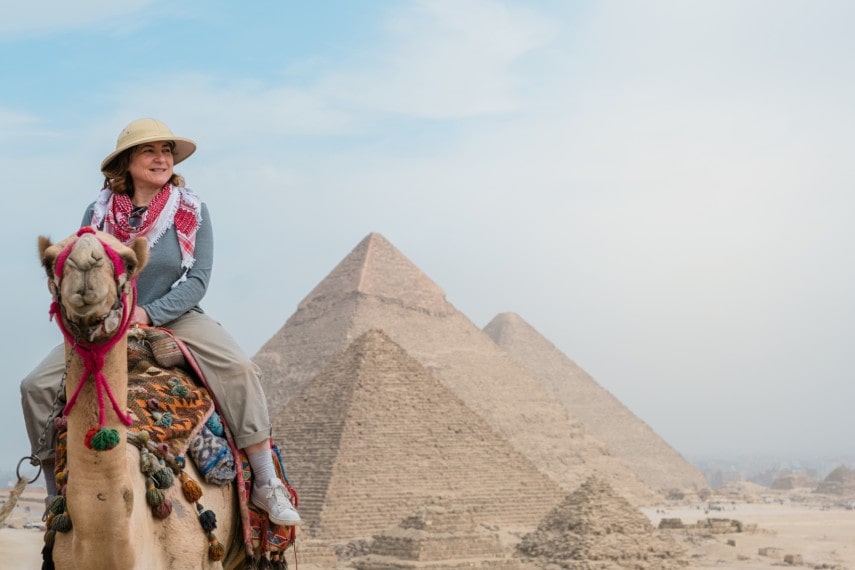
Walking tours of Cairo's historic districts, including Islamic Cairo and Coptic Cairo, sit comfortably in the mild afternoon range without the midsummer heat that makes the same walk exhausting in July. Camel or horse rides around the Giza plateau are pleasant in the morning cool and become genuinely hot on the sand by early afternoon, so operators and guides both tend to schedule these before 10am. Quad biking and desert safaris out of Hurghada or Marsa Alam work well in February's mild afternoons, though a wind layer is worth having for the ride itself, since moving through open desert air feels cooler than standing still. Shopping in open-air markets like Khan el-Khalili is comfortable at any hour in February, unlike summer, when the covered alleys trap heat.
Should You Actually Go in February?
The data on this page answers what the weather will do; it does not answer whether the month suits your trip. For crowd levels, price trends against January and March, Presidents' Day week timing, the Abu Simbel sun festival on 22 February, and how Ramadan's shifting dates might overlap with your travel window, see our companion Egypt in February guide, which covers the decision side in full.
Frequently Asked Questions
What is the weather like in Egypt in February?
Mild, dry and mostly sunny. Cairo runs 52 to 70F, Luxor 48 to 77F, Aswan 52 to 79F, and the Red Sea coast 54 to 75F with sea water around 70F. Rain is essentially absent outside Alexandria's short winter rainy season on the Mediterranean coast.
What is the temperature in Egypt in February?
It varies by region. Cairo sees a daytime high near 70F and a morning low near 52F. Upper Egypt (Luxor and Aswan) swings wider, from the high 40s overnight to the high 70s in the afternoon. The Red Sea coast stays in a narrower 54 to 75F band thanks to the moderating effect of the sea.
How does Egypt weather in February compare to January?
February runs slightly warmer than January across every region, typically by a few degrees on both the daily low and high. The difference is gradual rather than dramatic, so travelers choosing between the two months should weigh crowds and price more than the small temperature gap.
Is it cold in Egypt in February?
Not during the day. Afternoons are mild to warm depending on region. Nights and early mornings are genuinely cool everywhere, and can fall into the 40s Fahrenheit in the desert and in Upper Egypt away from the river, so a fleece or jacket for evenings is not optional.
Can you swim in Egypt in February?
Yes, in the Red Sea at Hurghada or Sharm el-Sheikh, where the water sits around 70F, comfortable with a shorty wetsuit for most swimmers. The Mediterranean at Alexandria, around 63F in February, is too cool for most people to swim comfortably.
Does it rain in Egypt in February?
Barely, and only in one region. Cairo, the Nile Valley and the Red Sea coast see close to no rain. Alexandria and the Mediterranean coast get roughly 20 to 30 millimeters over about a week of scattered days, since February falls inside Egypt's short winter rainy season there.
Is February windy in Egypt?
Generally not. Winds run light to moderate and mornings are typically the calmest part of the day. The khamsin, Egypt's hot dust-laden wind, is a March through May phenomenon that peaks in April, so February sits safely before that window.
How many hours of daylight does Egypt get in February?
Around 10 hours 45 minutes at the start of the month, stretching to about 11 hours 30 minutes by the end, as sunrise moves earlier and sunset later on the way toward spring, giving you a little more usable daylight with each passing week of the trip.
What should I pack for Egypt in February?
Light layers for the day, a fleece or jacket for evenings and desert nights, closed shoes for temple sites, a scarf for religious sites, sun protection even though the air is mild, and a wetsuit or rental for diving or snorkeling.
Egypt weather February: is it a good month overall?
For weather alone, yes: February combines mild, dry, mostly sunny days with none of the extreme heat of summer or the wind risk that starts building in March. The trade-off is cool nights everywhere and cool sea water on the coast.
What is the sea temperature in Egypt in February?
Around 70F on the Red Sea at Hurghada and Sharm el-Sheikh, and around 63F on the Mediterranean at Alexandria. The Red Sea figure holds fairly steady across the whole coast, including Marsa Alam, so the choice of resort town matters far less than the choice of coast when it comes to water temperature.
See also, for the months on either side of February: Egypt in January · Egypt in March · Egypt temperature by month · Best time to visit Egypt · Hurghada weather guide