
By the Sem Elegant Voyage team | Revised March 2026
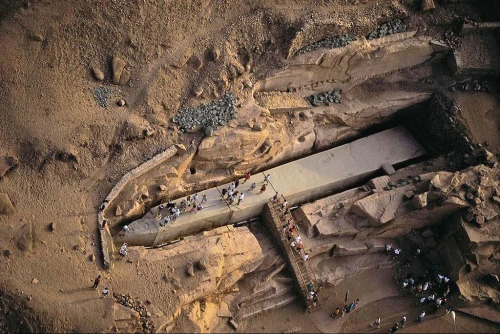
Want to see the biggest obelisk ever cut? You cannot, because it never left the ground. It is still lying in its quarry at Aswan. Colossal. Cracked. Abandoned for 3500 years. (Three and a half millennia, yes.) Six visits in, it tells me the same thing every time: the ancient Egyptians reached for the impossible and now and then fell short, and when they fell short they did so on a heroic scale. The slab of pink granite weighs 1168 tonnes. Think of the labour needed to free it. Then think of the shame when a single crack undid the lot. Here is how to see all of Aswan.
The Largest Block Ever Cut: Figures and Superlatives

42 meters high. 4.2 meters wide. 3.6 meters deep. This unfinished obelisk could have rivaled the Obelisk of Luxor (which is complete and measures 25 meters). In summary? It was a challenge to geometry, a declaration of pharaonic power.
Why carved in Aswan? Simple. The pink granite comes from here. The Aswan quarries supplied ancient Egypt with building stone. Temples, obelisks, colossal statues. It all started in these careers. (And some still active today, in fact, for smaller modern projects.)
This particular block dates from the 18th dynasty. Hatshepsut, perhaps. Or Thutmose III. Archaeologists are hesitant. Never mind. The real story? This is how we cut it and why we left it there.
KILLING FIGURE
1168 tons. That is the best estimate for this one block. For perspective, each of the two carved lions flanking the Luxor Obelisk in Paris weighs 2.5 tonnes. Multiply by 468 and you have the ancients' effort.
How They Pruned (And Why They Failed)
The Tools: Copper and Extreme Patience
There was no diamond saw and no power drill. The Egyptians worked with copper tools (which corrode) and hardwood, helped along by abrasive sand. And then there was water. They doused the stone to cool it, which turned the grit into a paste between block and tool. All at once every strike bit deep. Very deep indeed.
The technique was called "pounding". Hit. Hit. Hit. Day after day. Hundreds of workers, probably. Not chained slaves as Hollywood says (weak), but rather teams organized under contract or corvée. Breaks. Rations of beer and bread. (Yes, they drank beer at work. It was nutritious, considering the times.)
The Crack That Ruined Everything
Look at the block today. You will see a clear crack running down the sidewall. The workers spotted it during the pruning. Maybe 80%, maybe 90%. Impossible to say exactly. But a crack in the granite? It's a death sentence. The ancient tailors knew this. So, they gave up.
So the block stayed put. Never finished. A memorial to nature's hidden flaws. Geologists now think the fault ran through the raw rock all along, unseen until the stone around it was cut away. Human cost? Beyond reckoning. Set it beside the temples of Abu Simbel, which did get finished.
The Practical Tour: How to See This Obelisk
Admission is 30 EGP (less than one euro). You walk straight into the quarry: a stony site with one enormous slab lying across it, and that is all. No museum, no 3D model, only bare rock telling its own story. (Honestly, it is better for it.)
How long to allow? Somewhere between 30 and 45 minutes. You can circle the block, climb onto it (really), take your pictures, then inspect the other half-cut stones scattered nearby. A few ancient tools are on show as well. Guides will tell you the tool marks are still plain to see, and they are. Quite astonishing, in truth.
Practical pointers? Get there early, because by midday the sun is punishing and you will be drenched. The local guides loitering by the gate can spin a fine tale. What does an English-speaking guide cost? 5-£10. Money well spent if you enjoy the finer points.
LOGISTICS ADVICE
The unfinished obelisk is 2 km from the center of Aswan. Taxi: 10-15 EGP (20 cents). On foot if you like walking in the heat. Bring water. Lots of water. One liter minimum.
Combine With Other Aswan Sites
The Obelisk + The High Dam
It's the classic combo. Three kilometers separate them. Allow half a day in total (45 min obelisk, 30 min dam). View of the dam, then ancient history of the obelisk. Two Egyptian periods in one morning.
Basically, you're sweeping away 3,500 years of engineering (ancient and modern) without leaving the region. Total entries? 60 EGP. Transportation? 20-30 EGP. It's a deal.
The Obelisk + Philae Island
Philae is a temple, sacred to Isis, and a genuine wonder. It stands 7 km from the obelisk, so half a day covers the pair. Take the obelisk first thing (30-45 min), a light lunch (2- for mezze), then Philae after (allow 90 minutes). Time it well and you will catch the sun going down over the Nile.
Philae price? 80 EGP (entry + boat). Add obelisk (30 EGP) and transport (30 EGP). You have 110 EGP in expenses. Less than £0. For two of the most important sites. Lucrative.
CIRCUIT IDEAS
Our detailed guide to Luxor to Aswan itineraries shows you how to combine obelisks, temples and Nile scenery.
The Archeology Behind the Unfinished
Why are we being told this story? Because the unfinished obelisk gives us a unique window into ancient techniques. Modern quarries use explosives and diamond saws. The old ones? Copper, stone, water, and muscles. This obelisk rivaled in ambition with the Nile cruises which reveal other wonders.
By looking at this block, you can see exactly where the tools went. We measure the depth of the sizes. We understand the pace of work. (The lines parallel to the surface? These are "work benches." Each bench represents several days of labor.) It is a living, wordless archeology manual.
Which is why this "failed" obelisk is worth more than any finished one. The reason? It lays the whole process bare. No Egyptologist alive would turn down this block, and some return regularly to measure it and sharpen their theories about the methods.
Abu Simbel and the Obelisks: Connections
You visit this unfinished obelisk, then you go up to Abu Simbel (280 km south). The two temples of Ramses II await you. But here's the link: Ramses II also ordered obelisks. All the granite used in the pharaonic construction comes from the quarries of Aswan. Without this site, Abu Simbel (and all the temples) would not have been possible.
Basically, you're tracing the supply chain of the ancient Nile. From the quarry to the temple. Fascinating.
Looking for More Info?
Ask your questions on WhatsApp. Our advisors respond in less than 2 hours, 7 days a week, without obligation.
Contact by WhatsAppWe answer inside 2 hours · 7 days a week · Nothing to commit to
When to Go: Season and Weather
November to February? Perfect. Temperatures between 20 and 28°C. You can stay outside for 45 minutes without dying from the heat.
March to May? It's starting to heat up. 28-35°C. Possible, but bring a huge hat and water.
June to September? Forget. 38-48°C. Even the locals disappear in after 10am. The tourist sites are slowing down. The guides take breaks every 15 minutes.
That said, hotel rates drop dramatically in summer. You pay £20-£30 per night instead of £50-£60. Trade-off acceptable if you tolerate heat. Also see our complete budget guide.
Explore Aswan Completely
Unfinished obelisk, High Dam, Abu Simbel: plan the whole journey along the Nile with us.
Plan My VisitWe answer inside 2 hours · 7 days a week · Nothing to commit to
Conclusion: Why This Unfinished Business Is Worth It
Aswan's Unfinished Obelisk is no temple, no tomb, no palace. It is a lesson in stone about how far human ambition reaches, and where it stops. The Egyptians set their sights high, and now and then the rock refused. When rock refuses, even a pharaoh gives way.
This, though, is the heart of it: you get to stand on the thing. Run your fingers over the ancient tool marks. Picture the men hammering at it, one day after the next. Look at the very crack that beat them. There is no glass case in the way. You and the past, face to face.
Got 45 minutes spare in Aswan? Spend them here. This "minor" site outclasses most of the big-name attractions. Genuine. Instructive. Deeply human.
Discover Ancient Secrets
Learn how the granite was cut from a local archaeologist guide who unpicks the pink stone's secrets.
Explore NowWe answer inside 2 hours · 7 days a week · Nothing to commit to
💡 Before you go: The unfinished obelisk itself takes 30 to 45 minutes, though the wider granite quarry rewards a longer look. Study the marks in the rock and you will spot rows of holes where workers drove in wooden wedges and soaked them so the swelling timber split the stone. The same 3,500-year-old technique shows up all over the quarry, and it is genuinely gripping once you understand what you are looking at.
The quarry is in the open with next to no shade, so aim for early morning or late afternoon, above all between April and October. A hat, sun cream and a bottle of water are non-negotiable. Entry costs around 100 EGP and is usually part of any guided package. Going without a guide? The information board at the gate gives a fair overview, though the English text is brief. An audio guide, or a thorough article like this one, will serve you better on the spot.