
Philae Temple, known to French speaking visitors and in older travel literature as Temple de Philae, sits on Agilkia Island in the heart of the Nile, 7.5 miles south of Aswan. This sanctuary dedicated to the goddess Isis is one of the last great working temples of ancient Egypt: the mysteries of Isis were celebrated here until 537 AD, nearly a century and a half after Emperor Theodosius closed pagan temples empire wide in 391 AD. For the American traveler who pushes on as far as Aswan, Philae is not optional: it is the highlight of the stop, and probably the most beautiful boat arrival in all of Egypt.
Our SEV team arranges private guided visits to Philae Temple from Aswan with an English speaking guide, boat ride included and timing optimized to avoid the cruise buses. Request your personalized quote.
Request a Philae quote on WhatsApp →
Why Philae Temple (Temple de Philae) is unique in Egypt
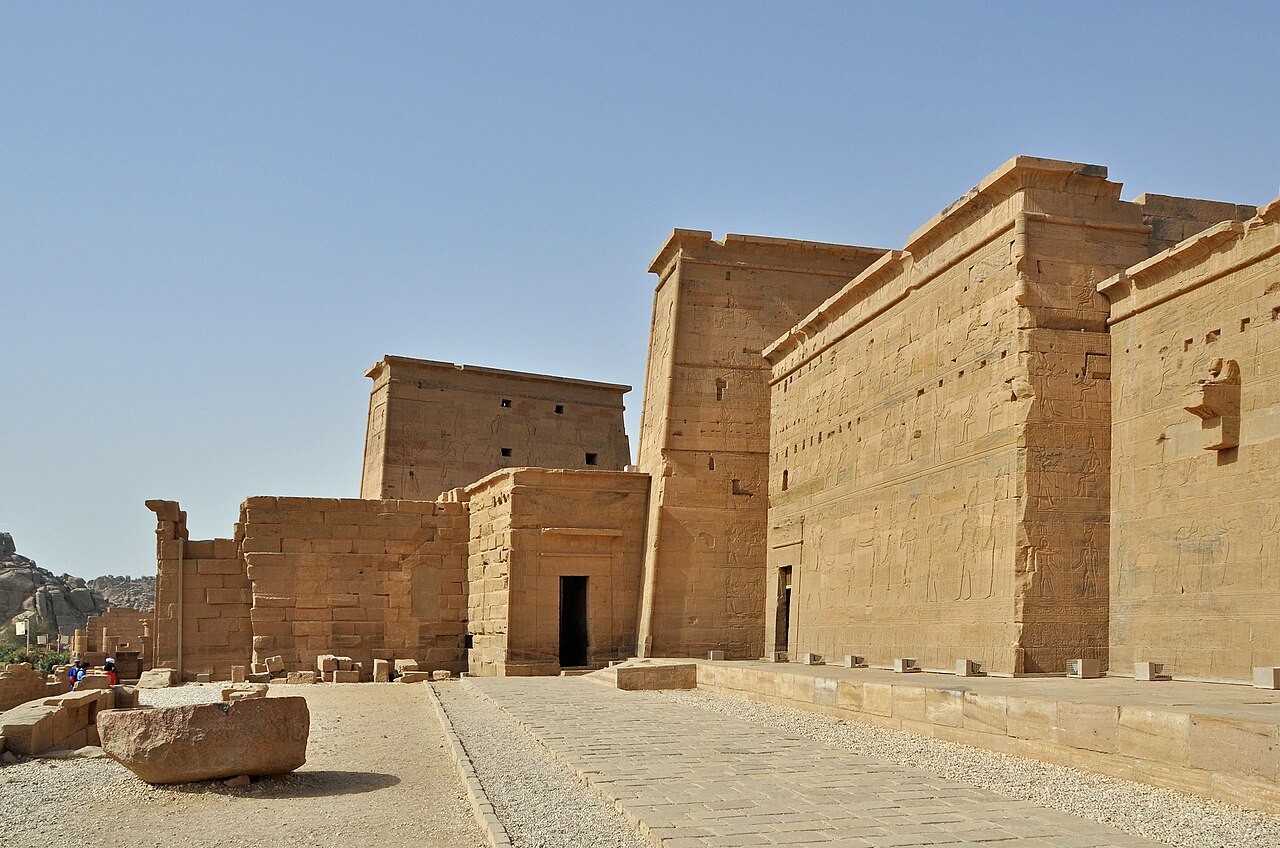
Three facts set Philae apart from every other Egyptian temple and explain why it absolutely deserves a half day of your Aswan stop.
- The last active pagan temple: the rites of Isis continued here until 537 AD, roughly a century and a half after Theodosius closed every other Egyptian temple in 391 AD. The latest datable hieroglyphic inscription in Egypt, carved in 394 AD and known as the Graffito of Esmet Akhom, is found on its walls.
- An entire island saved by UNESCO: about 40,000 blocks were dismantled stone by stone between 1972 and 1980, then reassembled exactly as before on the neighboring island of Agilkia, roughly 40 feet (12 meters) higher, to save it from the rising waters caused by the High Dam. Along with Abu Simbel, it is one of the only Egyptian temples ever moved from its original site.
- The boat arrival: you can only reach Philae by motorboat from the Shellal landing. The 10 minute crossing on the Nile, with the temple gradually revealed between the granite rocks, is one of the most beautiful archaeological approaches in the world.
History: from Ptolemy II to the UNESCO rescue
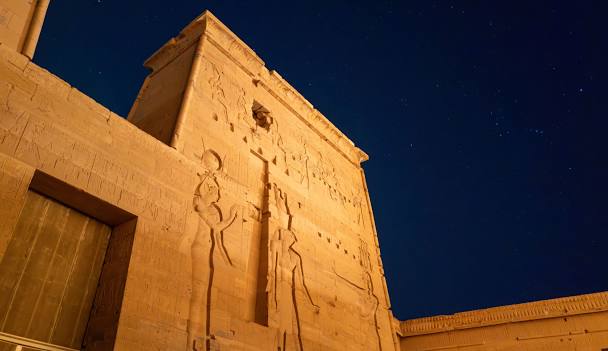
The name Philae comes from the ancient Egyptian Pilak, generally translated by specialists as "island of the end," a reference to the site marking the ancient frontier between Egypt and Nubia. The oldest sanctuary on the site dates to the reign of Nectanebo I (370 BC), a pharaoh of the 30th Dynasty. But most of the temple you see today was built during the Ptolemaic dynasty (Ptolemy II Philadelphus to Ptolemy XII Neos Dionysos, roughly 280 to 50 BC), with significant Roman additions under Augustus, Tiberius, Trajan and Hadrian.
The great temple is dedicated to Isis, goddess of magic, mourning and motherhood, and one of the most popular deities of the late Egyptian pantheon. Her cult later spread throughout the Roman Empire: Iseums have been found in Pompeii, Athens, London and even in Germania. Philae was the mother house, and the whole complex is inscribed on the UNESCO World Heritage list as part of the "Nubian Monuments from Abu Simbel to Philae" site, added in 1979.
When the Aswan dam began to be raised in 1902, the island of Philae found itself flooded six months a year. Visitors entered by boat between the columns emerging from the water, a famous sight photographed by Pierre Loti and David Roberts. With the construction of the High Dam in the 1960s (Sadd al Aali, completed in 1970), the island was set to be submerged permanently. In 1972 UNESCO launched the dismantling and reconstruction on the neighboring island of Agilkia, completed in 1980, the same Nubia Campaign that had already rescued Abu Simbel a decade earlier. This is the site you visit today: a work of modern archaeology as much as an ancient one.
The myth of Isis, Osiris and Horus behind the temple
Philae's reliefs retell one of ancient Egypt's central stories. Osiris, murdered by his jealous brother Seth, is mourned and magically restored by his wife Isis, who conceives their son Horus and raises him in hiding in the marshes. Horus later avenges his father and becomes the model for every living pharaoh. Egyptian tradition held that part of Osiris was buried on Biga, the small island just west of Philae that priests could approach but ordinary visitors could not, which is part of why Philae grew into such an important cult center rather than a purely local shrine.
If you continue north on a Nile cruise, you will meet the same story again: the Temple of Edfu is dedicated to Horus himself, and the double temple at Kom Ombo sits roughly midway between Aswan and Edfu. Seeing Philae first gives the rest of the myth context and makes the later stops read very differently.
How to get to Philae Temple from Aswan in 2026
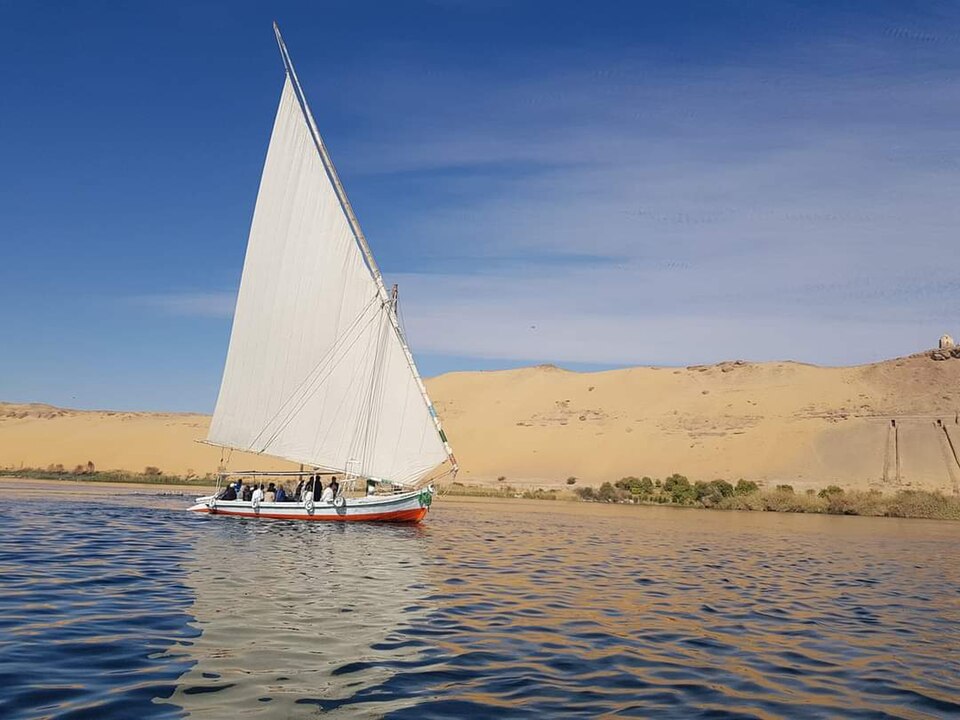
There are two stages to reach Philae, on any visit to Aswan: the drive to the Shellal landing, then the boat ride to the island.
Stage 1, Aswan to Shellal: the Shellal landing is 7.5 miles south of downtown Aswan, just behind the old dam (Aswan Low Dam, 1902). Allow 20 minutes by taxi (150 to 200 EGP one way, about $3 to $4). With an SEV organized visit, the private transfer in an air conditioned vehicle is included.
Stage 2, Shellal to Agilkia: flat bottomed or covered motorboat. The going rate quoted by boatmen at the landing in 2026 is around 300 EGP per boat (about $6) for a round trip with 1 to 2 hours of waiting on the island, though it is not fixed by any official tariff and can range from roughly 150 to 400 EGP depending on demand and negotiation, so confirm the price before boarding. The boat holds 6 to 10 people; if you arrive as a couple, you share with other travelers, which is friendly. The crossing takes 10 minutes each way.
With an SEV excursion, the boat is private for your group: you decide on your return time, you can take your time on the island, and the English speaking guide stays with you.
What you absolutely must see on Agilkia Island
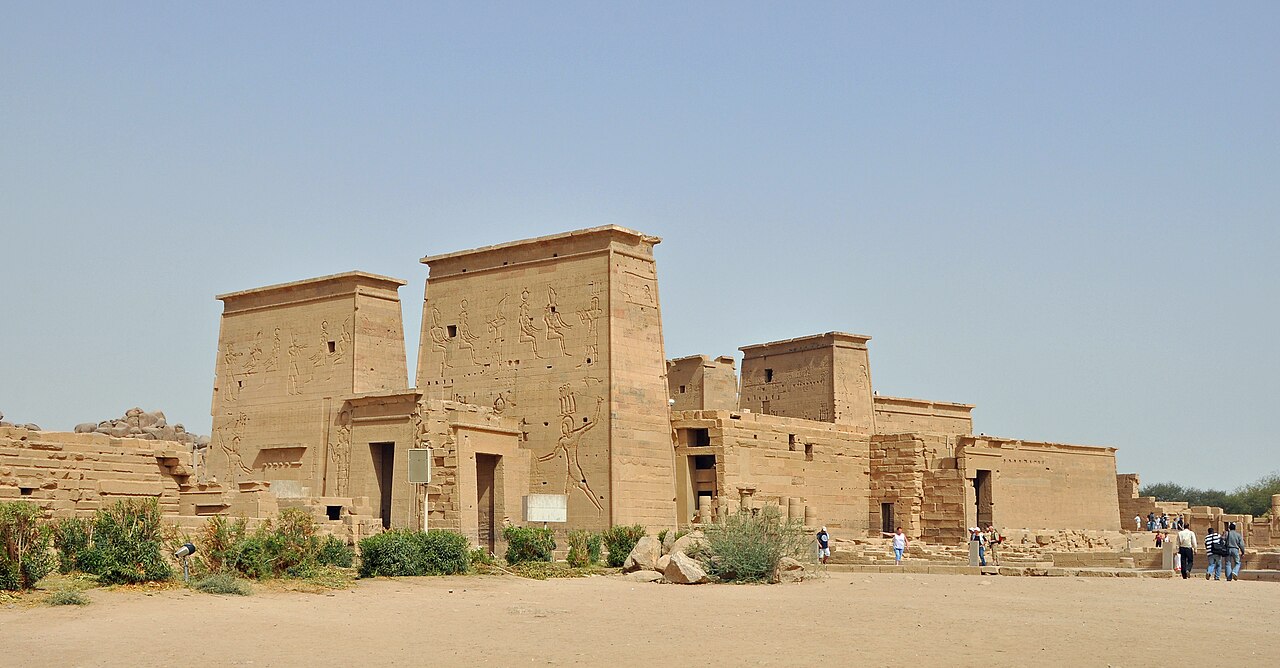
The island is 1,310 ft long by 425 ft wide. The great Temple of Isis takes up two thirds of the surface. Here is the logical order of the visit and the elements not to miss.
- The vestibule of Nectanebo (to the left as you land): the oldest element on the site (380 BC), a small open pavilion with Hathoric columns. A quiet spot with beautiful reliefs.
- The first pylon (monumental facade): 60 ft high, two symmetrical towers covered with reliefs of Ptolemy XII smiting his enemies. Walk through the great entrance gate and look up to the right and left: graffiti from the Bonaparte expedition carved into the stones (1799).
- The inner courtyard and the mammisi (to the left): the "birth house," a small chapel dedicated to the infant Horus. Isis nursing Horus is sculpted on the walls, very likely the origin of the Christian depictions of the Madonna and Child.
- The second pylon and the naos of Isis (heart of the temple): a hypostyle courtyard with 10 papyrus columns, then the inner sanctuary where the statue of Isis once stood. Beautiful reliefs where Isis nurses Horus, scenes from the myth of Osiris.
- The Kiosk of Trajan (east bank, south exit): our favorite. A small open pavilion with 14 composite columns, built under the emperor Trajan (98 to 117 AD) at the edge of the Nile. It is the motif that inspired Pierre Loti in The Death of Philae. A magical photo at sunset.
- The Temple of Hathor (to the west): a small temple next to the great sanctuary of Isis. Musical reliefs unique in Egypt: the god Bes plays the lyre and dances.
The Kiosk of Trajan: the most photographed motif at Philae
If you were to keep only one image of Philae, it would be the Kiosk of Trajan. Fourteen composite columns topped with mixed capitals (papyrus, lotus, Hathoric), a soaring roof that was never finished, and behind it the Nile and the pink granite rocks of Aswan. It has been the icon of Philae for 200 years of travel literature.
Our photo tip: stand on the east side, at 4 pm in summer (5 pm outside summer), with the sun behind you to catch the columns bathed in golden light and the Nile shimmering in the background. At 5:30 pm in winter, the kiosk glows red in the sunset, a cinematic moment.
The sound and light show: really in English?
Yes, and it is one of the rare authentic twilight experiences in Egypt, alongside the other sound and light shows across Egypt. The Philae show plays every evening on the island in several languages on rotation, including English. The show lasts about 1 hour, with narration by an actor's voice, colorful illuminations and orchestral music.
2026 schedule: 3 sessions per evening, at 7 pm, 8 pm and 9 pm (shifted one hour earlier in winter). The English session typically runs on Tuesday and Friday evenings. Check the current weekly program at the time of your booking, since it sometimes changes and is not published far in advance.
2026 price: around 600 EGP ($13) per adult at the gate, free for children under 6. Online booking platforms sometimes quote a higher fixed dollar rate that bundles a service fee, so the walk-up EGP price is usually the better value if your schedule allows it, and it is worth confirming the exact figure when you book. The boat to get there in the evening costs a supplement (200 to 300 EGP) since it is not included in the show ticket. With SEV, we bundle ticket, boat and transfer from your hotel in Aswan for the English session.
Book the sound and light show in English →
Philae prices 2026 and ticketing
Payment in EGP (Egyptian pounds) only at the ticket window. Credit cards are not consistently accepted, so bring cash. If you arrive with an SEV excursion, the ticketing is included in the package.
When to visit Philae: avoiding the heat and the crowds
The site is open year round, 7 days a week, generally from 7 am with last entry around 3 pm. But visiting conditions vary enormously depending on the season and the time of day.
- October to March: the ideal season. Aswan temperatures 64 to 82°F, clear skies, low humidity. Visit at any hour of the day. Attendance is high but bearable.
- April to May and September: hot (86 to 100°F) but still acceptable. Visit early in the morning (8 to 10 am) or late in the afternoon (4 to 6 pm).
- June to August: sweltering (104 to 115°F in the afternoon). Visit only between 7 and 10 am or after 5 pm. Plenty of water required, plus a hat and sunglasses.
To avoid the crowd of cruise buses, aim for the 7 am opening (the buses typically arrive at 9 am from the ships moored at Aswan) or the late afternoon from 3:30 pm when the cruises head back toward Luxor. SEV systematically schedules Philae visits at first light or in late afternoon for its private tour clients.
Combining Philae with Aswan in one day
Philae pairs perfectly with other Aswan must sees over a full day. Here is our most requested itinerary.
- 8:00 am, Philae: opening, 2 hours on site with an English speaking guide. Back at Shellal by 10:30 am.
- 11:00 am, Aswan High Dam: (Sadd al Aali). 30 minute visit with a photo stop, explanation of the Nile's history and hydrology.
- 11:45 am, Unfinished Obelisk at the Northern Quarry: 45 minutes to grasp the scale of the Ptolemaic obelisk abandoned in the bedrock.
- 1:00 pm, lunch aboard a felucca: a tour of the Nubian village with a traditional lunch aboard a traditional lateen sail felucca.
- 3:30 pm, Nubian village (Gharb Sehel or Aswan West): meet Nubian families, visit the traditional colorful houses, taste hibiscus tea (karkade).
- 6:00 pm, back to the hotel: optional, dinner on the Nile or the Philae sound and light show in the evening.
Estimated cost of a full private SEV Aswan day (transfers, entrances, English speaking guide, lunch and felucca): from $100 per person for groups of 4 or more, from $150 per person for a couple. Request a quote for your exact dates.
Get a personalized Aswan day quote →
Philae as part of a wider Aswan or Nile cruise trip
Most travelers see Philae either as a stand alone stop in Aswan or as the southern bookend of a Nile cruise. If you are sailing between Luxor and Aswan, Philae is usually visited on the Aswan side before boarding or after disembarking, alongside the temples you pass en route; our Luxor to Aswan itinerary, day by day shows where it fits. If you are still deciding which direction to sail, our comparison of sailing Aswan to Luxor versus Luxor to Aswan walks through the trade offs.
Travelers who add an extra day in Aswan often combine Philae with a dawn flight to Abu Simbel, the other great Nubia Campaign rescue, since both sites share the same UNESCO story. SEV can build either combination into a private Aswan program built around your flight or cruise schedule.
FAQ: frequently asked questions about Philae Temple
How much does it cost to visit Philae Temple in 2026?
The foreign adult ticket costs 550 EGP (about $10) in 2026. On top of that you must add roughly 300 EGP per boat (~$6, shared by 6 to 10 people) for the Shellal to Agilkia crossing. So plan on roughly $16 per person in total for entry and the boat transport. ISIC students and children 6 to 12 pay half price (275 EGP).
How do you get to Philae Temple from Aswan?
Two stages: taxi or private car from Aswan to Shellal (7.5 miles, 20 minutes, 150 to 200 EGP), then a motorboat from Shellal to Agilkia Island (10 minutes, around 300 EGP per boat). With an SEV excursion, the private transfer and a private boat are included.
How much time do you need on the island?
Plan on a minimum of 1.5 hours on the island for a complete visit of the great Temple of Isis, the Kiosk of Trajan, the Temple of Hathor and the mammisi. With an English speaking guide who explains everything, allow 2 hours. For photographers or Egyptology enthusiasts, 2.5 to 3 hours is comfortable.
Is the Philae sound and light show in English?
Yes, the sound and light show offers an English session, generally on Tuesday and Friday evenings (the program varies by season, to be confirmed when you book). The show lasts about 1 hour and costs around 600 EGP ($13). The boat for evening transport is not included in the ticket, so plan on 200 to 300 EGP extra.
What is the best time to visit Philae?
Early in the morning at 7 to 9 am (opening, few people, soft light) or in the late afternoon from 3:30 pm (golden light on the Kiosk of Trajan, the cruise buses heading back toward Luxor). Avoid between 10 am and 2 pm in the hot season, since the heat is intense and the groups are large.
Can you take photos inside Philae Temple?
Yes, photography is allowed free of charge throughout the site, including inside the naos. A tripod and professional photography require a special permit obtained at the Aswan archaeological inspectorate (300 EGP). Drones are strictly forbidden.
Is Philae Temple wheelchair accessible?
Partially. The boat arrival and the disembarking require assistance. Once on the island, the main courtyards are accessible via wooden ramps. The interior of the naos has a few difficult steps. SEV can arrange a visit with dedicated assistance, so let us know when you make your request.
When was Philae Temple relocated?
The relocation of Philae took place between 1972 and 1980, as part of the great program to save the monuments of Nubia launched by UNESCO in 1960. About 40,000 blocks were dismantled, numbered and reassembled exactly as before on the neighboring island of Agilkia, roughly 40 feet higher. The island's new topography was reshaped to resemble the old Philae.
What is the difference between the Aswan Low Dam and the High Dam?
The old dam (Aswan Low Dam) was built by the British in 1898 to 1902 and raised twice (1907 to 1912 and 1929 to 1934). It is the one that partially flooded Philae in the 20th century. The High Dam (Sadd al Aali, completed in 1970) lies 4.3 miles upstream and created Lake Nasser: it is the one that would have permanently drowned Philae without the UNESCO rescue.
Do you need an English speaking guide to visit Philae?
Not mandatory but strongly recommended. Without a guide, you see the architectural beauty but miss most of the mythological and historical stories that make the site so fascinating: the myth of Osiris, Isis and Horus, the UNESCO rescue, the Bonaparte graffiti. A certified English speaking Egypt guide costs 800 to 1200 EGP ($17 to $26) for 2 hours on site. SEV systematically includes a private English speaking guide in its Philae packages.
What does the name Philae mean?
Philae comes from the ancient Egyptian Pilak, generally translated as "island of the end," since the site sat on Egypt's traditional southern frontier with Nubia. The temple is also known in French, the language of much of the early Egyptology literature, as Temple de Philae, a name still used by many French speaking visitors and travel resources today.
What flights run Cairo to Aswan in 2026?
EgyptAir and Air Cairo operate 4 to 6 daily flights between Cairo (CAI) and Aswan (ASW). Flight time is 1 hour 25 minutes. 2026 fare: $97 to $160 one way depending on the period. Book 2 to 3 weeks in advance to get the best prices. The flights can always be combined with a Luxor to Cairo return for those doing the Nile cruise downstream.