
Temples of Egypt stretch across five thousand years of sacred building along the Nile Valley, from Saqqara just south of Cairo to Abu Simbel on the Sudanese frontier. Egypt holds more than 80 major temples and 11 known royal pyramids, and around twenty of them form the backbone of any serious cultural trip. Between Djoser's first step pyramid (2680 BC) and the last working temple of Isis at Philae (AD 537), Egyptian temples span three uninterrupted millennia of carved stone, a concentration of ancient monuments no other country on earth can match.
From Cairo, our SEV team designs personalised itineraries covering five to twelve of the major temples, matched to your timeframe and budget. Domestic flights between Egypt's sites, a Nile cruise, private transfers and an English-speaking Egyptologist guide are all part of the package. Ask for your quote.
Quick answer
The complete list of Egyptian temples runs north to south, from Giza and Saqqara near Cairo to Abu Simbel in Nubia, taking in Abydos, Dendera, Karnak, Luxor Temple, the Valley of the Kings, Hatshepsut, Medinet Habu, Esna, Edfu, Kom Ombo, Philae and Kalabsha along the way. Official 2026 ticket prices run from around £3 (Esna, Dahshur, Kalabsha) to around £12 (Abu Simbel), and a classic eight-day itinerary takes in nine or ten of them.
Request a quote for a trip to Egypt's temples →
Why Egyptian Temples Are Unlike Anywhere Else in the World
Three facts explain why a trip built around Egyptian temples remains, even in 2026, an unmatched cultural experience, and why so many travellers come back more than once in a lifetime.
- 3,000 years of continuity: pharaonic civilisation ran from 3100 BC to 30 BC, roughly ten times longer than the Roman Empire. Temples were built generation after generation, each dynasty adding its own pylons, columns and sanctuaries to what already stood. At Karnak alone you can trace 13 dynasties layered on top of one another.
- Exceptional preservation: the dry desert climate, together with the heavy use of limestone and later sandstone and granite, has kept hieroglyphs, painted reliefs and carved scenes legible in a way found nowhere else. The astronomical ceiling at the temple of Esna, cleaned and revealed between 2018 and 2023 after centuries under soot, is the clearest recent example.
- Concentrated accessibility: around 90% of the great temples sit within a kilometre of the Nile. River cruises (three nights Luxor to Aswan, seven nights Aswan to Cairo) let you cover the essentials without repeated road transfers. With an English-speaking guide on board, you reach the history without the logistics getting in the way.
The Complete List of Egyptian Temples by Region: 2026 Prices
Here are the 17 major temples and pyramids worth knowing, listed north to south down the Nile and grouped by region, each with the visit time to plan and the official 2026 entry price (adult, excluding the Valley of the Kings' premium tomb surcharges).
The classic eight-day itinerary covers Giza and Saqqara (Cairo, two days), a four-night Luxor-Aswan cruise (Karnak, Luxor Temple, the Valley of the Kings, Edfu, Kom Ombo, Philae) and an optional Abu Simbel excursion. SEV rate from £1,070 per person, all inclusive.
Giza and Dahshur: The Pyramids Against the Desert
West of Cairo, the Giza plateau gathers the three most famous royal pyramids on earth: Khufu (around 2560 BC, the only one of the Seven Wonders of the ancient world still standing), Khafre (which still carries part of its original limestone casing at the summit) and Menkaure, the smallest of the three. The Great Sphinx, carved from a single block of limestone, keeps watch in front of them.
2026 rate: general plateau ticket 700 EGP (about £10), entry inside the Khufu pyramid as a surcharge (1,000 EGP, about £15), Khafre or Menkaure interior (280 EGP, about £4 each). Allow 3 hours for a full visit of the plateau with an English-speaking guide. Most travellers pair Giza with the Grand Egyptian Museum on the same day (1,450 EGP, about £22, with a further rise for foreign adults confirmed from 1 November 2026: check the current rate when booking). For the full practical guide (tickets, opening times, getting inside the pyramids, the best viewpoints), see our practical guide to the Giza pyramids.
A short drive south, Dahshur rounds out a Cairo day with the Bent Pyramid and the Red Pyramid of Sneferu (2580 BC), both far quieter than Giza. 2026 rate: 200 EGP (about £3). Allow an hour on site. For the full guide (access, history, combining it with Saqqara), see our dedicated Dahshur and Red Pyramid guide.
Saqqara: The First Pyramid in History
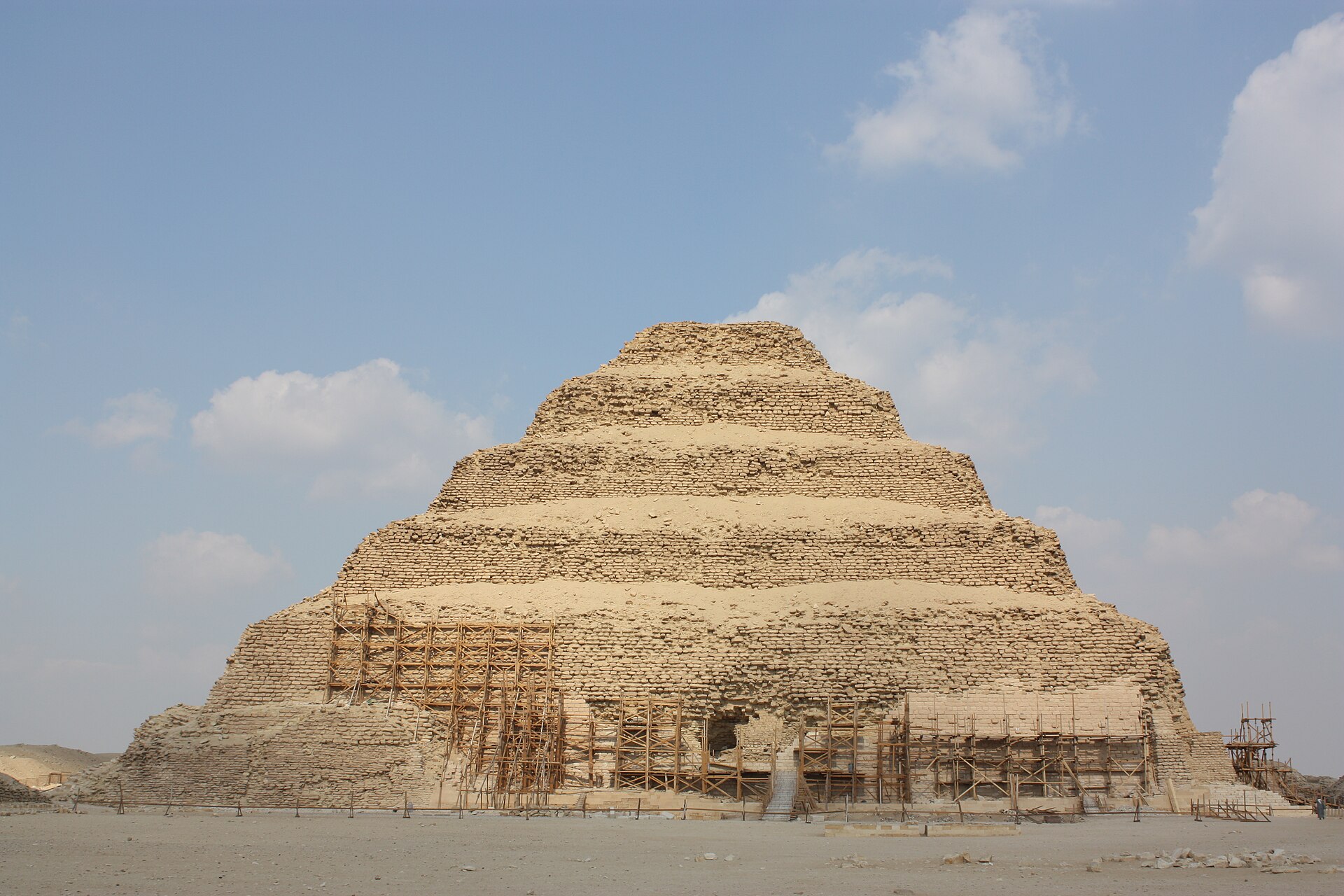
About 30 km south of Cairo, the vast necropolis of Saqqara predates Giza by roughly a century. This is where the architect Imhotep built the step pyramid of pharaoh Djoser around 2680 BC, the first pyramid ever built by human hands, 60 metres tall in six stacked levels. The site covers 7 km of desert plateau and holds 11 royal pyramids and hundreds of painted mastabas, notably those of Ti and Mereruka.
The Serapeum, a 200-metre underground gallery with 24 giant granite sarcophagi built for the sacred Apis bulls, has been open to the public since 2014. 2026 rate: general site ticket 600 EGP (about £9), with surcharges for the interior of the Djoser pyramid (280 EGP, about £4) and the Serapeum (340 EGP, about £5). Allow 2 hours on site. For the full guide (Djoser, Ti, the Serapeum, Memphis, Dahshur, an excursion from Cairo), see our dedicated guide to Saqqara and the pyramid of Djoser.
Middle Egypt: The Temples of Abydos and Dendera
Between Cairo and Luxor, Middle Egypt is the least visited stretch of the country, which makes it a rewarding add-on for anyone returning to Egypt for a second or third trip. At Abydos, the temple of Seti I holds the famous king list of Egypt carved into stone and one of the best preserved sanctuaries dedicated to Osiris. 2026 rate: 260 EGP (about £4). Allow 1.5 hours on site.
At Dendera, the temple of Hathor holds a richly painted ceiling and a well known astronomical zodiac (the original relief is kept at the Louvre in Paris; a copy is on display on site). 2026 rate: 300 EGP (about £4). Allow 1.5 hours on site. Both sites are usually visited as a day trip from Luxor or Cairo.
Karnak: The Largest Ancient Religious Complex in the World

On the east bank at Luxor, the Amun-Ra complex at Karnak covers 250 hectares, roughly Vatican City and the Roman Forum put together. Built, enlarged and redecorated over more than 1,500 years, from the Middle Kingdom through to the Ptolemies, it stands as the architectural high point of pharaonic civilisation as a whole.
The centrepiece is the hypostyle hall with its 134 papyrus-shaped columns (the 12 central columns reach 23 metres, the rest 15 metres), covered in polychrome hieroglyphs. Notre-Dame Cathedral in Paris would fit inside it whole. Karnak also holds 4 monumental obelisks, including that of Thutmose I at 23 metres, the sacred lake, the processional avenue of ram-headed sphinxes and several secondary sanctuaries dedicated to Khonsu, Ptah and Mut.
2026 rate: 600 EGP (about £9). Allow 3 to 4 hours on site for a full visit with an English-speaking Egyptologist guide. A sound and light show runs nightly, with several sessions rotating through around ten languages including English: confirm the exact English-language slot when you book. For the full guide (history, site map, the sound and light show), see our dedicated Karnak temple guide.
Luxor Temple: The Heart of Ancient Thebes
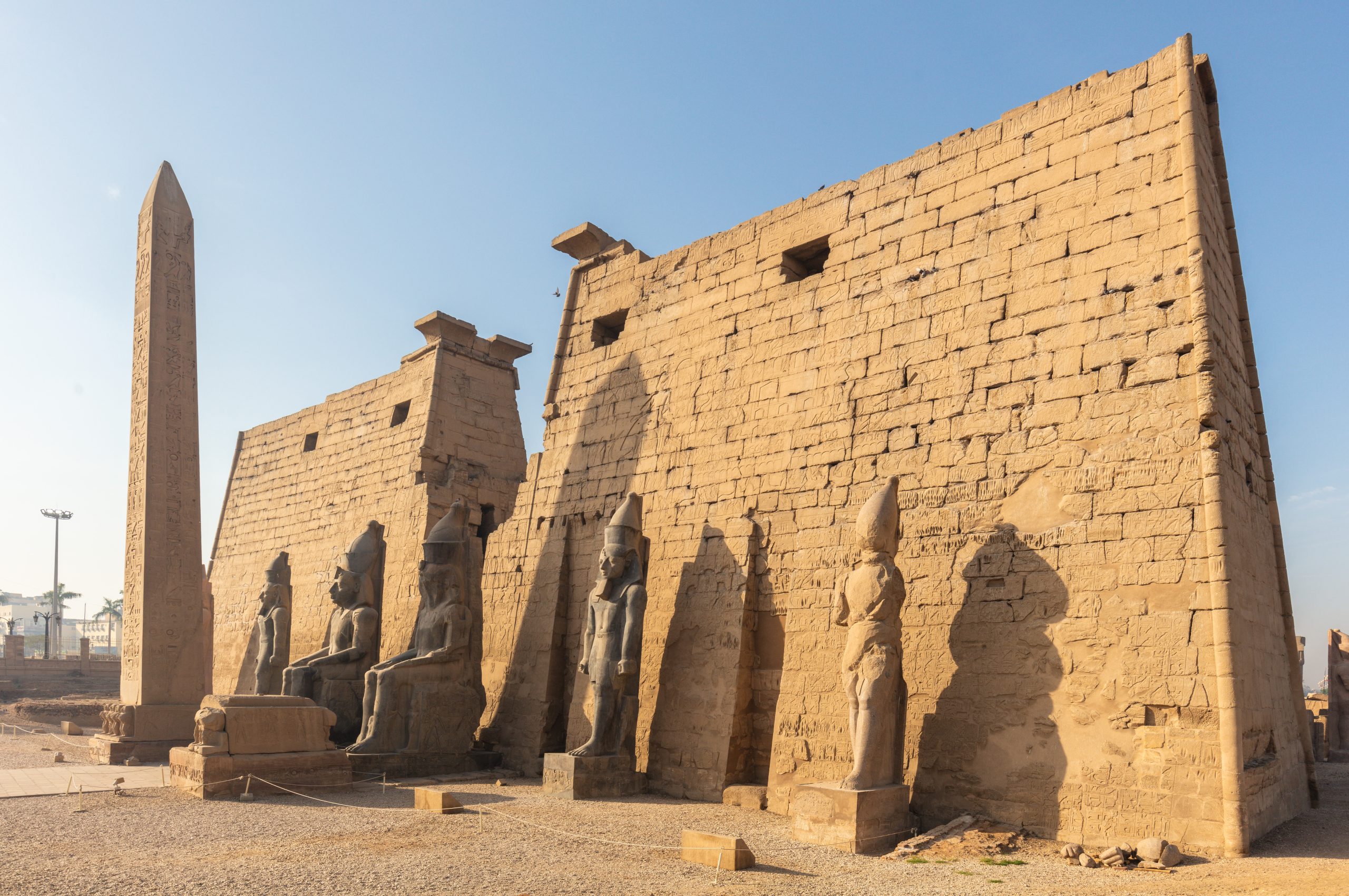
About 3 km south of Karnak (the two temples were once joined by a 2.5 km avenue lined with sphinxes, reopened in 2021), Luxor Temple is the east bank's other great sanctuary. Amenhotep III began it around 1380 BC and Ramesses II completed it, and it was the setting for the Opet Festival, the yearly procession in which the statue of Amun travelled from Karnak to Luxor to be ritually united with the goddess Mut.
A standout detail: the twin obelisk of the Place de la Concorde in Paris still stands before the first pylon. The second obelisk was given to Charles X in 1830 by Muhammad Ali and unveiled at the Place de la Concorde in 1836 by Louis-Philippe. At Luxor you can see the obelisk that stayed put, and picture its Parisian twin some 3,200 km away.
2026 rate: 500 EGP (about £7). A late-afternoon visit (5pm to 6pm) is recommended: the temple is fully lit after dark, a striking setting for photographs and a slow walk around.
Valley of the Kings: 63 Royal Tombs
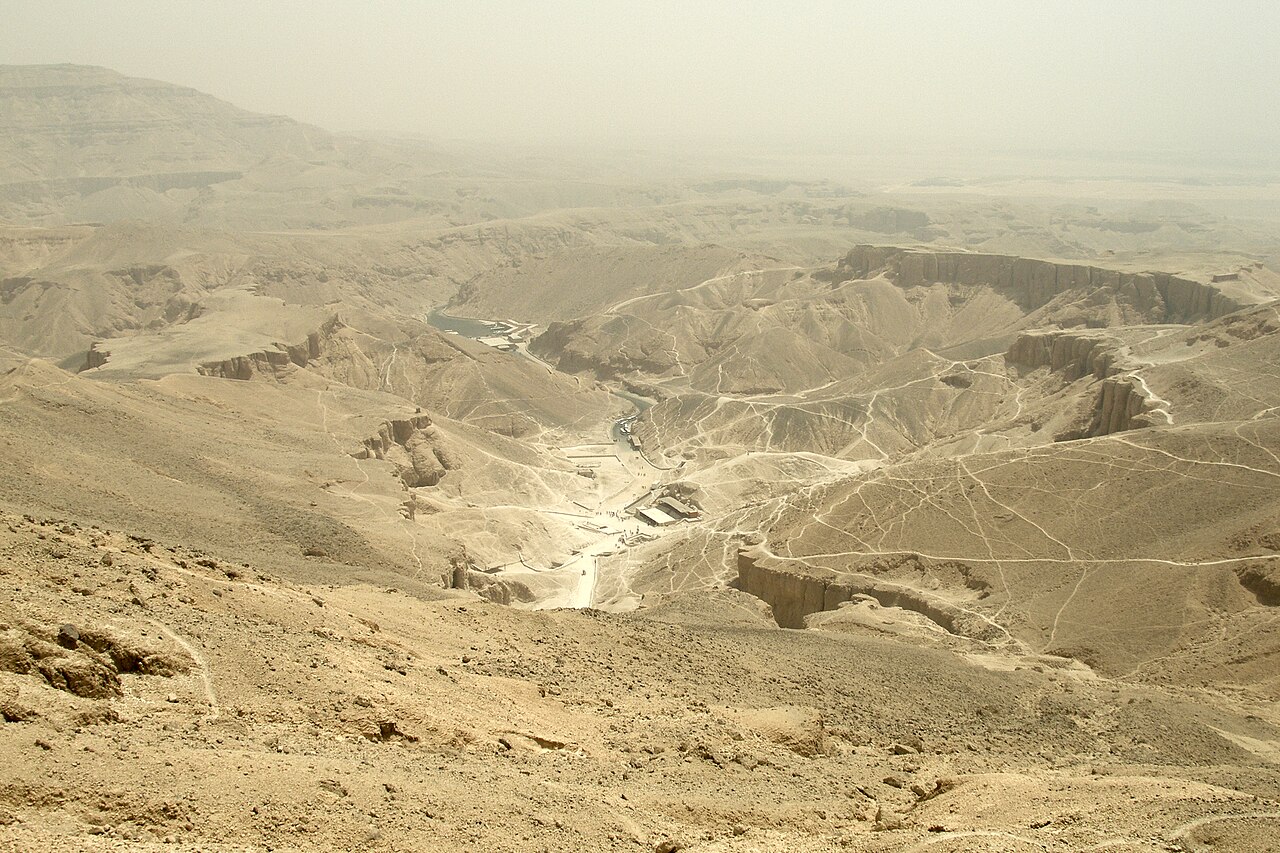
On the west bank at Luxor, beneath the pyramid-shaped peak of el-Qurn, the Valley of the Kings is the largest royal necropolis in history. 63 officially recorded tombs (KV1 to KV63), carved into the limestone rock over 500 years between 1493 and 1069 BC. This is where Tutankhamun, Ramesses VI, Seti I, Thutmose III and the entire great New Kingdom dynasty were laid to rest.
2026 rate: the standard ticket (750 EGP, about £11) gives access to 3 tombs of your choice among those open on rotation. Premium tombs carry a surcharge: Tutankhamun KV62 (700 EGP, about £10), Ramesses VI KV9 (220 EGP, about £3), Seti I KV17 (2,000 EGP, about £30). Allow 2 to 3 hours on site. For the full guide (choosing your tombs, surcharges, opening times, a full west-bank day), see our dedicated Valley of the Kings guide.
Hatshepsut: The Terraced Temple of Deir el-Bahari
Set against the limestone cliff of Deir el-Bahari, a short walk from the Valley of the Kings, the funerary temple of the female pharaoh Hatshepsut (around 1470 BC) is one of the most photographed monuments in Egypt: three stacked terraces linked by ramps, set against a golden cliff face. The original reliefs record the trading expedition to the land of Punt and the divine birth of the queen, a political narrative built to legitimise her reign in a system reserved for men.
2026 rate: 440 EGP (about £7). Allow 45 minutes to an hour on site, ideally in the late morning, since the site sits in full sun by the afternoon. For the full guide (Hatshepsut's history, the architecture, access from Luxor), see our dedicated Hatshepsut temple guide.
Medinet Habu and the Colossi of Memnon: Luxor's West Bank
A short drive south of Deir el-Bahari, Medinet Habu is the fortified funerary temple of Ramesses III, the best preserved of all the Theban funerary temples thanks to its high enclosure walls. The outer reliefs record the naval battle against the Sea Peoples in remarkable detail, one of the most precise historical sources for an episode Egyptologists still do not fully understand. 2026 rate: 220 EGP (about £3). Allow 1 hour on site. For the full guide, see our dedicated Medinet Habu guide.
On the road between the boat dock and Medinet Habu, the Colossi of Memnon, two seated 18-metre statues of Amenhotep III, make a free, quick photo stop (15 to 20 minutes), all that survives today of his once immense funerary temple. Our guide to the Colossi of Memnon has the story behind their name.
Esna: The Temple of Khnum and Its Restored Ceiling
About 55 km south of Luxor, right in the centre of Esna, the temple of Khnum sits well below today's street level, in a pit uncovered by a century of excavation. Only the hypostyle hall (the pronaos) has been cleared: 24 columns, each with a different capital, covered in Ptolemaic and Roman-era ritual texts among the latest carved in Egypt.
Between December 2018 and autumn 2023, a joint Egyptian-German mission (the University of Tübingen and Egypt's Ministry of Tourism and Antiquities) restored the astronomical ceiling of the pronaos, recovering its original colours under centuries of soot: the zodiac, the decans and several previously undocumented scenes are now visible. It is one of the most significant restoration projects carried out in Egypt in recent years.
2026 rate: 200 EGP (about £3). Allow 30 to 45 minutes on site. Esna is a short stop, usually added to a Luxor-Aswan itinerary by private car rather than a classic cruise, since the large boats pass through the Esna lock without always stopping. To build an itinerary that includes this stop, see our detailed Luxor to Aswan itinerary guide.
Edfu: The Best Preserved Temple in Egypt
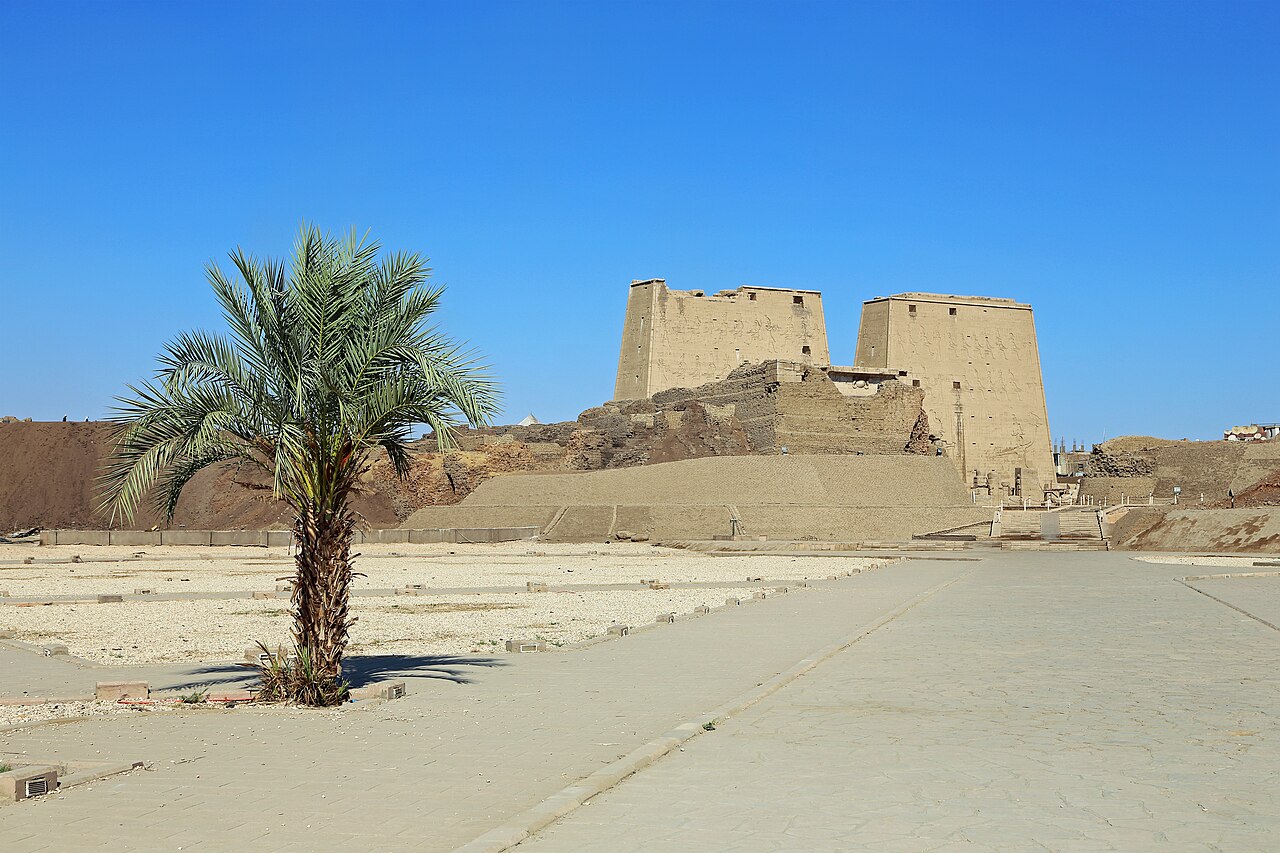
About 110 km south of Luxor and 60 km north of Kom Ombo, the Temple of Horus at Edfu is, thanks to its exceptional condition, the most complete sanctuary surviving from ancient Egypt. Built under the Ptolemies between 237 and 57 BC, it lay buried under drifting sand for two thousand years before Auguste Mariette excavated it in 1860, which is exactly why it looks so fresh today.
The entrance pylon stands 36 metres tall, the largest intact pylon in Egypt. The peristyle courtyard, the inner naos, the black granite statues of Horus before the sanctuary, and above all the hieroglyphic inscriptions of the Feast of Behdet (the ritual marriage of Horus with Hathor of Dendera) are among the most complete sources we have for understanding Egyptian ritual.
2026 rate: 550 EGP (about £8). Allow 1.5 to 2 hours on site. A standard stop on the four-night Nile cruises. For the full guide (tickets, opening times, the sound and light show, the mammisi), see our dedicated Temple of Horus at Edfu guide.
Kom Ombo: The Only Double Sanctuary in Egypt
About 45 km north of Aswan, on the east bank of the Nile, Kom Ombo is the only double temple in ancient Egypt, one half dedicated to Sobek the crocodile god, the other to Haroeris, Horus the Elder. Everything is mirrored in perfect symmetry: pylons, courtyards, sanctuaries. Next to the temple, the Crocodile Museum displays around fifty mummified sacred crocodiles found on the site. On the rear outer wall sits the oldest medical relief known, around thirty surgical instruments carved under the Ptolemies.
2026 rate: 450 EGP (about £7), with the Crocodile Museum included in the ticket. Allow 1 to 1.5 hours on site. For the full guide (Nile cruise, an excursion from Aswan, the mummy museum, 2026 rates), see our dedicated Kom Ombo temple guide.
Philae: The Last Active Pagan Temple in Egypt
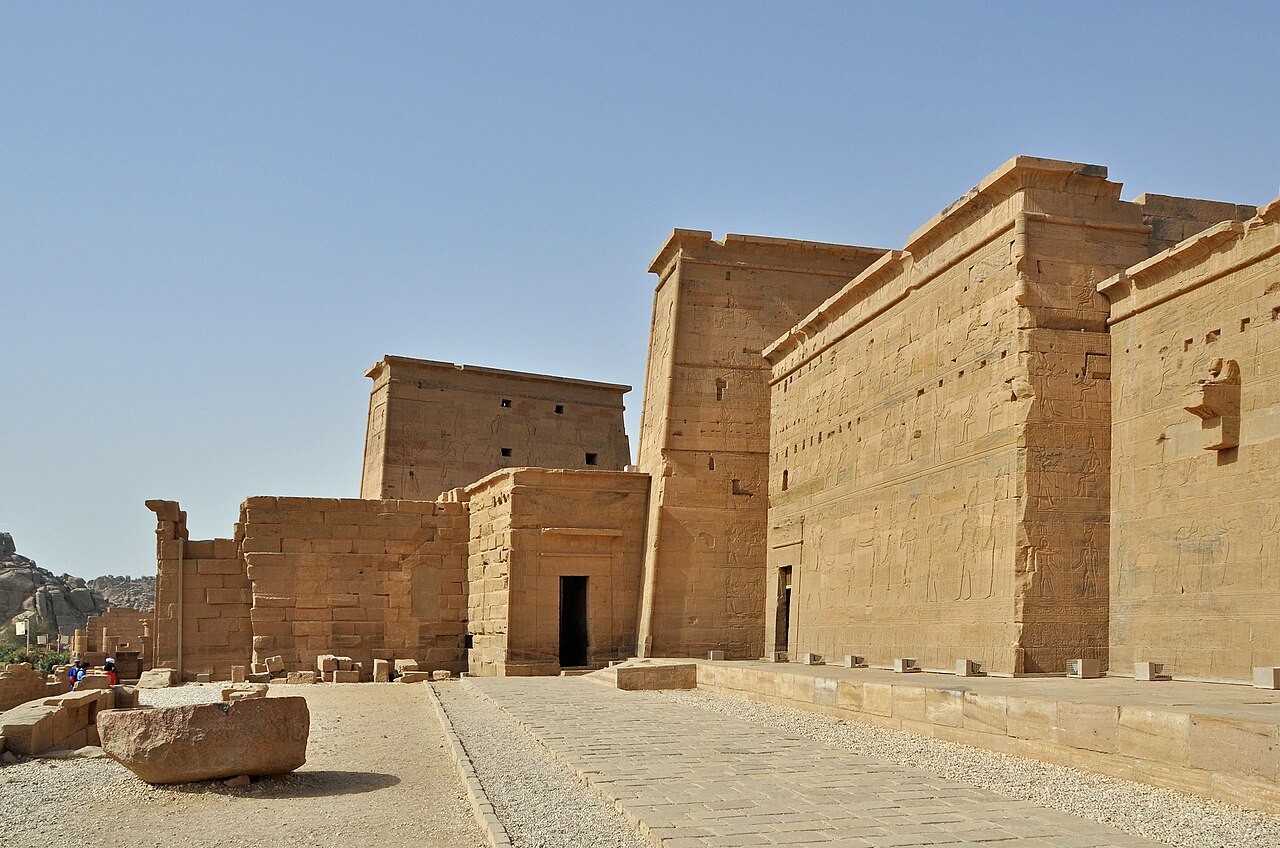
About 12 km south of Aswan, set on the island of Agilkia in the middle of the Nile, Philae is the last active pagan temple of ancient Egypt. The cult of Isis continued here until AD 537, two centuries after Theodosius closed every other Egyptian temple in 391. On its walls you can see the latest hieroglyphs ever carved, graffiti dated to the 4th century.
You arrive by motor launch from the Shellal jetty, a crossing of around 10 minutes. Waiting on the island: the great temple of Isis, the Kiosk of Trajan (the one on every postcard), the temple of Hathor with its reliefs of musicians, and the mammisi built for the infant Horus. Like Abu Simbel, the whole of Philae was taken apart stone by stone between 1972 and 1980 and rebuilt on neighbouring Agilkia island, out of reach of the lake formed by the High Dam.
2026 rate: 550 EGP (about £8), the return boat crossing from Shellal included. Allow 1.5 to 2 hours on site. For the full guide (rates, the sound and light show in English, transfers from Aswan, a combined day out), see our dedicated Philae temple guide.
Kalabsha: The Nubian Temple Saved From the Waters of Lake Nasser
Just beyond the Aswan High Dam, on an artificial island facing Lake Nasser, the temple of Kalabsha (dedicated to the Nubian god Mandulis, built under the Roman emperor Augustus) was dismantled stone by stone between 1961 and 1963 to escape the rising waters, just like Abu Simbel and Philae. Far quieter than its two famous neighbours, it makes for a peaceful visit, often without another visitor in sight.
2026 rate: 200 EGP (about £3). Allow 30 to 45 minutes on site, usually combined with a visit to the High Dam. To understand why these temples had to be moved at all, see our dedicated Aswan High Dam guide.
Abu Simbel: The Colossi of Ramesses II

About 280 km south of Aswan and just 40 km from the Sudanese border, the great temple Ramesses II raised at Abu Simbel ranks among the two or three most recognisable sites in Egypt. Four seated colossi of the king, 20 metres tall, are carved straight out of the sandstone cliff. Inside sits a hypostyle hall of Osiride pillars, a chamber for the New Kingdom gods, and the sun alignment of 22 February and 22 October, when daylight reaches the sanctuary and lights three of the four divine statues for 20 minutes.
The whole temple was dismantled and rebuilt 65 metres up the hillside between 1964 and 1968 by UNESCO, to save it from the rising waters of Lake Nasser. Along with Philae, it is one of only two Egyptian temples ever physically moved.
2026 rate: standard ticket 822 EGP (about £12). For the sun-alignment dates (22 February and 22 October), a special surcharged ticket (1,272 EGP, about £19) replaces the standard rate. Allow 2 hours on site. For the full visiting guide (flight access from Aswan, the convoy road, the Seti and Nubian Village hotels, Lake Nasser cruise tips), see our dedicated Abu Simbel temple guide.
How Many Temples Should You See in One Trip?
It all depends on the length of your trip and the pace you want. Here are the formulas our travellers ask for most.
- 5-day essentials (Cairo and Luxor): Giza, Saqqara and the Grand Egyptian Museum, then Karnak, Luxor Temple and the Valley of the Kings. 6 major temples. From £680 per person.
- 7-day classic: the 5-day essentials plus a 2-day short Luxor-Aswan cruise (adds Edfu, Kom Ombo, Philae). 9 temples. From £920 per person.
- 8-day classic plus Abu Simbel: the 7-day classic plus an Abu Simbel excursion from Aswan. 10 temples. From £1,070 per person.
- 10-day complete: all 17 sites in this guide, plus free time on the Red Sea at Hurghada or El Gouna. From £1,300 per person.
- 14-day intensive culture: every major site plus Abydos, Dendera, Esna and Kalabsha. For Egyptology enthusiasts. From £1,760 per person.
Every package includes domestic flights within Egypt that we arrange for you (Cairo-Aswan, Aswan-Luxor, Cairo-Sharm el-Sheikh and more), private transfers, 4 or 5-star hotels, an English-speaking Egyptologist guide, entry to the major sites, meals as per the programme, a four-night cruise where applicable, and our 24/7 WhatsApp support in English throughout your stay. Your flight to Egypt remains your own responsibility, and our service begins the moment you land, with a VIP welcome at the airport.
Get a tailor-made Egyptian temples trip quote →
FAQ: Frequently Asked Questions About Egyptian Temples
How Many Temples Are There in Egypt?
Egypt holds more than 80 major temples and 11 known royal pyramids, plus hundreds of tombs, including the 63 in the Valley of the Kings alone. On a typical 8 to 10 day trip with an English-speaking guide, you take in 8 to 12 headline sites: Giza, Saqqara, Karnak, Luxor Temple, the Valley of the Kings, Edfu, Kom Ombo, Philae and Abu Simbel. Keen travellers can extend that to 15 or more by adding Dendera, Abydos, Hatshepsut, Medinet Habu, Esna and Kalabsha.
Which Egyptian Temple Is the Most Beautiful?
Karnak, Abu Simbel and Philae top most travellers' lists, each for a different reason: Karnak for sheer scale, with its hypostyle hall of 134 columns; Abu Simbel for iconic status, with its four colossi of Ramesses II; and Philae for the beauty of its setting, an island in the middle of the Nile with the Kiosk of Trajan. For pure preservation, the Temple of Horus at Edfu is the best kept of them all. For historical depth, Saqqara, home to the first pyramid in history, takes the prize.
What Is the Oldest Temple in Egypt?
The oldest ceremonial site is the funerary complex of Djoser at Saqqara, built around 2680 BC, whose step pyramid was the first ever raised by human hands. Nearly as old are the Old Kingdom sun temples, Abusir in particular (2450 BC). Work on Karnak began in the Middle Kingdom, around 1950 BC. The youngest of the major sites are the Ptolemaic temples at Edfu, Philae, Kom Ombo, Dendera and Esna, built between 300 and 50 BC.
How Much Does It Cost to Visit Egypt's Temples?
Adding up the official 2026 rates for the nine major sites covered in this guide (Giza 700 EGP, Saqqara 600 EGP, Karnak 600 EGP, Luxor Temple 500 EGP, the Valley of the Kings 750 EGP, Edfu 550 EGP, Kom Ombo 450 EGP, Philae 550 EGP, Abu Simbel 822 EGP) comes to 5,522 EGP, about £83 at the 2026 exchange rate, for entry tickets alone, excluding the premium tomb surcharges. The secondary sites (Esna, Dahshur, Kalabsha) each cost about £3. Book an all-inclusive SEV package and every ticket is covered.
In What Order Should You Visit the Temples of Egypt?
Work north to south, following the river: start with Cairo, Giza and Saqqara, move on to Luxor (Karnak, Luxor Temple, the Valley of the Kings, Hatshepsut, Medinet Habu), sail Luxor to Aswan (Esna, Edfu, Kom Ombo) and finish in Aswan (Philae, Kalabsha, Abu Simbel). That also happens to match the historical sequence: Old Kingdom pyramids first, then New Kingdom Thebes, then the Ptolemaic and Roman-era temples of Edfu, Philae and Esna. Culturally coherent from start to finish.
Should You Visit the Temples on a Cruise or From a Fixed Hotel?
A cruise, four or seven nights between Luxor and Aswan, is the more efficient option logistically: several major sites covered without repeated transfers, meals and accommodation on board, and a genuinely immersive atmosphere. A fixed hotel (three nights in Luxor, then two in Aswan) gives you more flexibility, a choice of restaurants and superior hotel comfort. SEV offers both formats, depending on what you prefer.
When Is the Best Time to Visit Egypt's Temples?
October to March is the best window, with 18 to 28°C, clear skies and dry air. April, May and September work too, though it turns hot (30 to 38°C). June to August is stifling (40 to 46°C), so stay off the sites around midday. Travelling for Eid al-Adha 2026 (27 to 30 May) brings a festive mood while the heat is still bearable; our guide to Eid al-Adha 2026 has the detail.
Can You Visit the Temples as a Family With Children?
Yes, it's actually an ideal cultural trip for children from around 7 or 8 years old. The sites are large, open-air, and full of striking visual elements: giant statues, hieroglyphs, colour. Our advice: build in frequent breaks, carry plenty of water, and avoid the hottest hours. SEV adapts family itineraries with a lighter pace and extra activities, such as a felucca ride, the spice market or a hieroglyphics workshop.
Do You Need a Guide to Visit the Temples?
Technically no, but it would be a shame to go without one. Without an English-speaking guide, you take in the architecture but miss most of the historical and iconographic detail. Few temples have an audio guide in English, and the signage is in Arabic and basic English. A private English-speaking Egyptologist guide costs 1,000 to 1,500 EGP, about £15 to £22, per site. SEV always includes a private English-speaking Egyptologist in every package.
Is Egypt Safe for Tourists in 2026?
Yes. Egypt has considerably strengthened tourist security since 2017, with dedicated tourist police at every major site and optional convoys on certain routes, Abu Simbel in particular. The tourist areas, central Cairo, Luxor, Aswan and the Red Sea, are perfectly safe. The Foreign, Commonwealth and Development Office lists Egypt's main tourist areas as low risk, while advising against travel to North Sinai and the Libyan border. See our full Egypt safety guide for 2026.
Do British Travellers Need a Visa for Egypt in 2026?
Yes, a tourist visa is required for British passport holders. Two main options: the e-visa before departure (30 USD single entry, 65 USD multiple entry, since 27 April 2026) via visa2egypt.gov.eg, or the visa on arrival at the airport counter (30 USD, since 1 March 2026), payable in cash or by card. Your passport must be valid for at least 6 months beyond your return date, with a blank page free. See our full Egypt visa guide.
What Should You Budget for an 8-Day Trip to the Temples of Egypt?
All-inclusive land package (domestic flights within Egypt, 4 or 5-star hotels, transfers, entry tickets, a four-night cruise, an English-speaking guide, meals as per the programme): from £1,070 per person for 8 days in an SEV package. Add £150 to £230 for Abu Simbel or upgraded rooms, and budget £80 to £150 in cash for tips, craft purchases and drinks outside the hotel. Egypt's value for money in 2026 remains one of the best in the world for the culturally minded traveller.